Aerial Landscapes
Visibility
One of the striking things about the Mine Water Treatment Sites is their visibility, but not usually from the ground, as despite the intensity of the colours the sites themselves are usually hidden behind fences, off tracks, along relatively inaccessible stretches of land - but from above through Google Earth they are clearly discernible, sometimes from many kilometres ‘up’. I have found the sites on Google Maps on my iphone, if the site can’t be found by its nearest post code, then I pull over to zoom out and up to see where I am, and where the site is.
 Cuthill 55°50 59.82 N 3°36 34.65 W 513m
 Saltburn 54°34 07.37 N 0°57 42.87 W 1130m
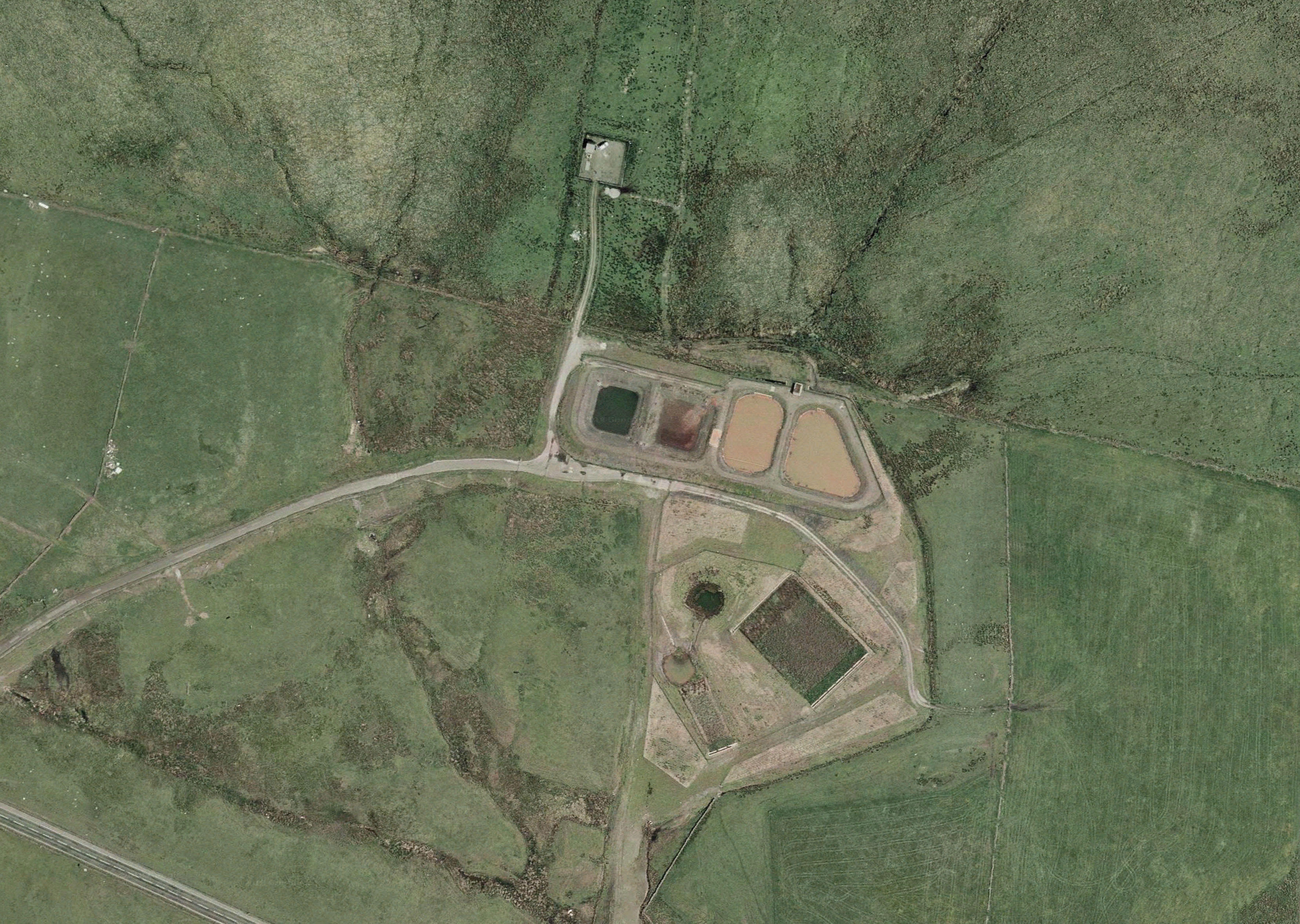
 Deerplay Hill 53°44 07.95 N 2°12 10.84 W. 1460m
 Six Bells 51°43 33.56 N 3°07 58.63 W 638m
  Tan-y-Garn 51° 46 10.01 N 3° 59 05.93 W 418m
Vanishing Point
The satellite images of the earth that have helped construct these journeys have become part of the imagination of these landscapes. Seeing; finding the site from above and arriving on the ground by van, walking and digging out buckets of ochre sludge from the settling lagoons: Perception of these colours/places is partly shaped by Google Earth - I see the colour through the satellite’s eye. How to separate these different images; from above, from the ground and from underground.
Link
Flat Time House (FTHo) website: http://flattimeho.org.uk/events/aerial-landscapes/
Mine Water Pollution and Treatment
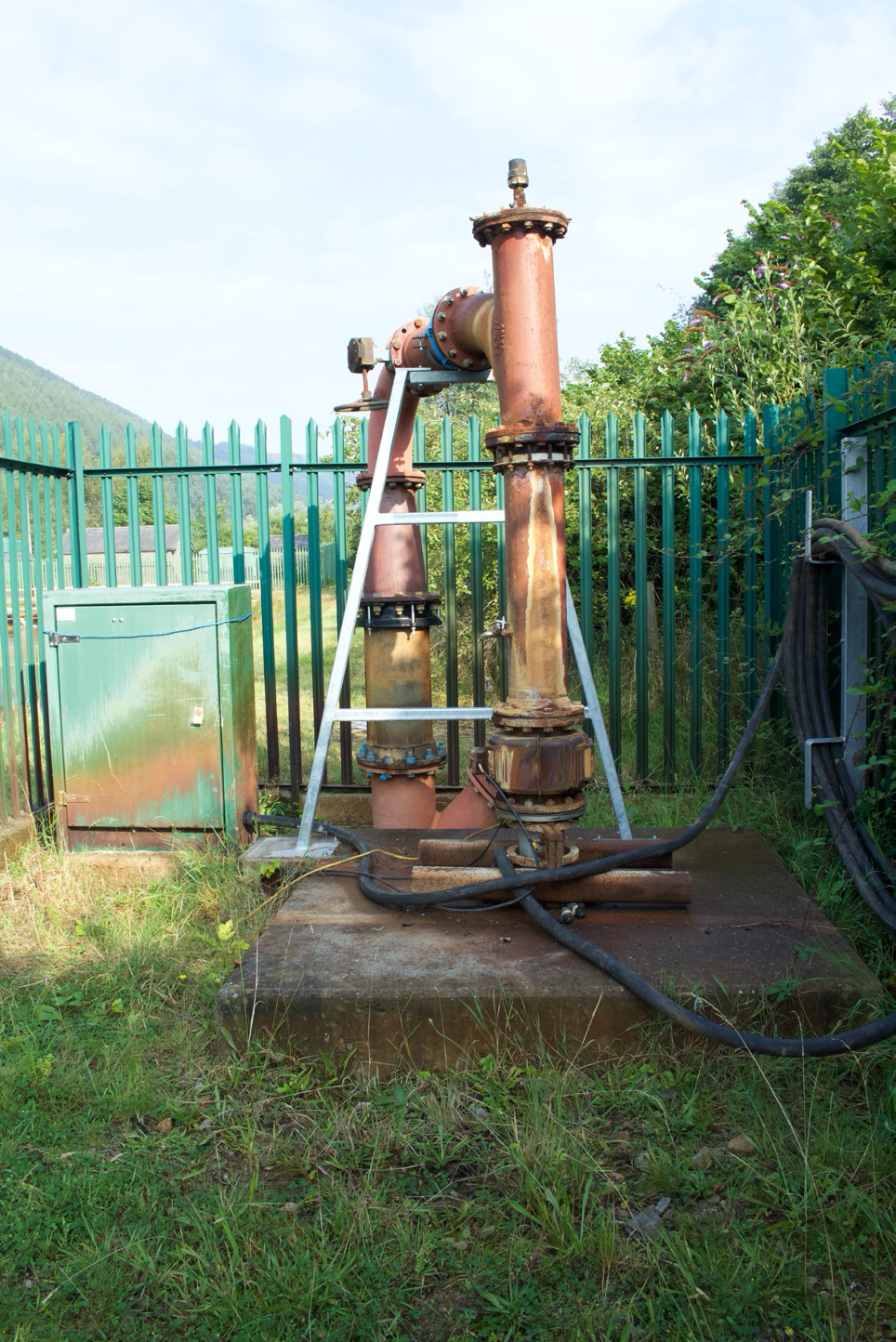
Water pump, Six Bells
In 2001 a borehole was driven 216m down into the old mine workings at Vivian shaft, Six Bells where an underground roadway had been backfilled in 1962.1 From this borehole polluted water is now pumped out of the mine before it reaches the river preventing the water from being polluted with raw mine water.
Six Bells is an ‘active’ treatment site, hydrogen peroxide is added to the pumped mine water. Hydrogen peroxide, H2O2, is a relatively unstable compound, its desire is to become water, which it does by readily letting go of its second oxygen atom to whatever will take it. Iron takes up oxygen so an exchange takes place and the iron is exposed to greater concentrations of oxygen than by aeration alone, speeding the oxidising process. The polluted water, pumped directly from the mine is first mixed with the hydrogen peroxide and then pumped out through a channel up to the top of a three metre high fibreglass cascade further increasing exposure to oxygen in the air.

Cascades, Six Bells Mine Water Treatment Scheme
The water travels down the aerating cascades into two parallel deep lagoons measuring 1540m2 each where the water and newly oxidised pigment particles settle. The mine water treatment process is concluded by passing the water with its residual load of suspended iron particles through an artificial reed bed. When the pumping started in January 2002 the acidic mine water contained 250mg of iron per litre of water. After a period of four months the iron concentration in the water had stabilised to 50mg per litre of water.2 By the time the water flows into the river the iron content has reduced down to less than 1mg per litre of water, which is the environmental quality standard for discharge to surface waters. For 15 years the polluted mine water has been continually pumped from these underground workings 24hr an day, at a rate of 40 litres per sec.3
Coal Authority - Understanding Mine Water Treatment: https://assets.publishing.service.gov.uk/government/uploads/system/uploads/attachment_data/file/362236/Understanding_mine_water_treatment.pdf
1 Jennifer Geroni, Rates and mechanisms of chemical processes affecting the treatment of ferruginous mine water, Master’s thesis, Cardiff University (Cardiff: Cardiff University, 2011), 61-7
2 Coal Authority, Environment schemes, Available at: http://coal.decc.gov.uk/en/coal/cms/environment/schemes/schemes.aspx (Accessed: 20th September 2013)>
3 Jennifer Geroni, Rates and mechanisms of chemical processes affecting the treatment of ferruginous mine water, Master’s thesis, Cardiff University (Cardiff: Cardiff University, 2011), 61-7
Red Earth Falling
Red Earth Falling 13min duration digital video 2014
The oceans of ice and silicate that formed in the Earth’s first billion years contained green iron dissolved in solution, silicate rocks and melt undergoing processes of subduction and eruption, pleating and folding the forming earth. Then bacteria learned to use the sun’s energy and absorb carbon dioxide, releasing oxygen into the green iron oceans - iron sucks up oxygen - and a miraculous transformation was triggered, turning the iron-rich oceans from green ferrous iron (Fe2+) into RED ferric iron (Fe3+), from soluble to insoluble, liquid into particle. Bacteria and sunlight combined and particles of red iron develop. The early forming Earth turned from green to red.
The heavy sinking now particulate iron is drawn down towards the centre of the still forming earth, weighted, drawn to the core. Settling on ancient ocean floors intermittent layers of magnetite/ silicate/ haematite/ silicate/ magnatite layering the Banded Iron Formations, a slow geological formation, now mined for steel - iron is intimately bound up with the history of human evolutionary cultural practices and technological developments.
Siderite (iron carbonate FeCO3) and pyrite (iron sulphide FeS2) minerals are set free from the exposed rock surface of abandoned coal mines - the act of mining increases the surface area of the rock and introduces oxygen. The iron rich solution streams through the empty passages, transported in the water courses and caverns underground, developing just like the early earth forming irons from green to red as they oxidise on contact with oxygen in the air - these young iron oxides mimic those early ancient earth forming processes as particles settle in river beds and lakes where they form deposits of hydrated ferric oxides.
Under View
Mine Walk
Clearwell Cave Mine Trip led by Jonathan Wright
Six Bells, South Wales
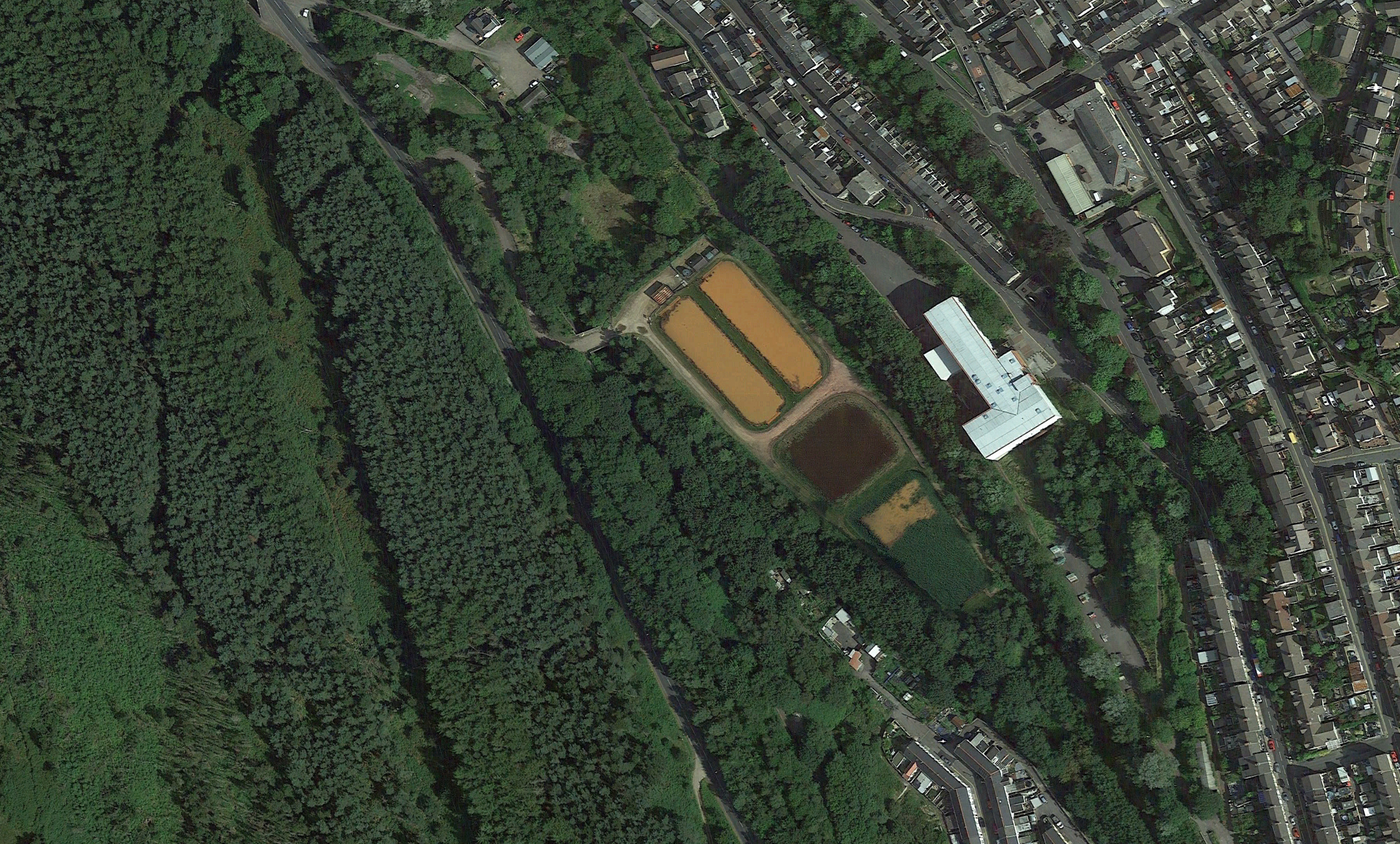
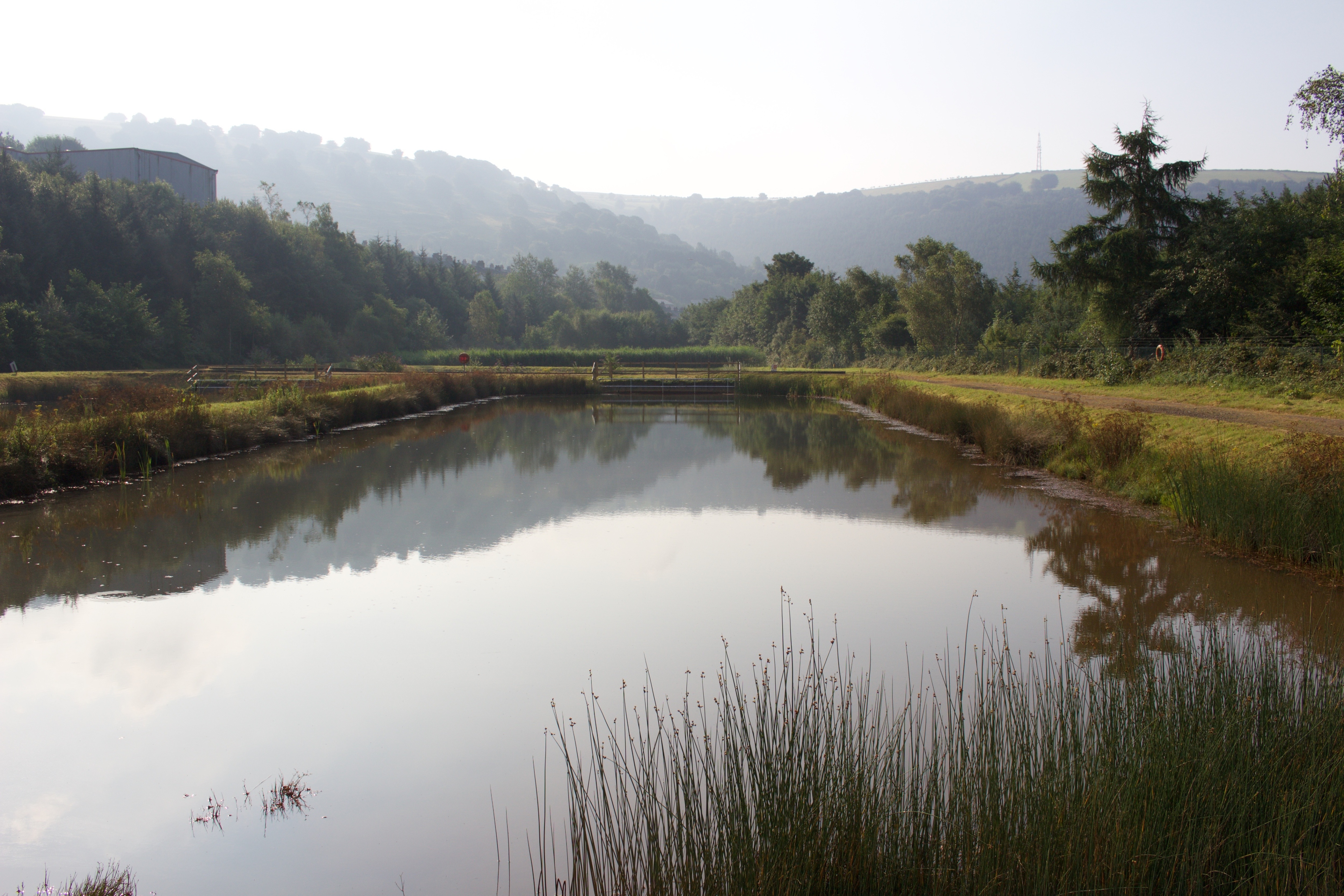
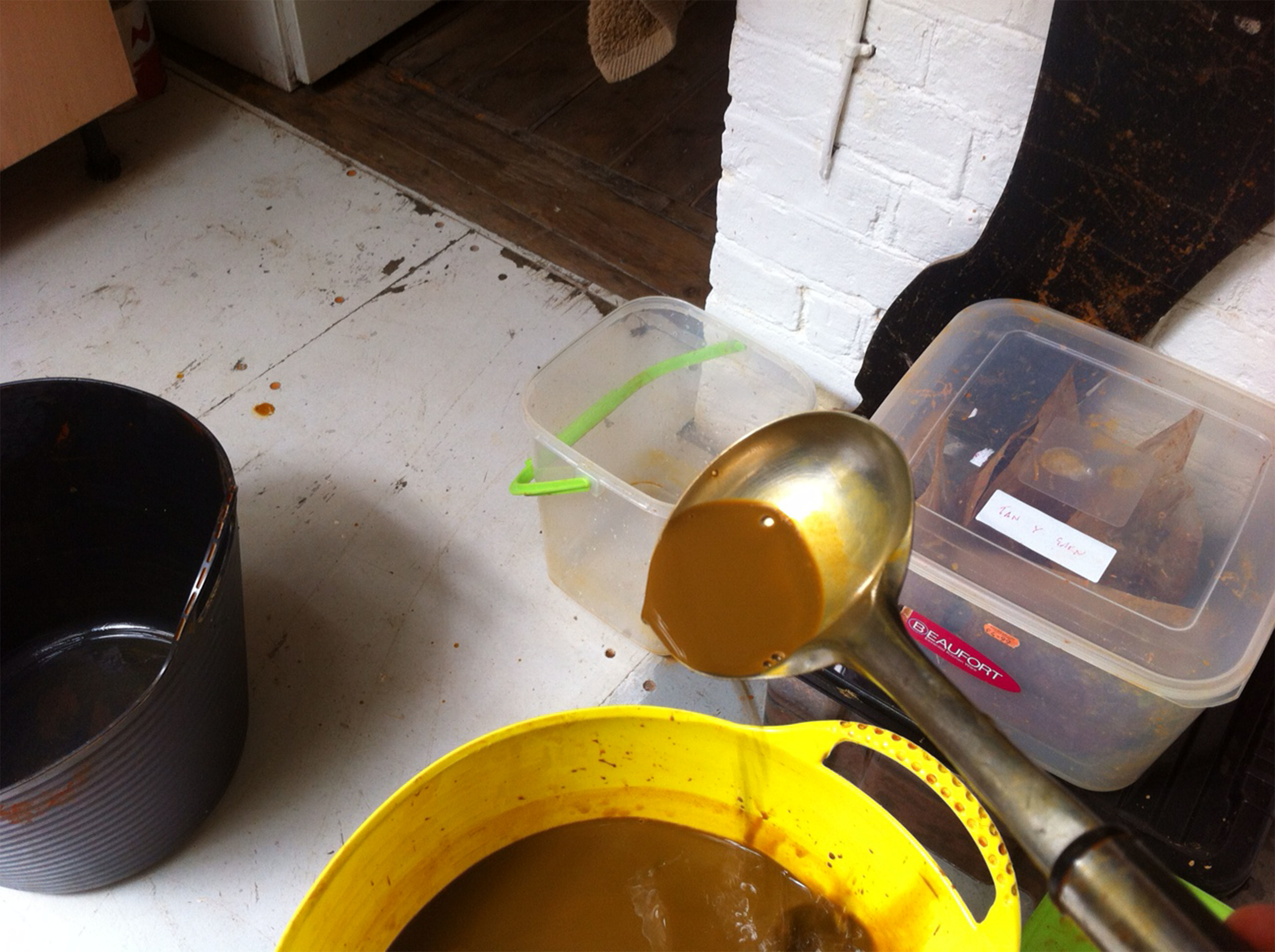
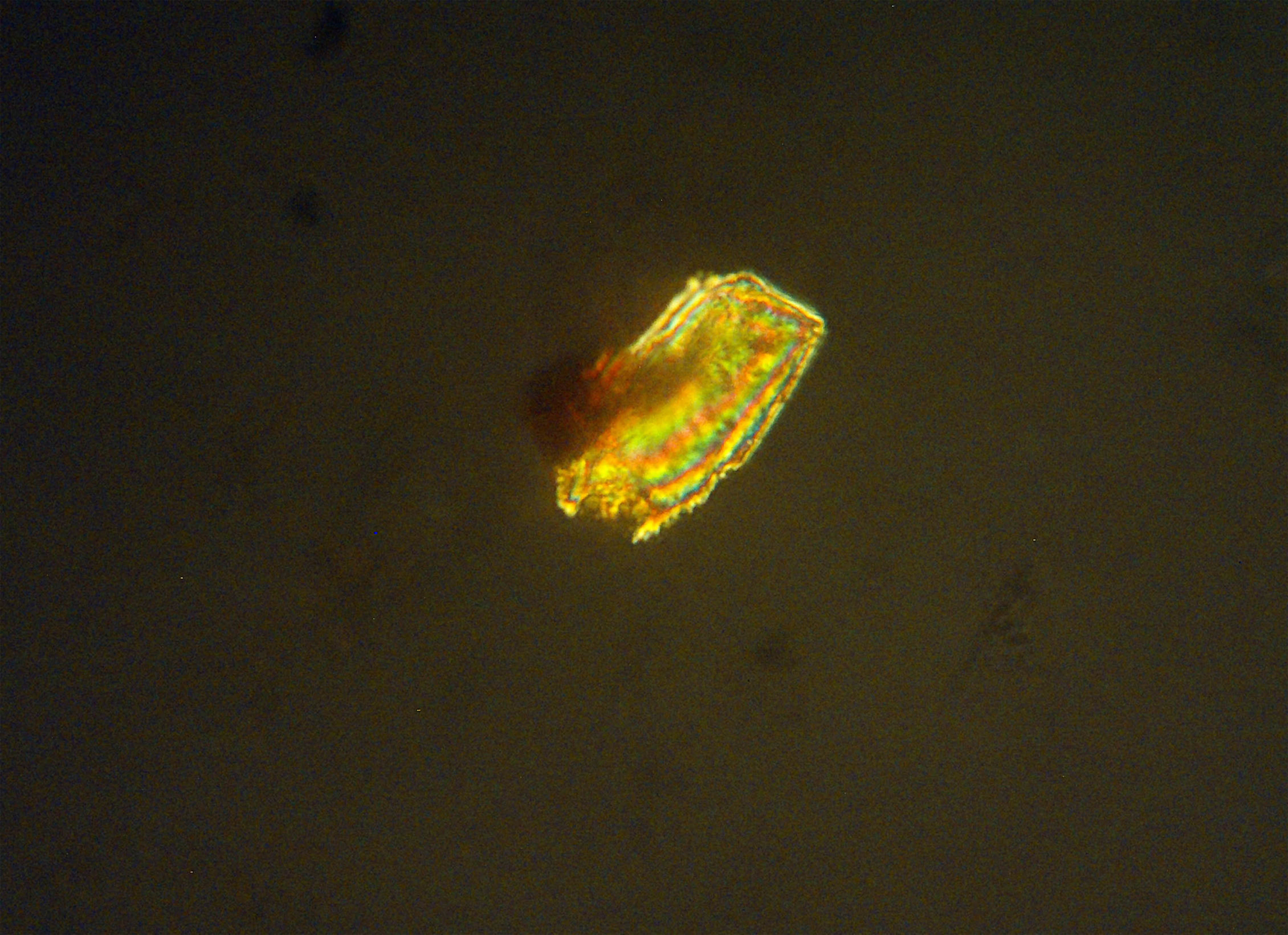
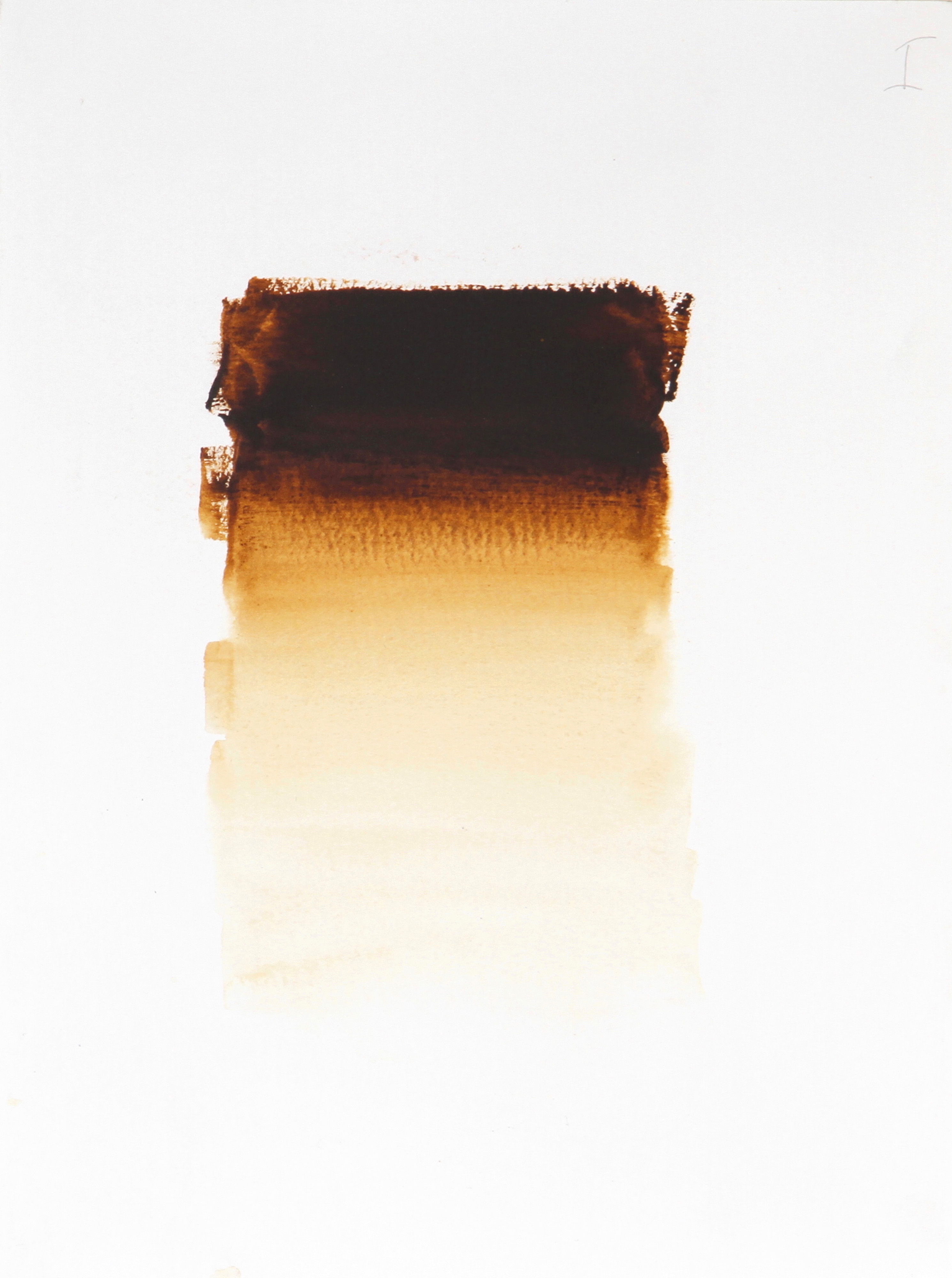
The transparency of Six Bells is unusual for a ‘natural’ ochre. The nearest equivalent colour would be ‘raw sienna’. The last batches of genuine raw sienna came from the lower slopes of Monte Amiata to the south of the city of Siena. The relatively high optical transparency of Six Bells place it somewhere between a natural and a synthetic colour. The mineralisation process is different from natural ochre which occurs much more slowly. The mine ochres form when pyrite minerals are unlocked from their natural rock setting through the action of mining. As the mines flood, water picks up the released minerals in solution and transports them to the surface where they oxidise into the insoluble ferric form on contact with the air and the hydrated iron oxides start to precipitate forming particles of ochre.
Six Bells is located in the Ebbw Fach valley, an area that was once the centre of coal mining in South Wales until the last mines closed here in the 1980’s. The water levels now flooding the mines rise and fall with weather conditions, and climatic variations, but the water will keep flushing through picking up mineral residue along the way. The legacy of the coal industry necessitates an environmental programme of mine water treatment that will go on for decades, or hundreds of years – inadvertently and unavoidably turning the landscape into an iron oxide or ‘ochre’ pigment production site of industrial proportions.
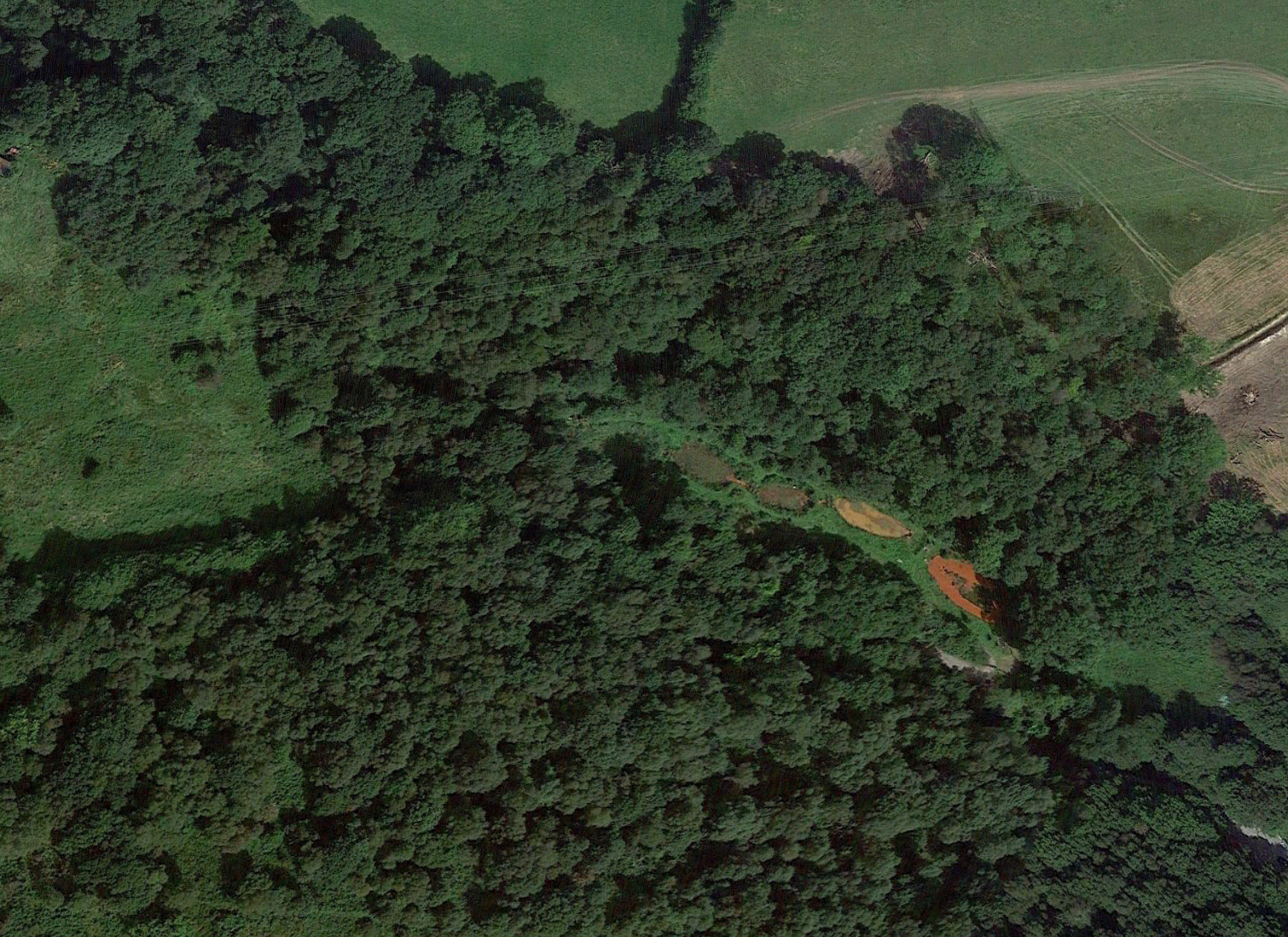

Tan-Y-Garn (Under the Mountain), South Wales
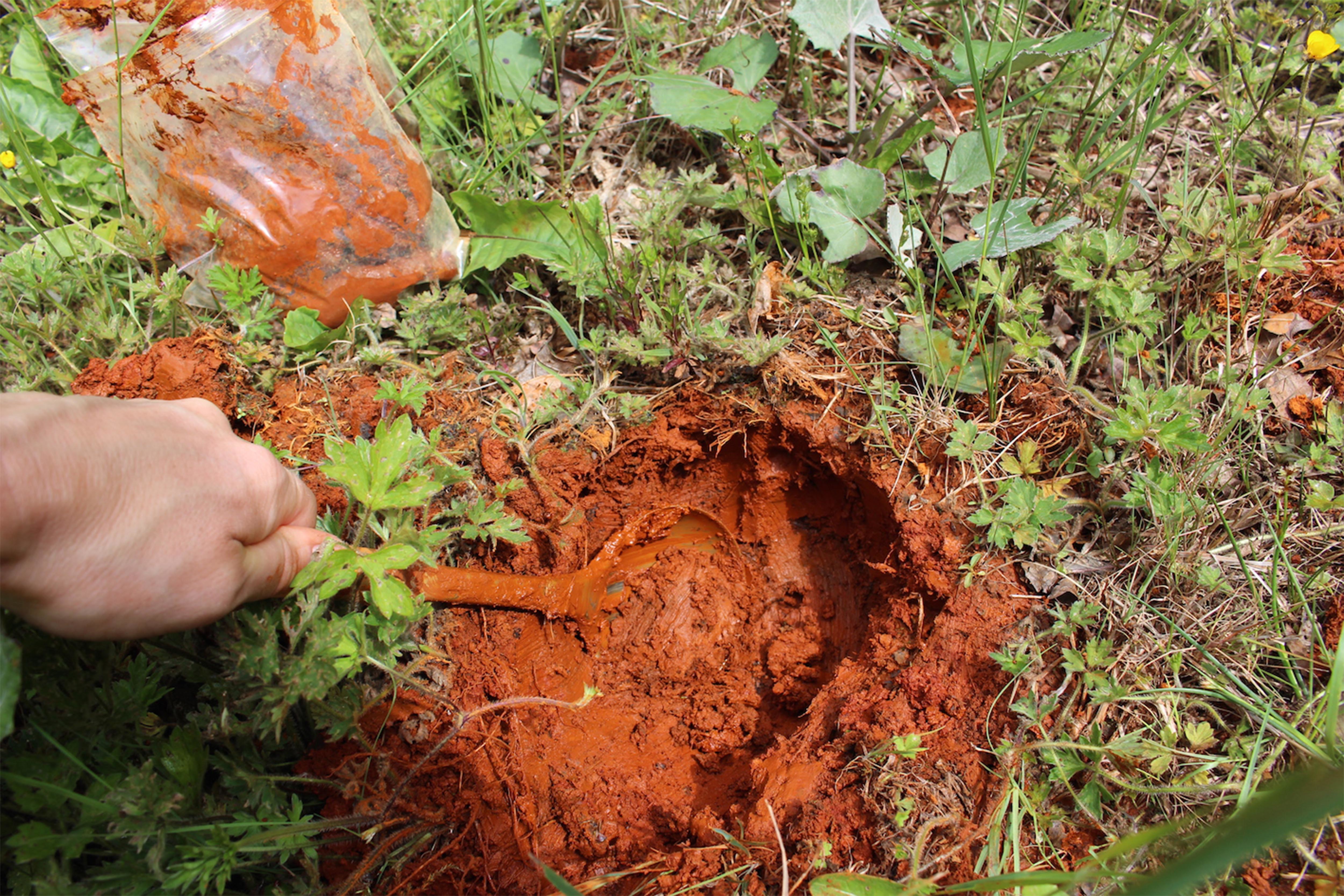
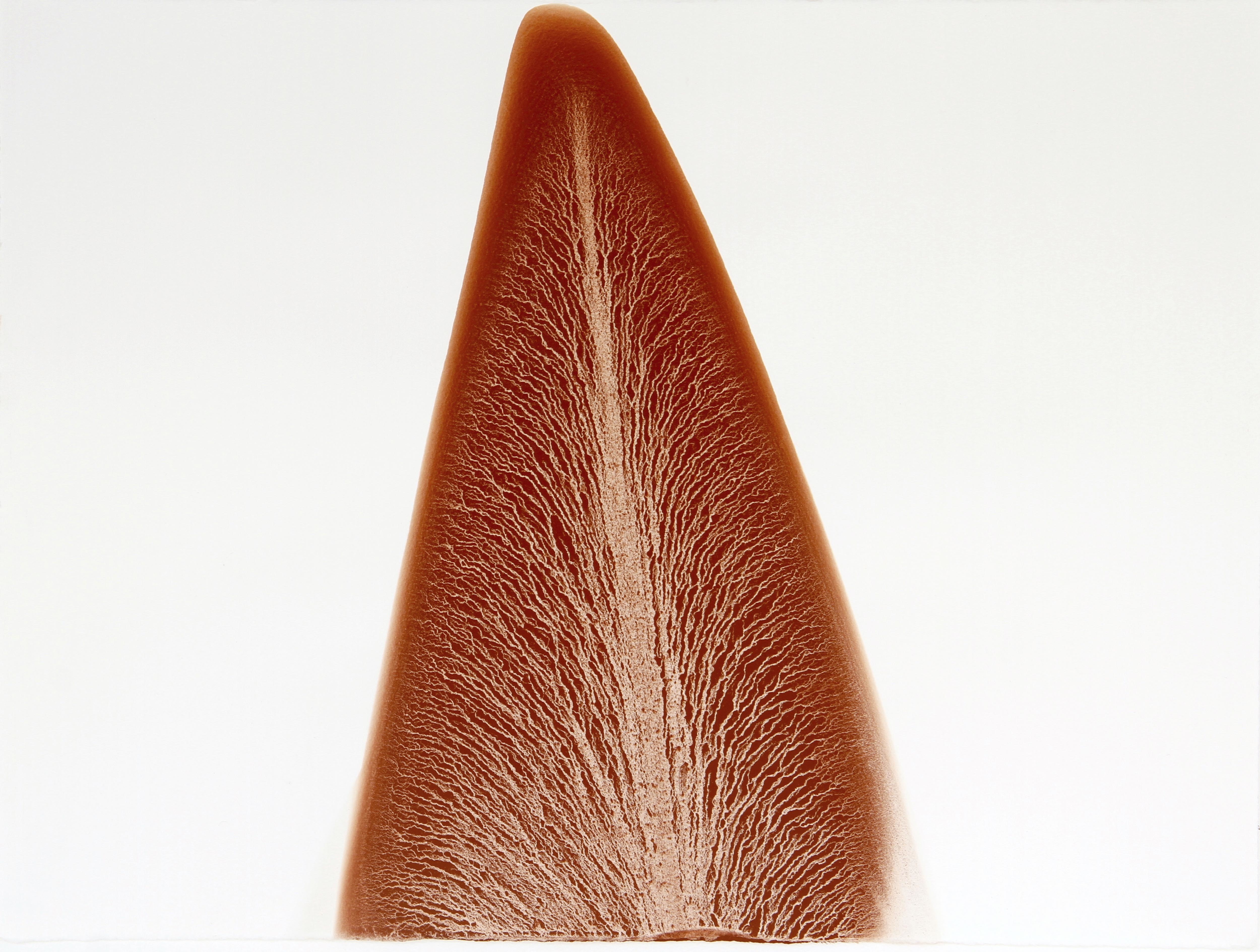
Tan-y-Garn is more remote than the other sites, surrounded by trees, tucked into the side of a high valley in South West Wales. The deep orange ochre that forms here begins as rain water percolating through the rocks, finding routes through the cracks and fissures of the former mine workings absorbing minerals on the way. Eventually the mineral rich water leaches out from the mine adit at the base of the mountain, oxidising and gaining its colour.
The water treatment process uses limestone and mushroom compost to reduce the acidity of the mine water. The limestone raises the pH which helps iron oxidation and the mushroom compost supports bacterial processes causing anaerobic conditions that prevent the limestone becoming clogged.
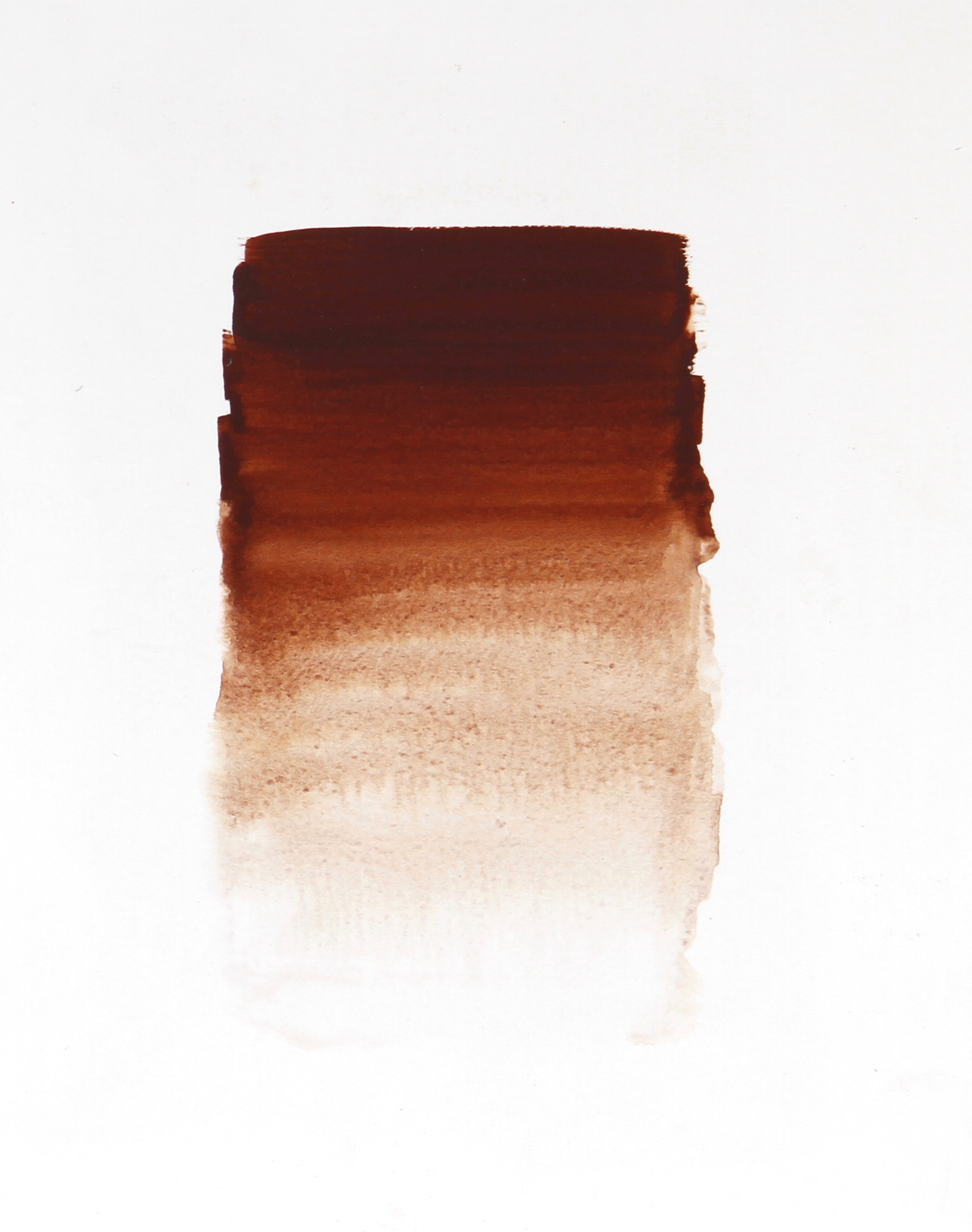
Tan-y-Garn it is a deep red brown. When suspended in water different colours are visible as the pigment particle sizes vary. It moves between bright orange through to deep purple with a blood like brownish red that dominates the final colour.
The mine here was worked until the early 1990’s, supplying fuel for the Port Talbot Steel works.




Saltburn, Cleveland
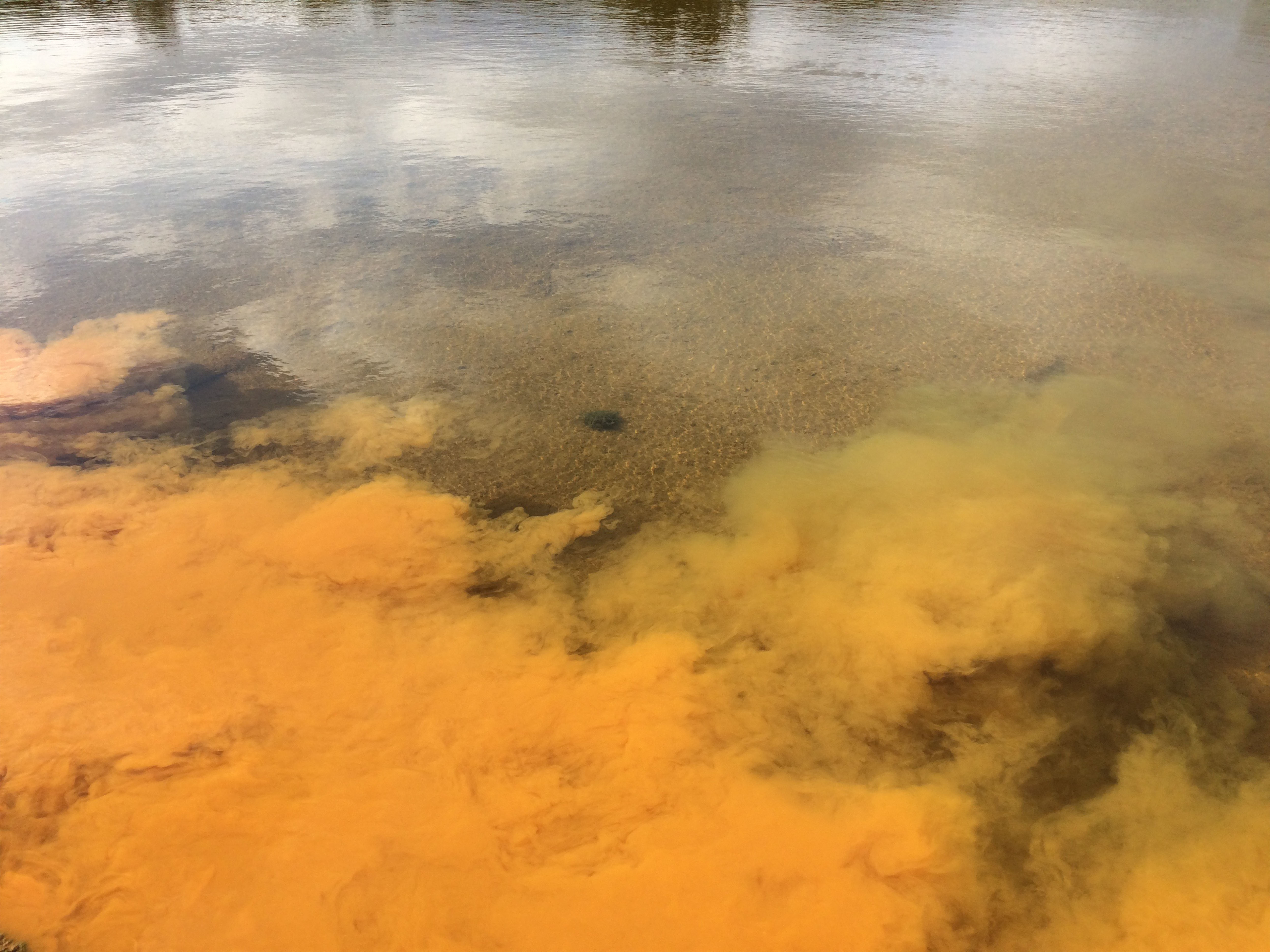
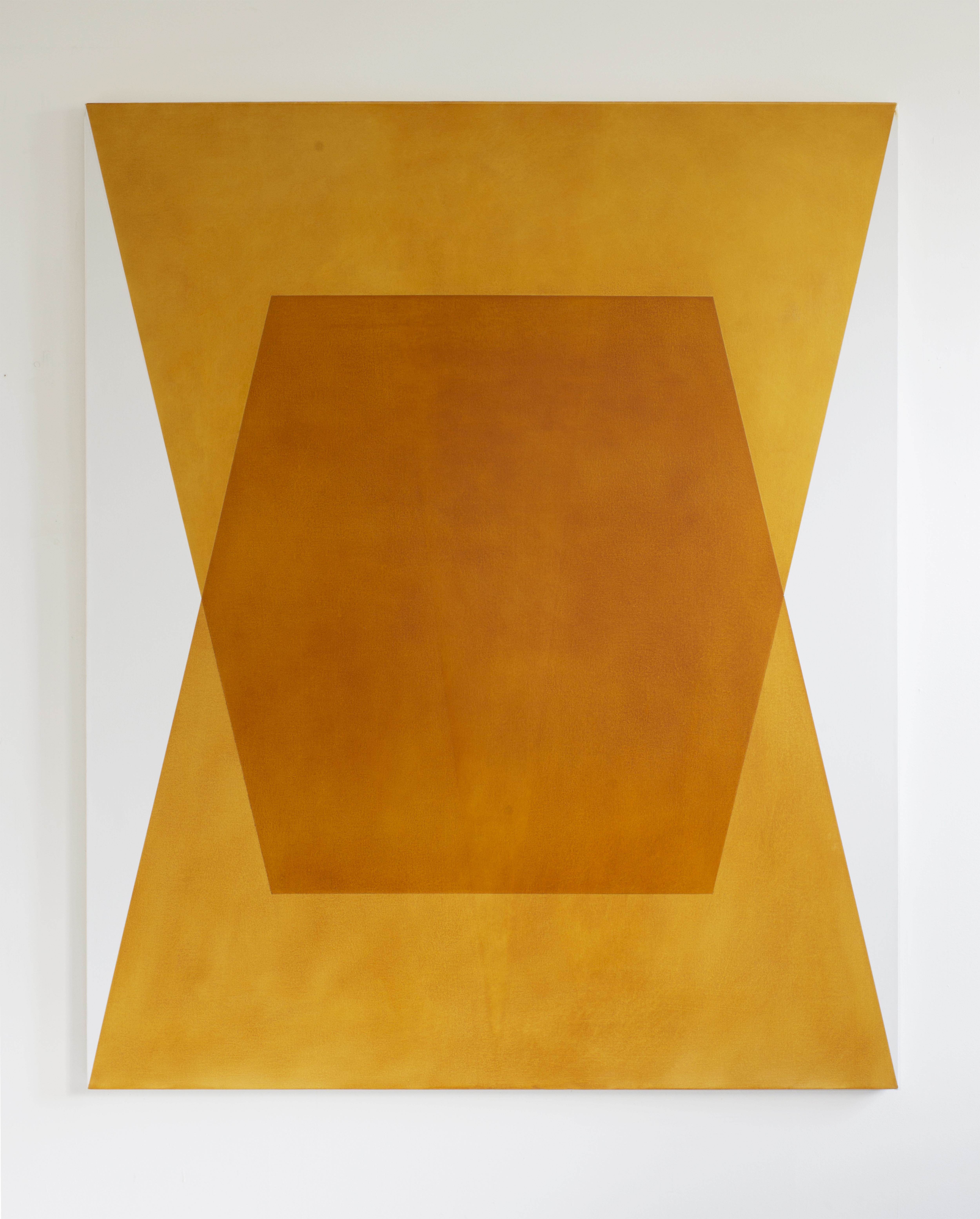
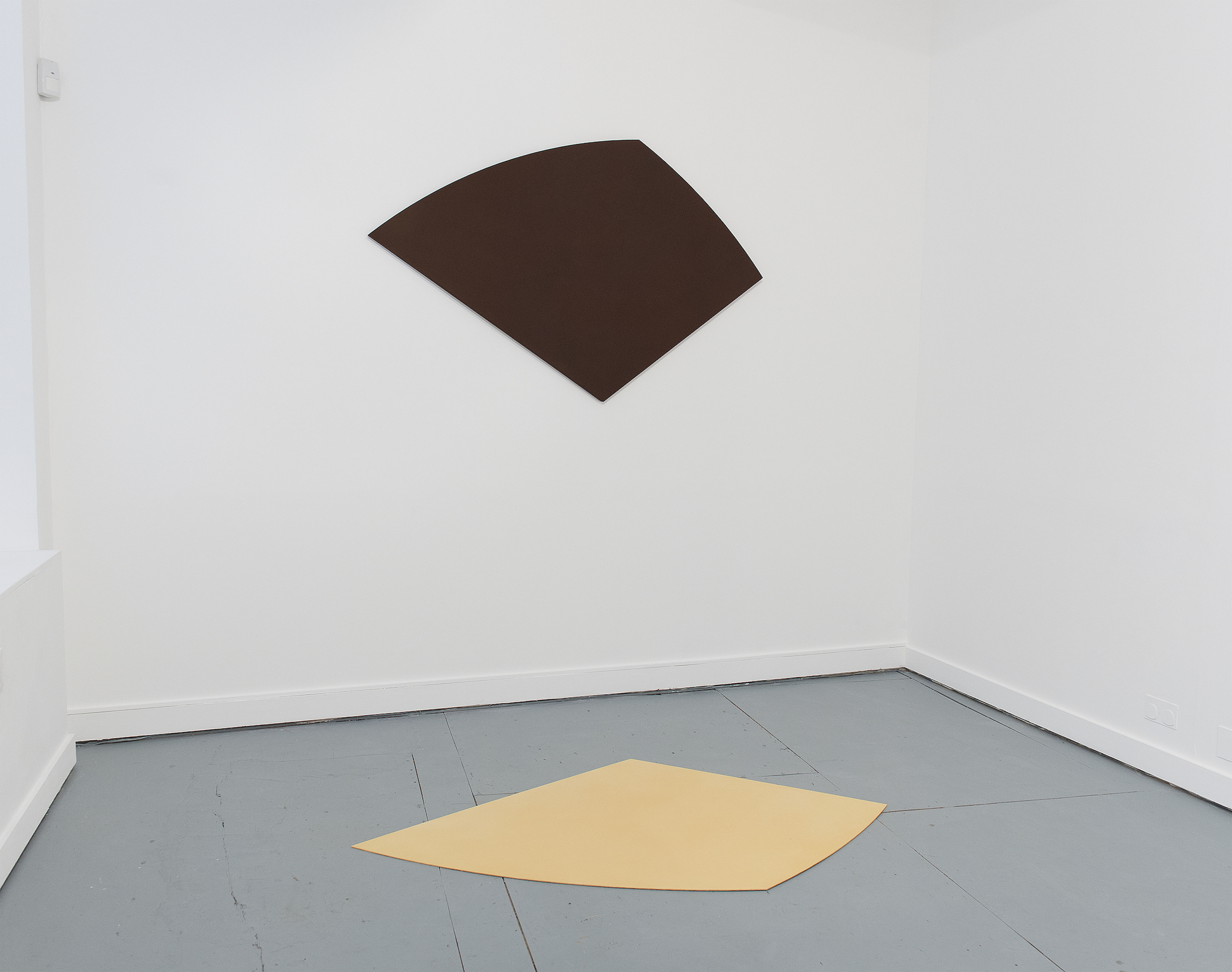
South of Middlesborough on the north east coast of England is Saltburn-by-Sea. A mile or so inland is Saltburn Mine Water Treatment Scheme. The site treats the floodwater of an iron stone mine that closed in the 1960’s. Like the surrounding landscape, illuminated by the glare of reflected light off the North Sea, Saltburn yellow ochre is lighter in tone than the other mine water ochres. The paint on the wall is an ultra matt emulsion that resembles the material in its raw pigment state, it has no additional binders or enhancers other than an organic cellulose medium. This flat matt surface conceals an unexpected brightness and warmth visible when the colour is expressed in a transparent medium like watercolour.
Saltburn is in one of the few mining regions that remains active. A thousand meters under the North Sea is Boubly potash mine, one of the deepest in Europe. An environment so remote that it doubles as a deep underground laboratory suitable for hosting ultra-low background science projects, like the search for dark matter.


Deerplay Hill, Bacup, Lancashire
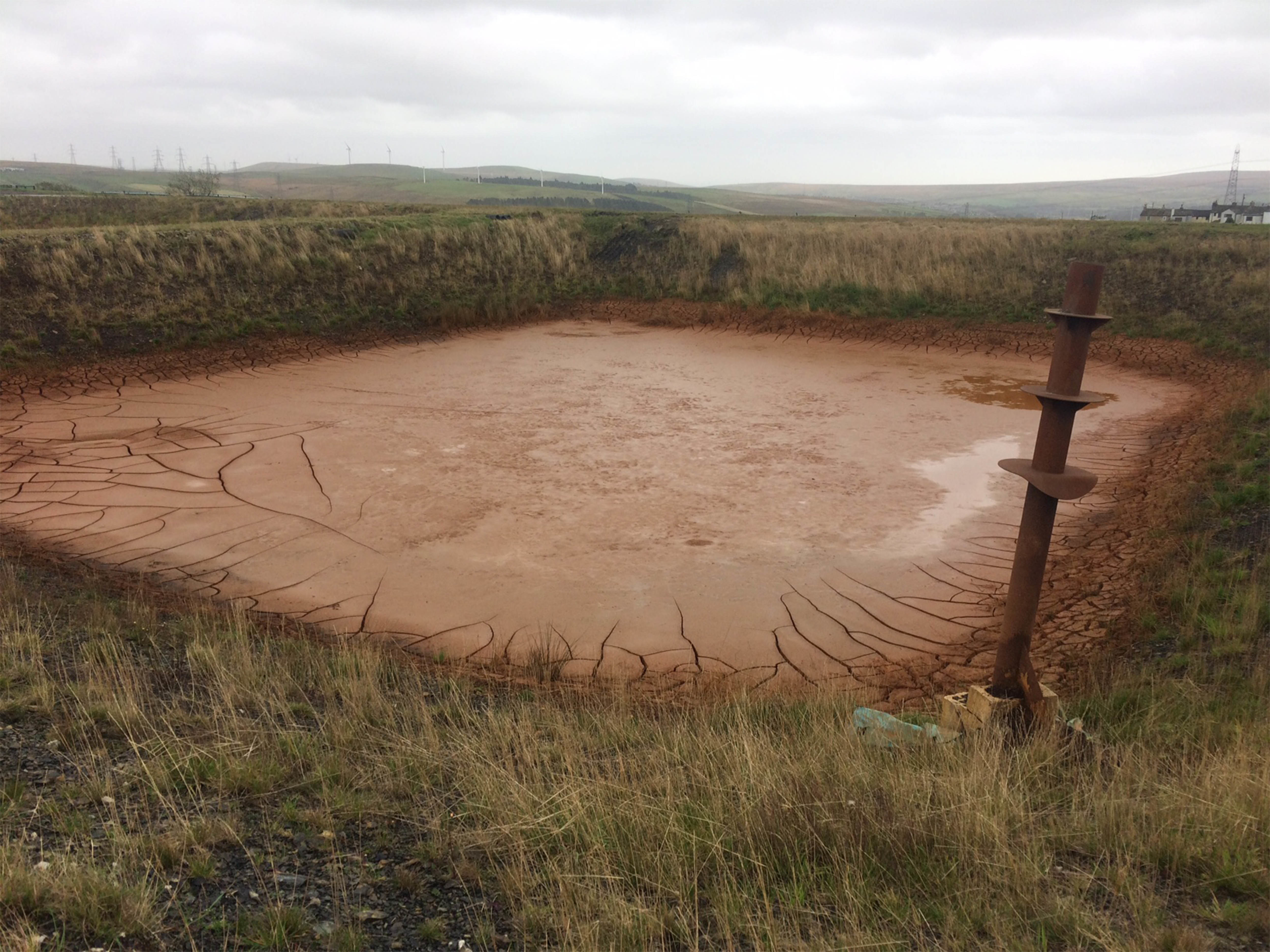
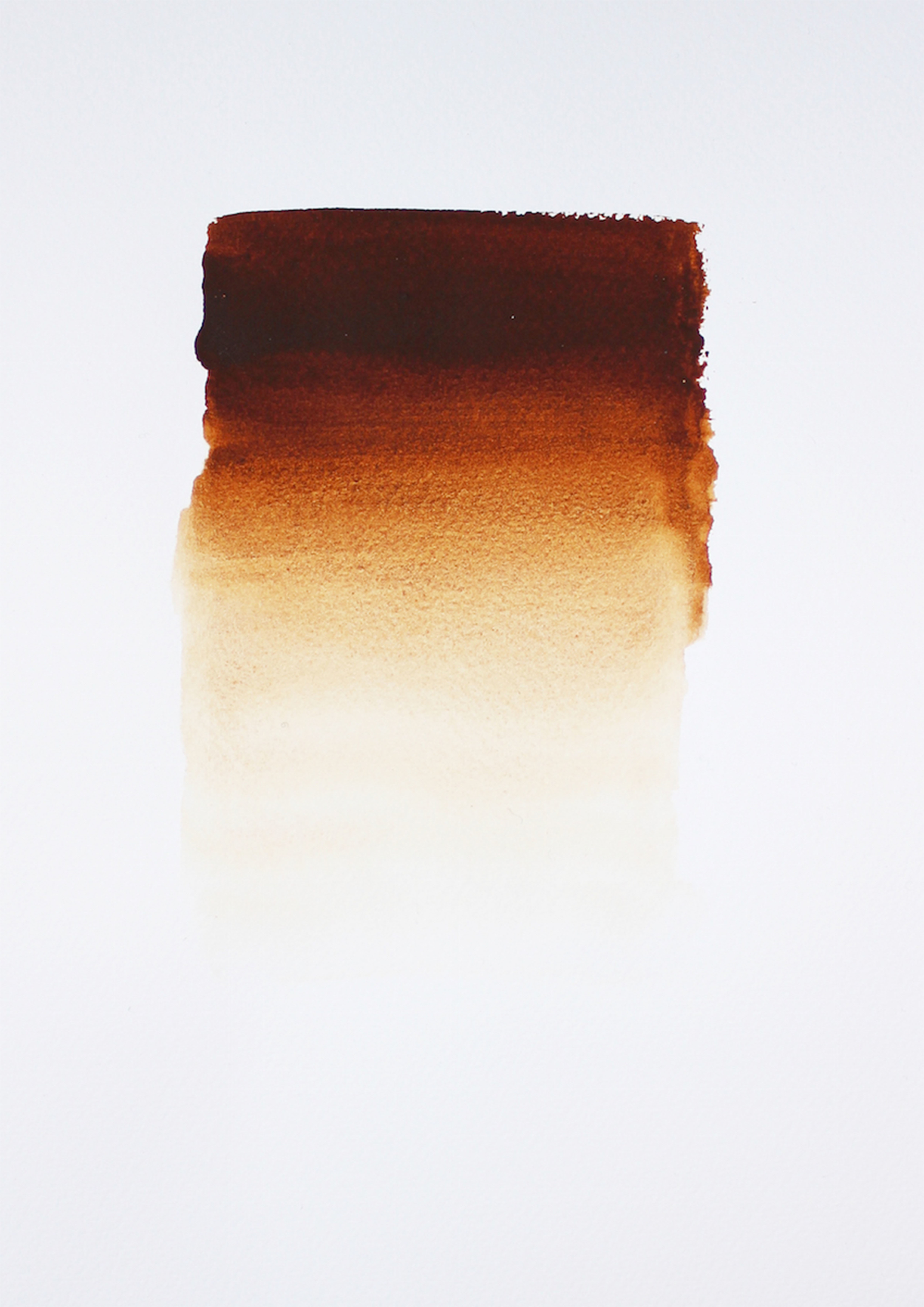
The Mine Water Treatment Site at Deerplay Hill sits high up on Todmorden Moor - the source of the river Calder in the Lancashire Pennines - overlooking the wind farms that have sprung up in recent years. The landscape is formed of shale, mudstone, sandstones and gritstones, the ground is a thick layer of hill peat covered in scrub grasses and heather. The peat minerals in the ground influence the colour leaching from the old mines which appears dark brownish orange in the landscape. When the ochre has been dried and ground and painted in a transparent medium like watercolour it reveals a wider register of colour from dark charred brown with a tinge of purple, through to a golden-orange undertone.
The relatively small scale of the mine workings in this region, which mainly closed around the 1960’s, are a reflection of the geological fracturing of the coal fields caused by fault lines cutting up and displacing the coal field.



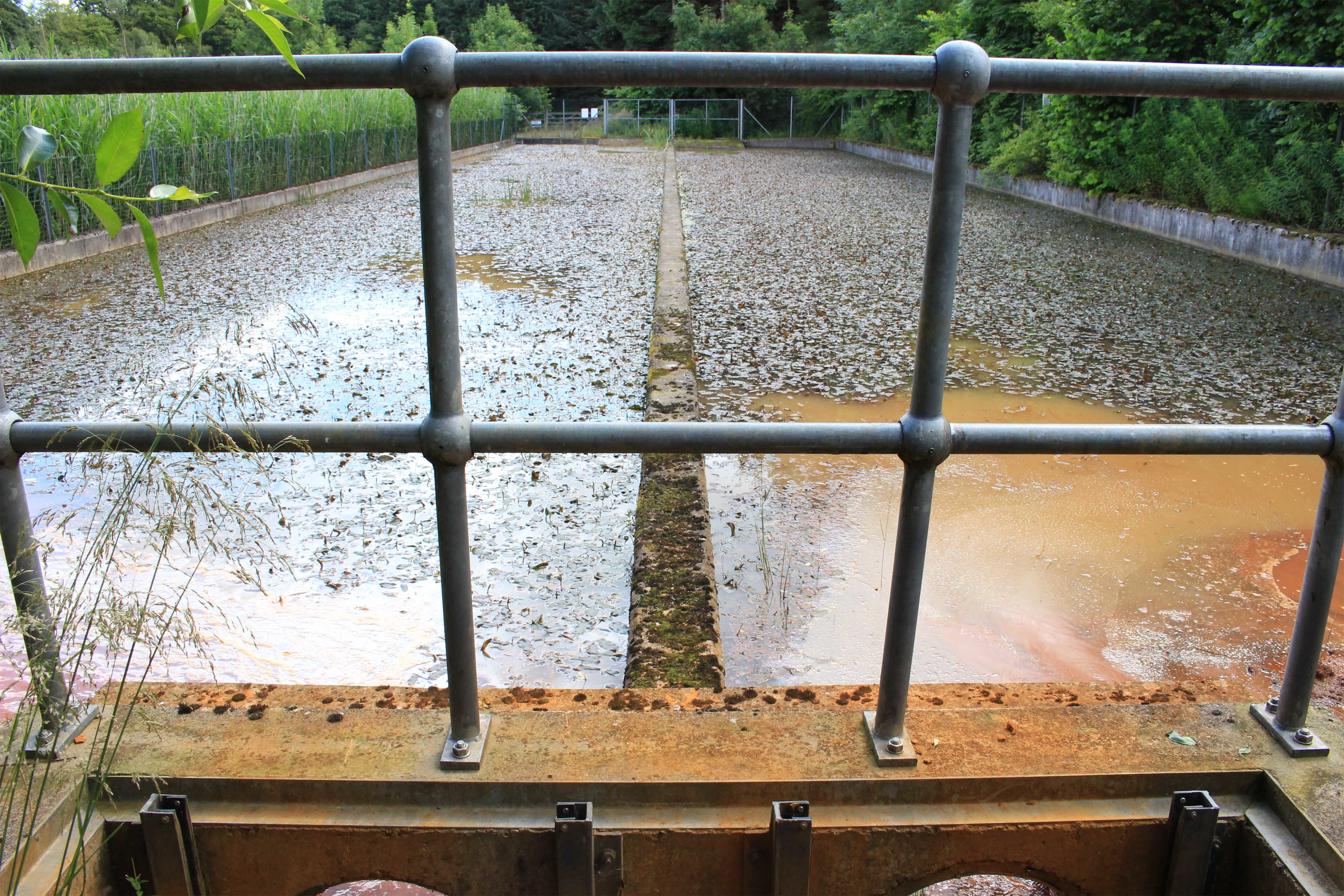
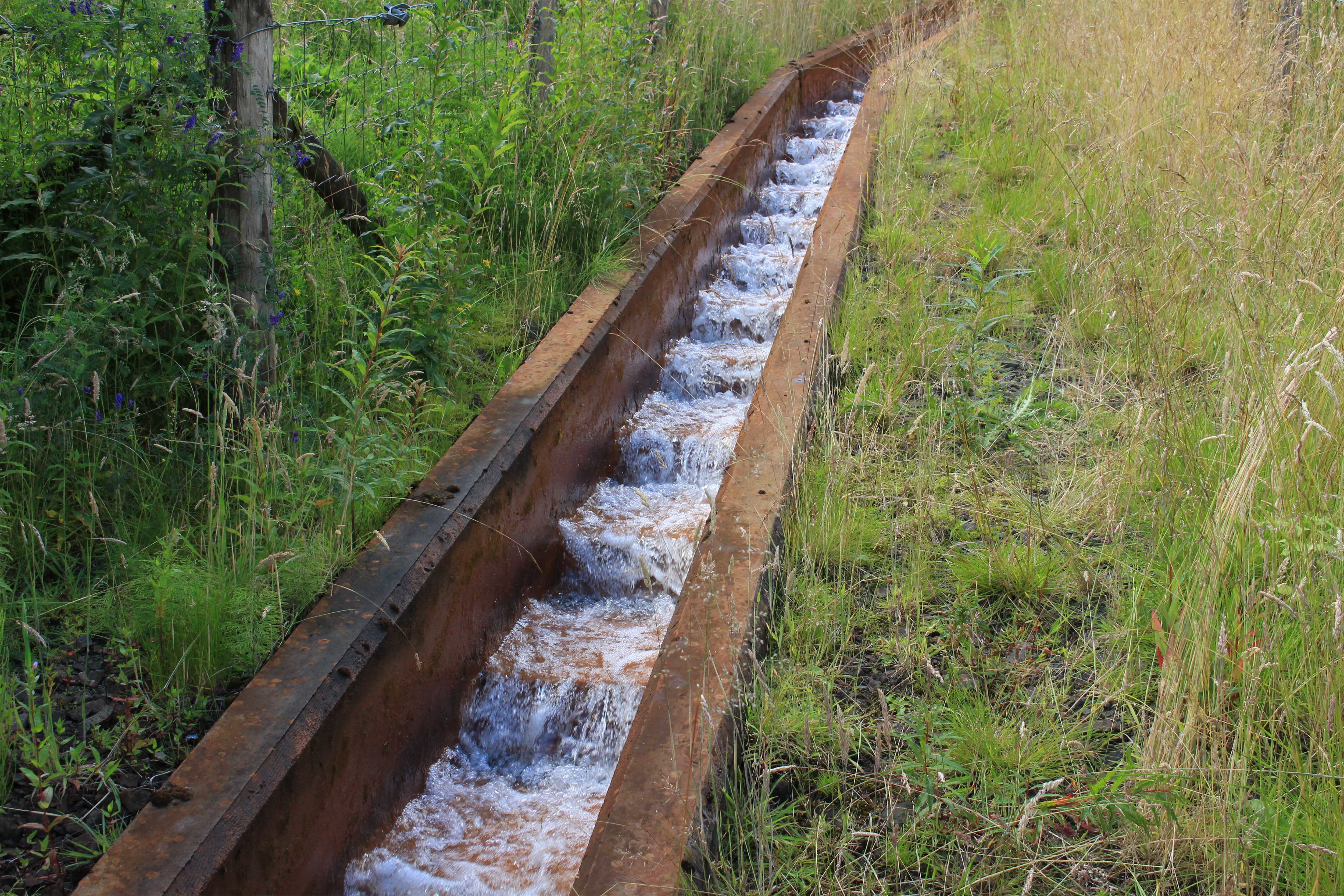
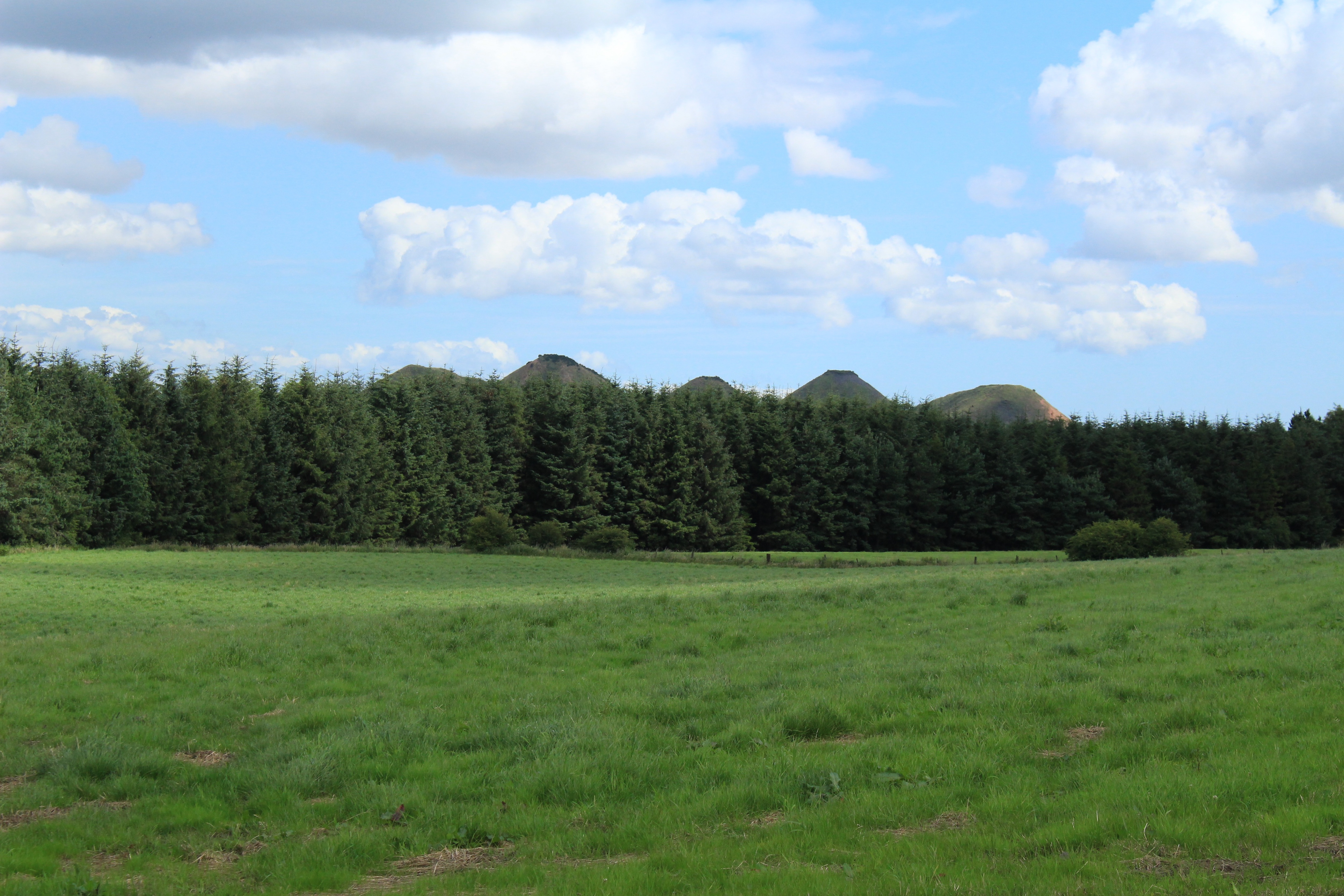
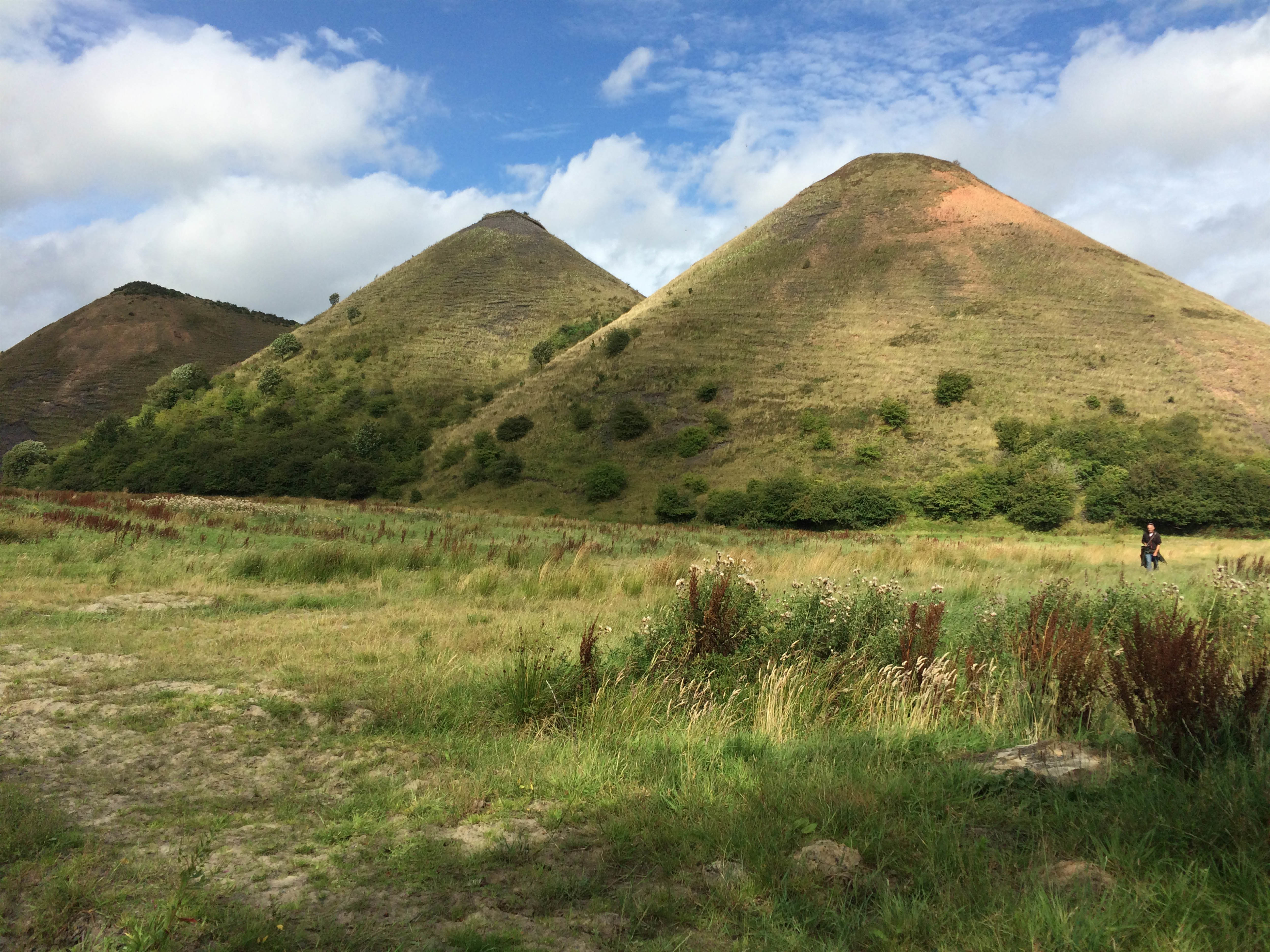
Cuthill, West Lothian, Scotland
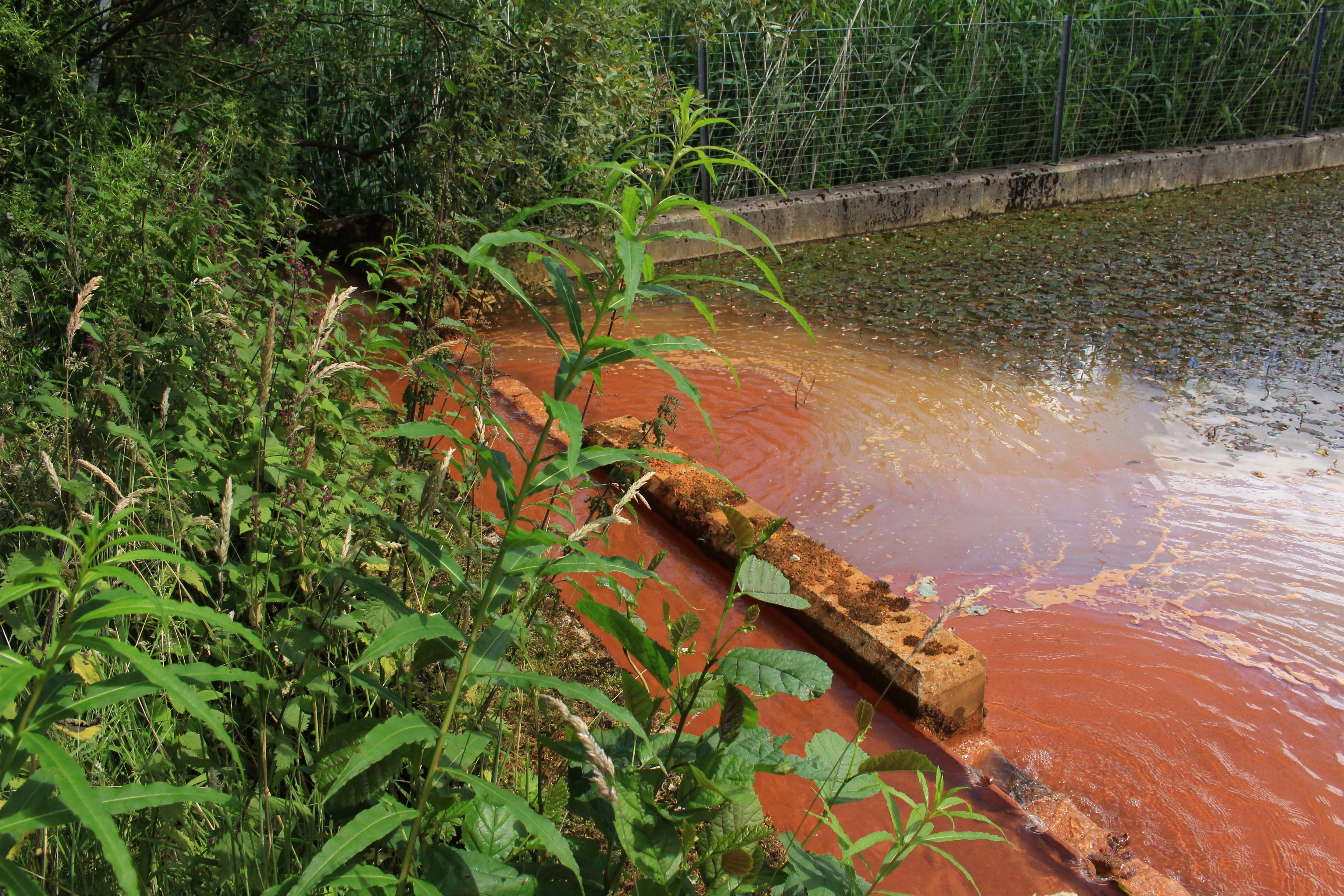
The Mine Water Treatment Scheme built in 2003 sits beside the river Almond near Addiewell village in West Lothian, Scotland. The coal mines were worked here until the early 1960’s. The coal provided fuel for the giant furnaces used for extracting oil from shale in Scotlands first oil industry. Cuthill Mine Water Treatment Scheme is a few fields away from one of the slag heaps or ‘bings’ that mark the landscape of West Lothian; Five Sisters Bing was designated an artwork by John Latham in 1976, and has since become an internationally recognised monument. The scheme at Cuthill performs the function of cleaning the polluting mine water that inadvertently produces many tones of waste ochre every year.
Burning ochre at around 600 degrees will cause it to dehydrate, turning the yellow ochre material red. The ochre from Cuthill is distinguished by the subtle pinkish tone it creates when burnt, a colour that resembles the burnt fragments of waste shale that form the structures of the ‘bings’.
Turning Landscape into Colour 2017
Abstract
Through the practice of painting this research questions how geologically distinct earth colours that are constantly forming from coal mine water treatment waste in geographically varied landscapes across the UK can be used to re-view perceptions of colour, material, and connection with the contemporary landscape. If historical connections between colour and landscape have been expressed through the names of colours such as burnt sienna and, in the context of the UK, Oxford ochre, how can finding, naming and using new sources of earth col-our re-establish links between colour and landscape? Over the course of several journeys across the UK, visiting 34 Mine Water Treatment Sites run by the Coal Authority, five previously un-used and un-named earth colours from different sites are selected and used here for the first time. What sets these new ochres apart is the quality of their colour and their formation processes inside the flooding cavities of former coal mines, inadvertently providing a sustainable source of earth colour at a time of increasingly scarce mineral resources that paradoxically point towards the causes of industrial pollution. The practice of making individual artworks reveal optical and material distinctions between the new colours while suggesting unexpected idiosyncratic connections be-tween individual colours and the unique landscapes they belong to, further contributing to the discourse on con-temporary landscape.
https://discovery.ucl.ac.uk/id/eprint/10039744/
Mine Water Pollution and Treatment
Water pump, Six Bells
In 2001 a borehole was driven 216m down into the old mine workings at Vivian shaft, Six Bells where an underground roadway had been backfilled in 1962.1 From this borehole polluted water is now pumped out of the mine before it reaches the river preventing the water from being polluted with raw mine water.
Six Bells is an ‘active’ treatment site, hydrogen peroxide is added to the pumped mine water. Hydrogen peroxide, H2O2, is a relatively unstable compound, its desire is to become water, which it does by readily letting go of its second oxygen atom to whatever will take it. Iron takes up oxygen so an exchange takes place and the iron is exposed to greater concentrations of oxygen than by aeration alone, speeding the oxidising process.
The polluted water, pumped directly from the mine is first mixed with the hydrogen peroxide and then pumped out through a channel up to the top of a three metre high fibreglass cascade further increasing exposure to oxygen in the air.
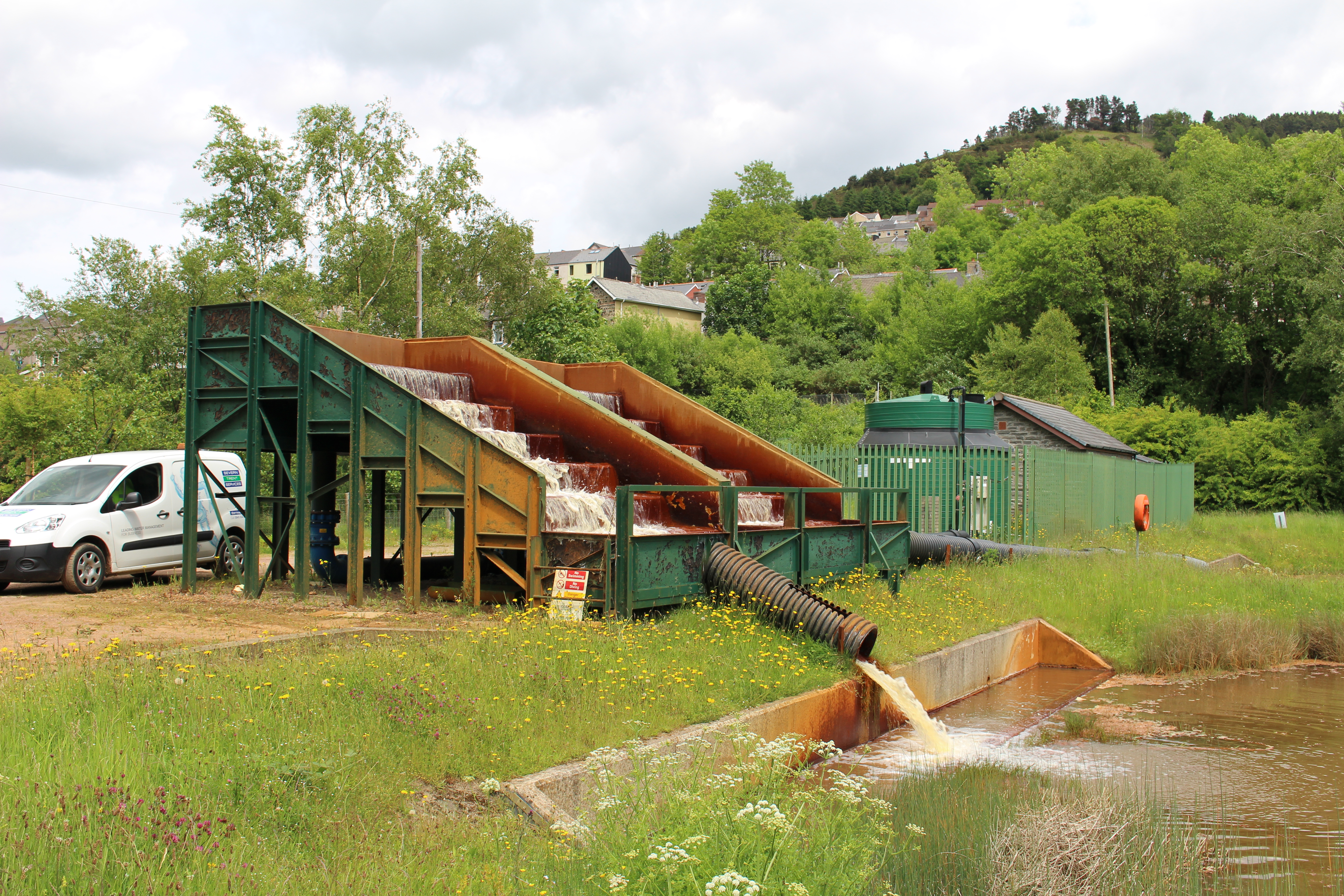 Cascades, Six Bells Mine Water Treatment Scheme
The water travels down the aerating cascades into two parallel deep lagoons measuring 1540m2 each where the water and newly oxidised pigment particles settle. The mine water treatment process is concluded by passing the water with its residual load of suspended iron particles through an artificial reed bed. When the pumping started in January 2002 the acidic mine water contained 250mg of iron per litre of water. After a period of four months the iron concentration in the water had stabilised to 50mg per litre of water.2 By the time the water flows into the river the iron content has reduced down to less than 1mg per litre of water, which is the environmental quality standard for discharge to surface waters. For 15 years the polluted mine water has been continually pumped from these underground workings 24hr an day, at a rate of 40 litres per sec.3
Coal Authority - Understanding Mine Water Treatment: https://assets.publishing.service.gov.uk/government/uploads/system/uploads/attachment_data/file/362236/Understanding_mine_water_treatment.pdf
1 Jennifer Geroni, Rates and mechanisms of chemical processes affecting the treatment of ferruginous mine water, Master’s thesis, Cardiff University (Cardiff: Cardiff University, 2011), 61-7
2 Coal Authority, Environment schemes, Available at: http://coal.decc.gov.uk/en/coal/cms/environment/schemes/schemes.aspx (Accessed: 20th September 2013)>
3 Jennifer Geroni, Rates and mechanisms of chemical processes affecting the treatment of ferruginous mine water, Master’s thesis, Cardiff University (Cardiff: Cardiff University, 2011), 61-7
Repurposing Waste Material
This research has presented discoveries of new sources of earth colour forming as waste from Mine Water Treatment processes across the British landscape. It has identified that each mine water ochre has a unique quality that link its colour with the specific identity of its landscape origins, and that these ochres can be repurposed and used sustainably as new colour that is named by place.
The funded doctoral part of this research was supported by artist paint manufacturer Winsor & Newton. A comparison was made with current industry standards and historic colours like sienna and umber, supported by George Field’s notes in the Winsor & Newton archive. This helped to determine if the colours could ‘perform’ in the established pigment market for artists paints.
Through developing paint with paint manufacturers and making unique artworks the research has clearly demonstrated that previously un-named and unused ochre materials forming in redundant coal mining areas can be harnessed, processed and sustainably recycled for use as high quality pigments that compare in quality to the famous siennas and umbers of the past. This establishes for the first time in over 50 years a real connection between colour and place in the British landscape.
Mine Water Treatment Schemes
This project identifies the Mine Water Treatment Schemes themselves as performing a significant cultural event in the post-industrial landscape. Their function is a necessity of the industrial legacy of coal mining that requires the clean up of polluting ground water and contaminating land. The production of ochre - as a waste material - is redefined here; repurposed as a culturally potent material that re-connects colour with its place in the landscape and shows the need for a shift in perception and change in attitude towards the earth as a finite resource.
I propose that five Mine Water Treatment Schemes are recognised as important cultural sites linking the earliest human ochre markings with the current conditions effecting the contemporary landscape. The deep orange ochre lagoons are containers for colour and monumental watercolour paintings in the ground. This has developed into a proposal and current plans with the Coal Authority to name the five Mine Water Treatment Sites as public artworks.
Sustainable Material
The mine water treatment process happens on an industrial scale across the ex-mining regions of the UK in order to treat many millions of litres per second of polluted mine water. This is a process that will continue for many decades, even hundreds of years to keep the ground and drinking water supplies clean.
The distinctive stepped cascades help to oxygenate the water as it is pumped out of the ground. Then it passes into ‘settlement lagoons’ where the ochre particles settle out under gravity. The Coal Authority aims to find the most efficient and cost effective treatment and management system possible for each particular site.
This project is working with the Coal Authority to recycle the ‘waste’ materials formed from this process. The CA are facilitating access to their MWTS and have set aside many tons of material for the furture of this work.
Coming soon....
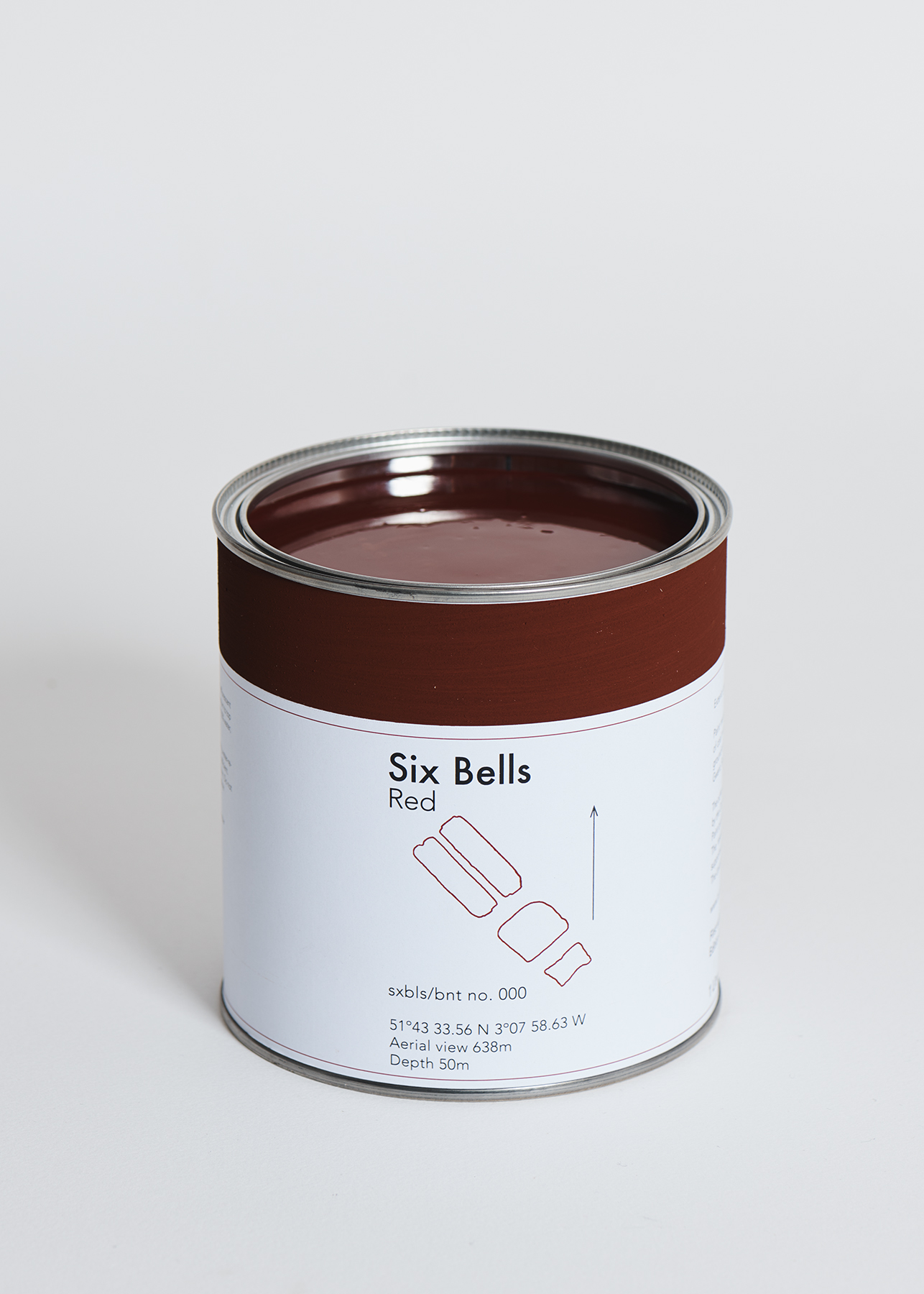
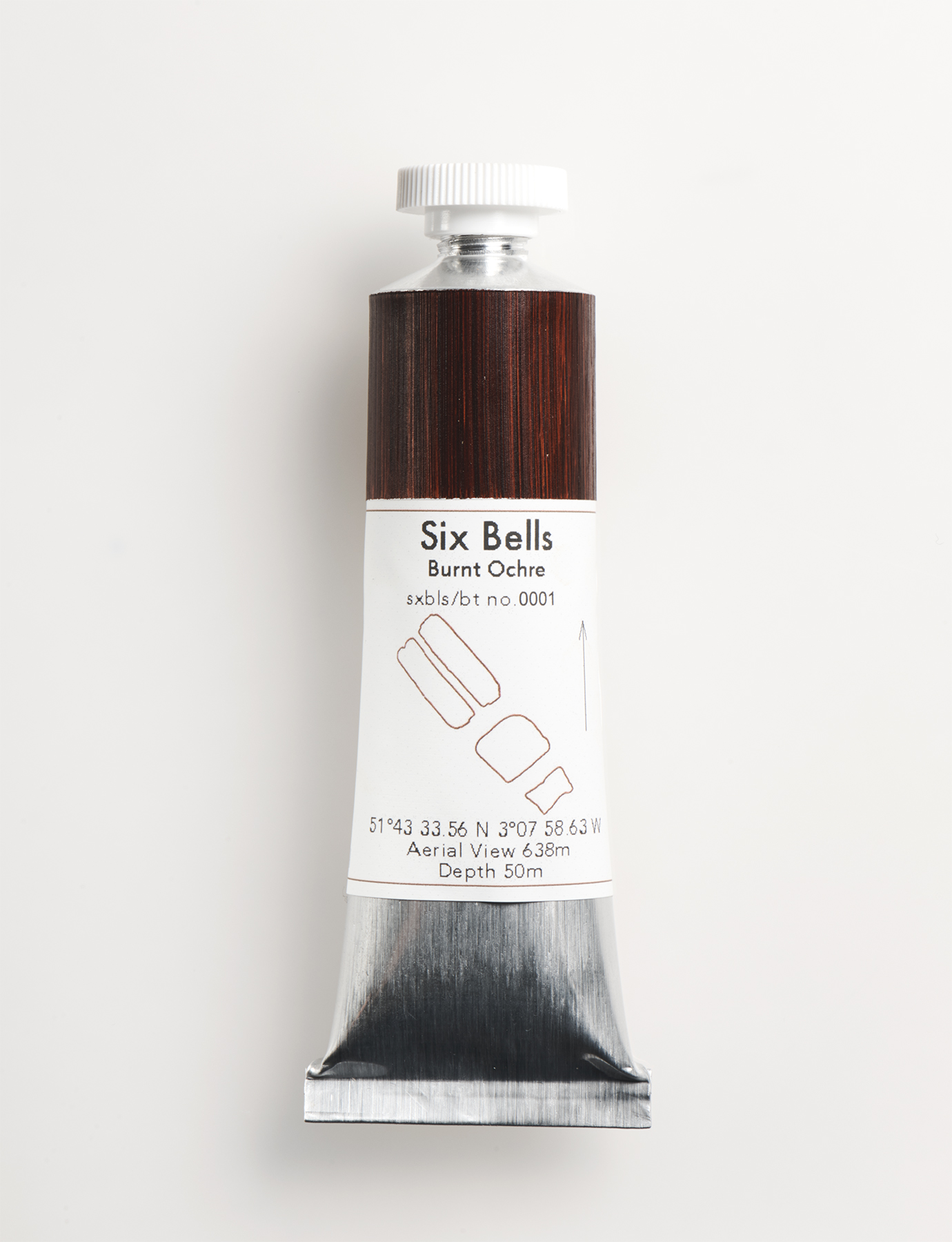
In just a few weeks we will be launching the very first ever exterior grade mineral based wall paint made from 100% coal mine waste ochres Six Bells Red. A special edition of 100 one litre tins will be available to buy here. At the same time we launch an amazing new oil paint in collaboration with Michael Harding; Six Bells Burnt Ochre (Slade Red) will be available as a first edition artists oil paint. Finally, the Mine Water Treatment site at Six Bells will be marked with a plaque naming it as the source of the colour.
Preparing Pigment for Paint
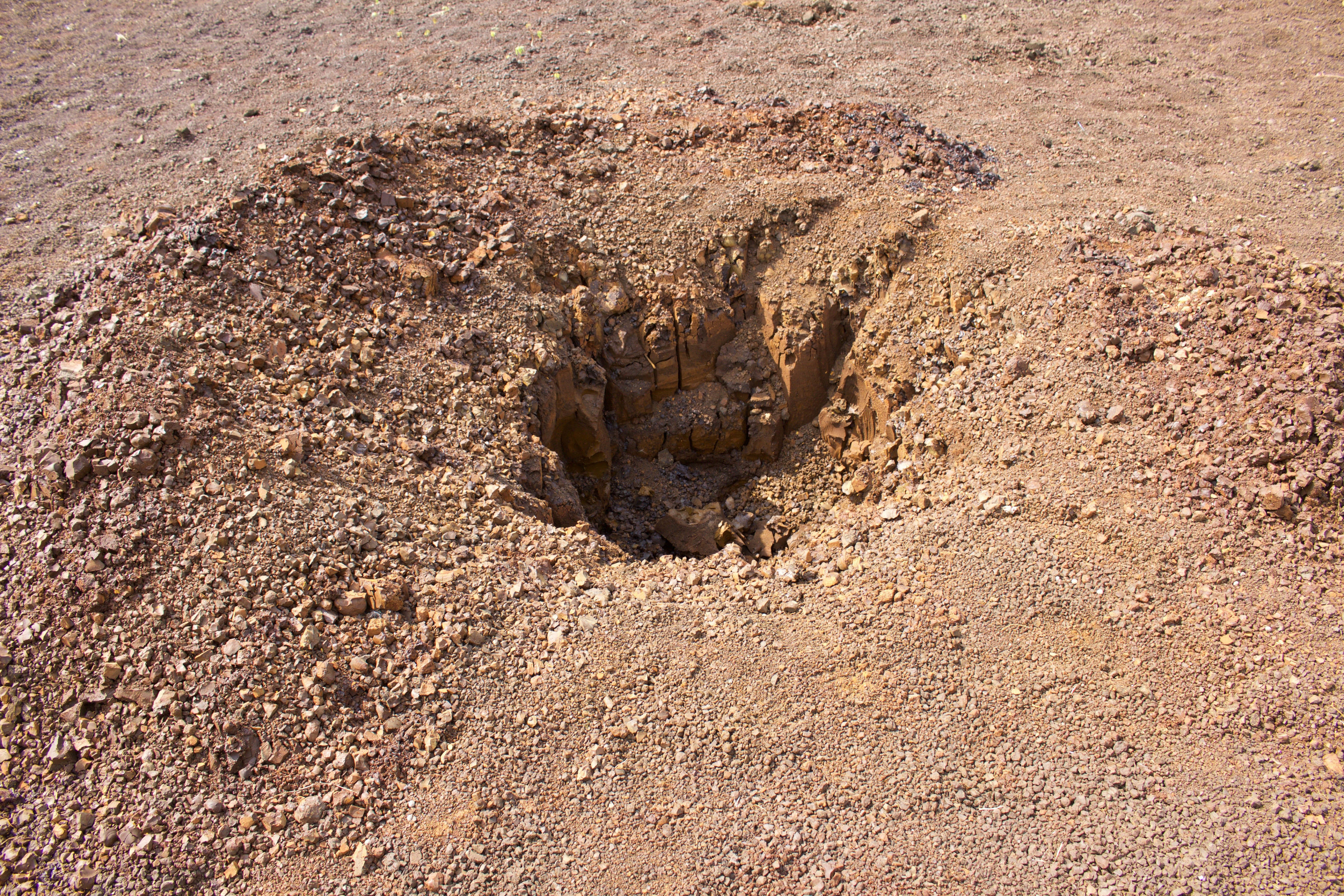
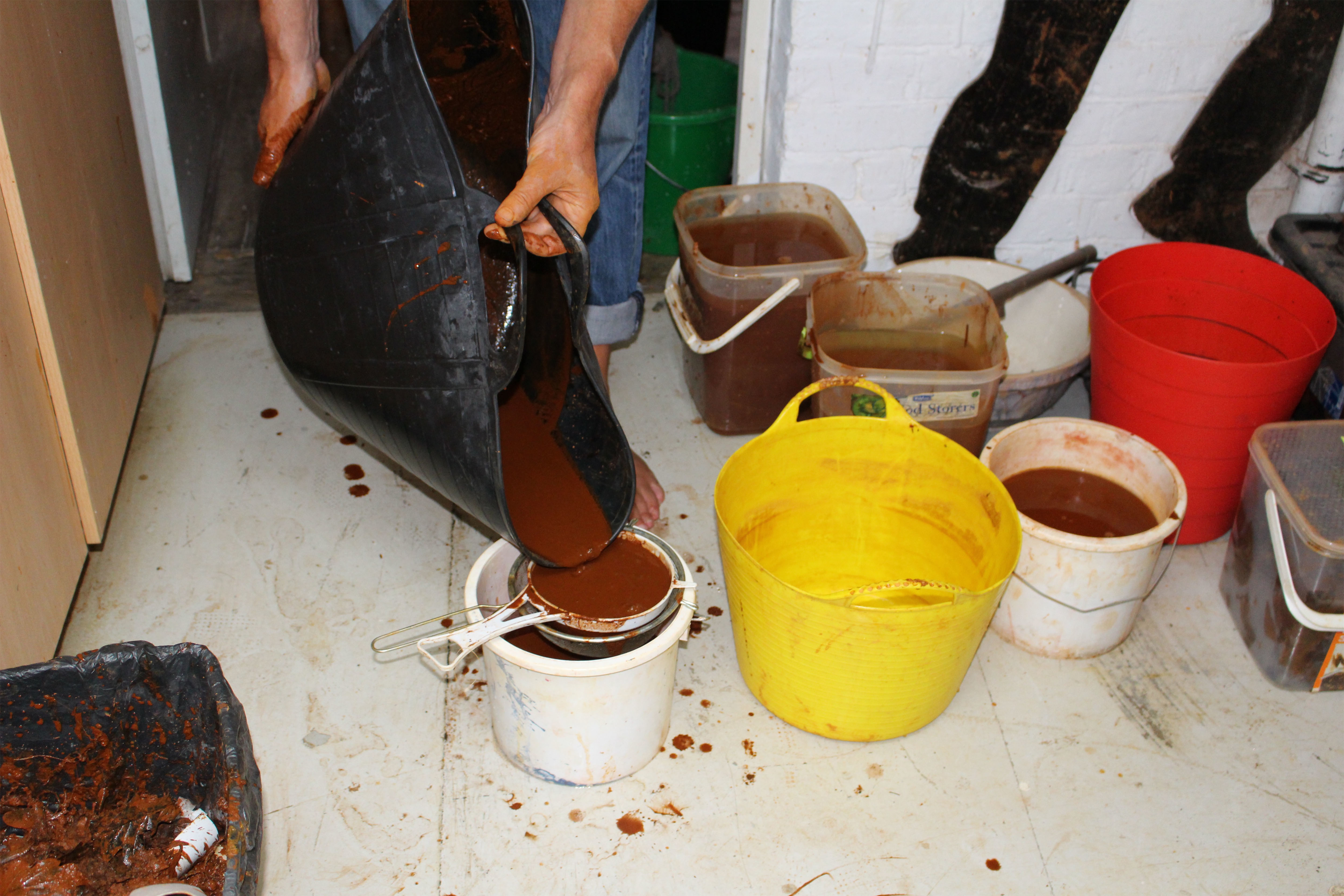
The process of extracting ochre from the mine water treatment schemes is either a small scale thing - a shovel and bucket, or a larger scale operation involving mechanical diggers or desludging equpiment, each site has different challenges and requires a different apporach. Jon Aumonier from the Coal Authority helped to devise different methods of extraction based on quantities of materials that we needed. Starting with the shovel and bucket method.
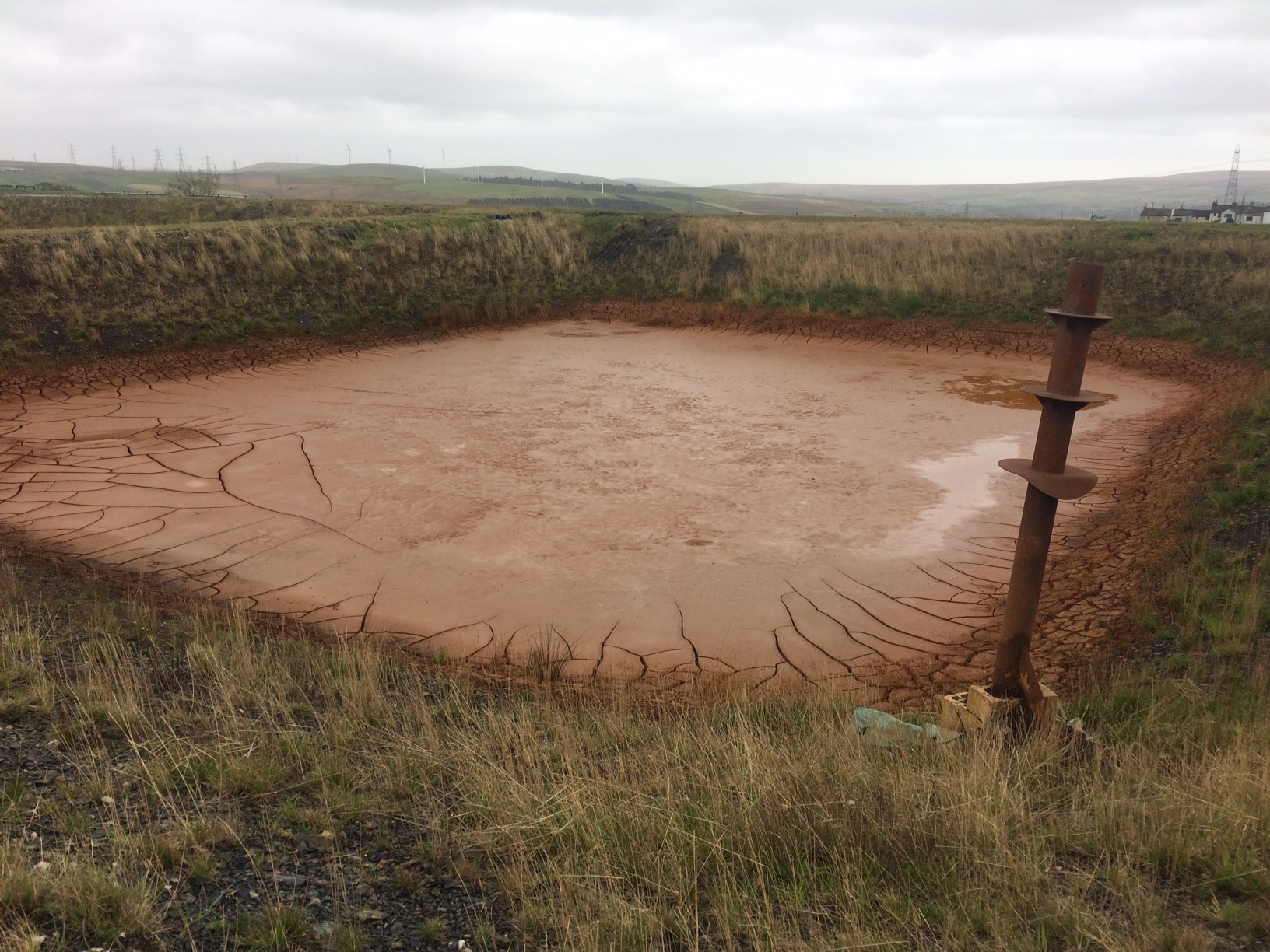
Deerplay Hill drying bed
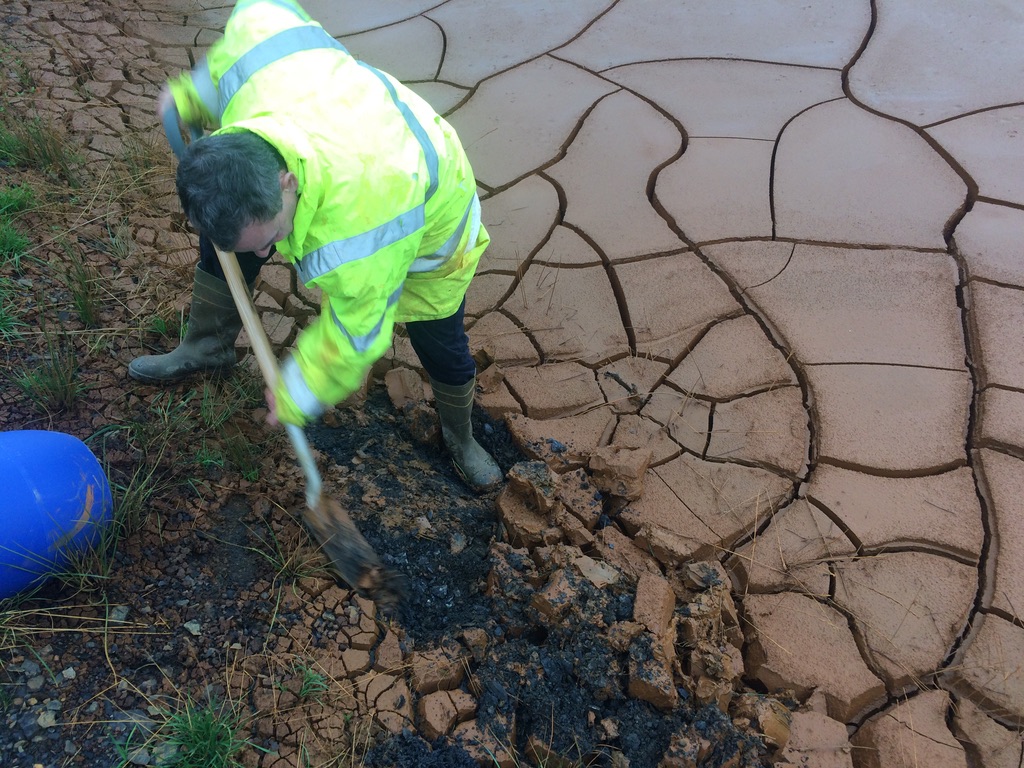 Digging out ochre from the Deerplay Hill drying bed
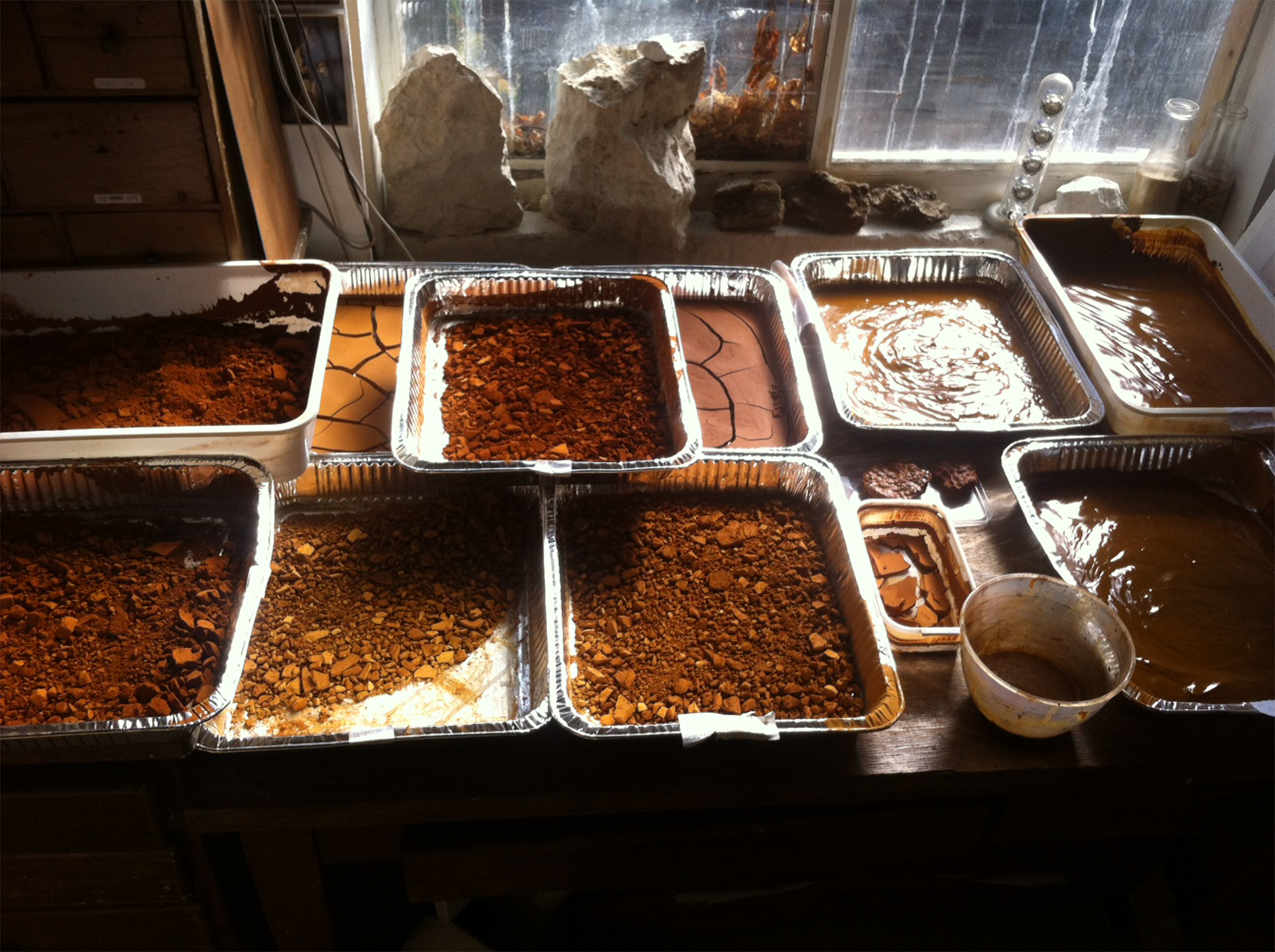
Drying ochre
Colour consistency
All the samples we collected had to be dried out and the best way to do this turned out to be natural air drying as it is low cost and low energy and we wern’t in a rush. Commercial paint manufacturers want colour consistency, this was one of the principles that Winsor & Newton based their reputation on. But the coal mine ochres will never achieve consistent colour - there may be slight variables between one batch to the next. But, over the past 7 years I have collected multiple samples from all five of the sites and I each time I arrive I can see the distinctive colour of each place is always identifiable as Six Bells, Tan-y-Garn, Saltburn.... There may be very slight variations with extreme changes in the environment - a lot of rain fall one year may effect the mineral constituent later down the line as minerals are flushed through the mines at different rates, at different levels . But on the whole the colours have their identies, and there is something human about inconsistencies anyway.

Working with the Coal Authority
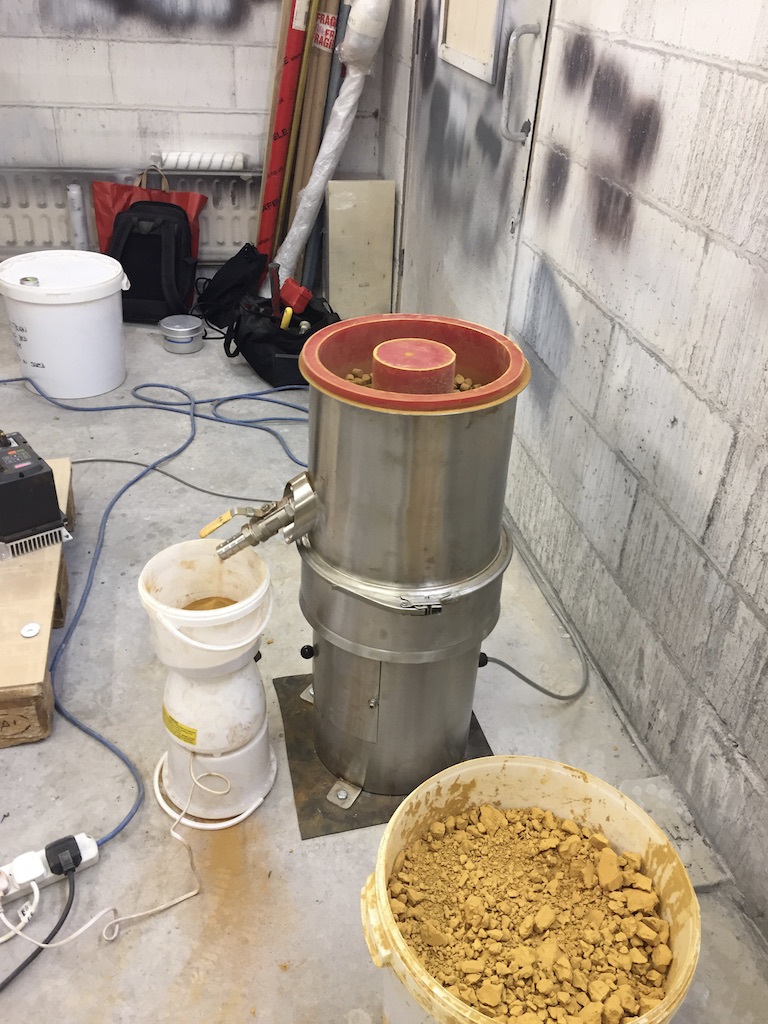
Milling trials - this is a lab sized vibro mlill.

This is a 60 litre capacity ball mill. It is a relatively old fashioned method of grinding material but the batch sizes are just right to manage. It can process between 30 and 50 kilos of pigment in a single batch.
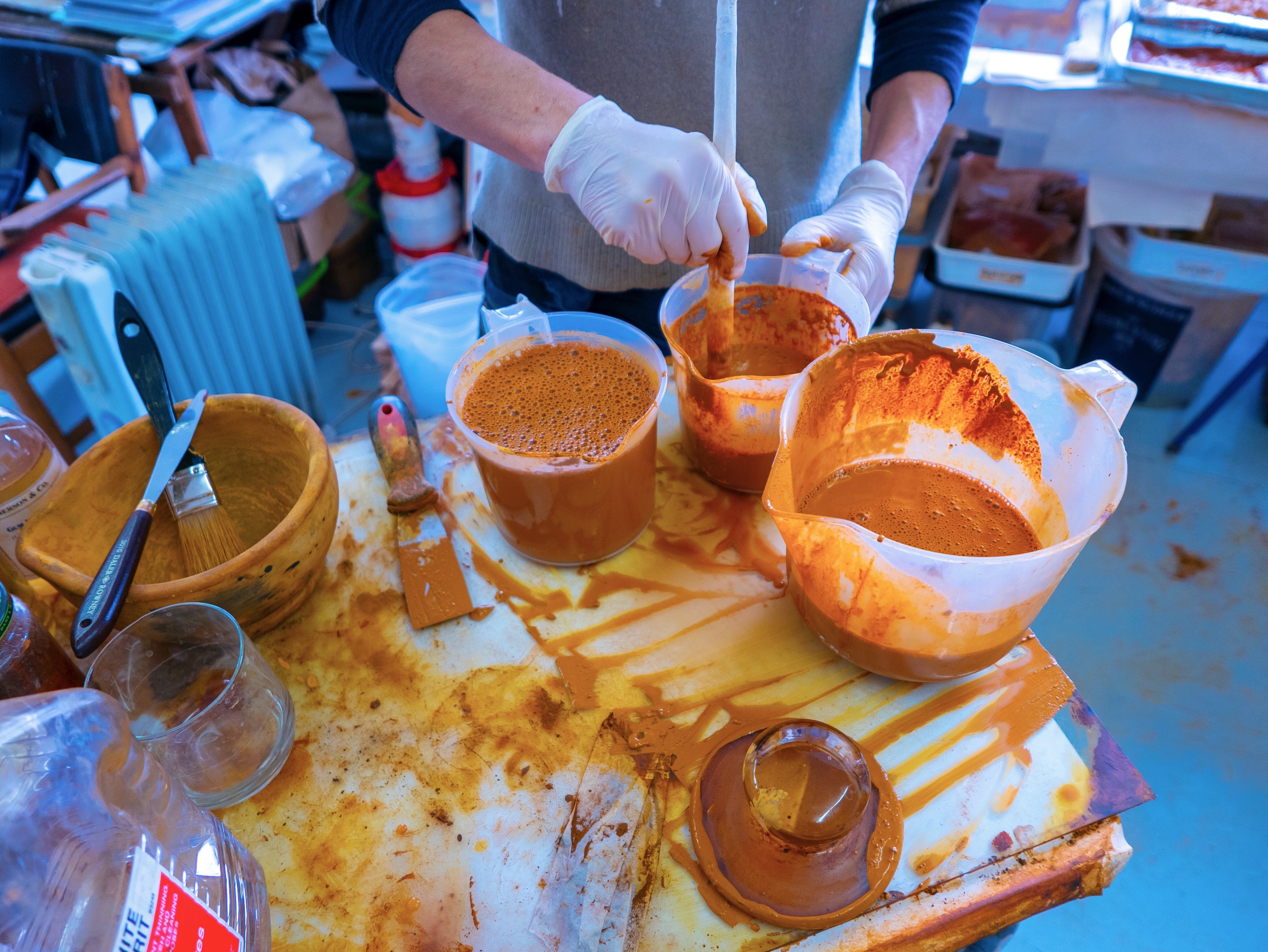
Studio prep, photograph by Jonathan Sissons
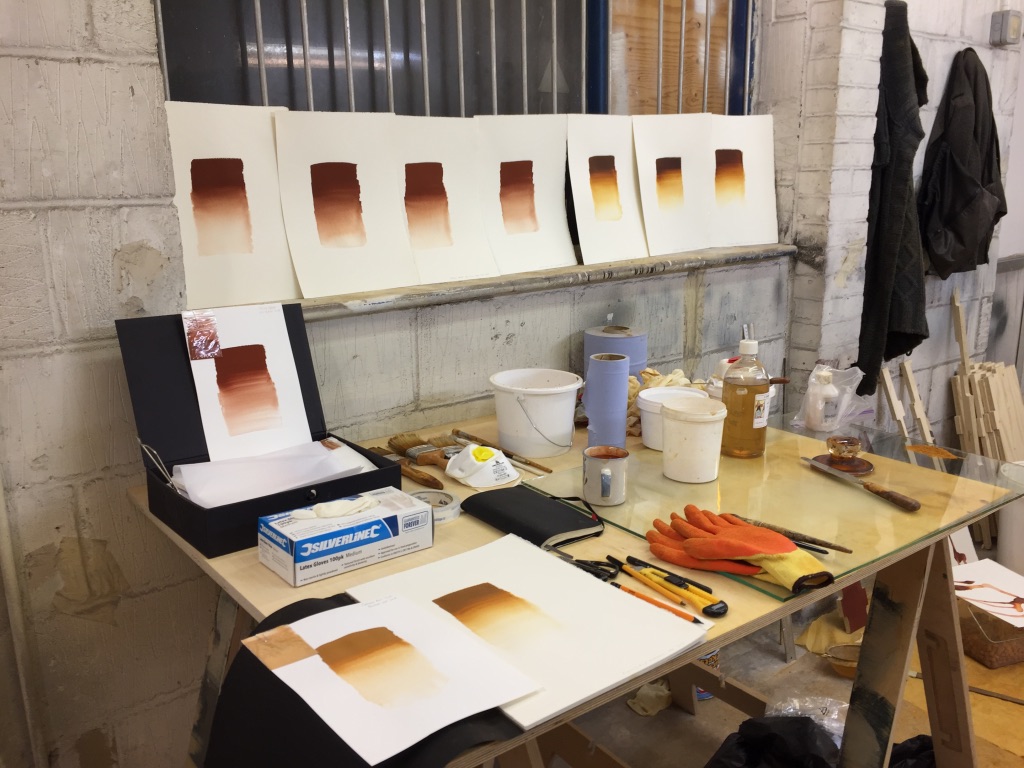
Watercolour tests
Mineral Structures
Particles Iron oxide particles are made up of numerous different kinds of mineral composition that determine their structure, such as haematite, goethite, ferrihydrite, limonite - there are many more. Some structures are amorphous and others crystalline. Viewing through the microscope determines this to a degree - a crystal structure will glow through cross polarised light, while an amorphous structure will not, as the light is not refracted back in the same way. But determining exactly what kind of crystal structure requires X-Ray diffraction.
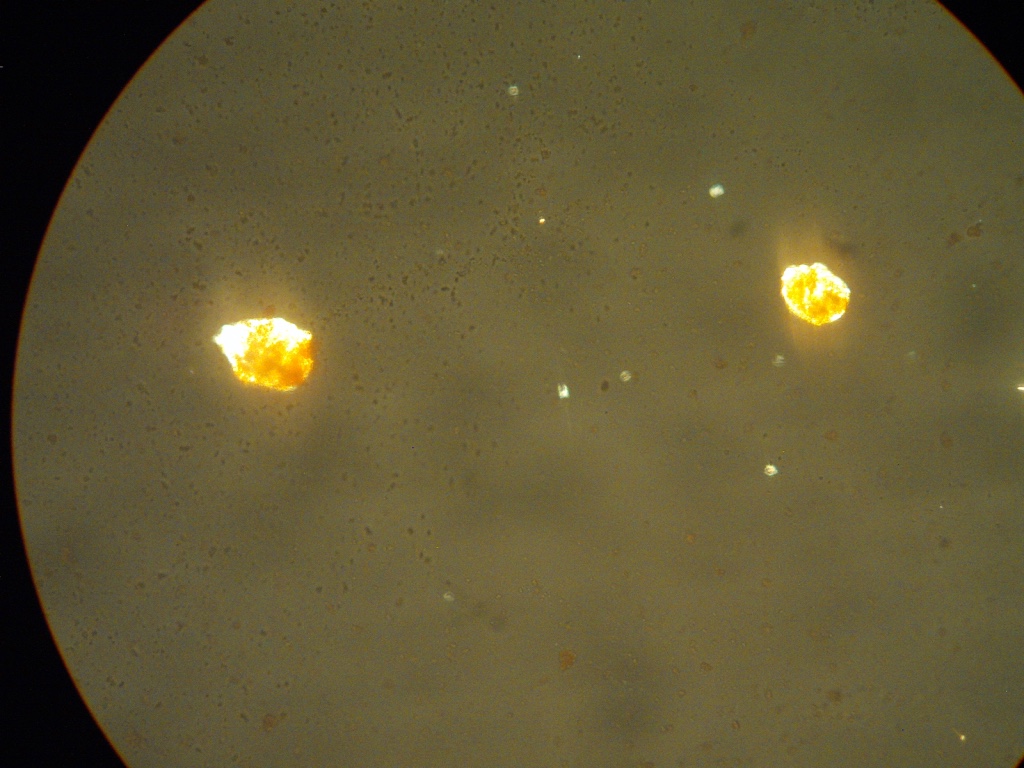 Cuthill Ferrihydrite Digital photograph Cross-Polarised Light (XPL) x1000, Field of view 0.1 mm
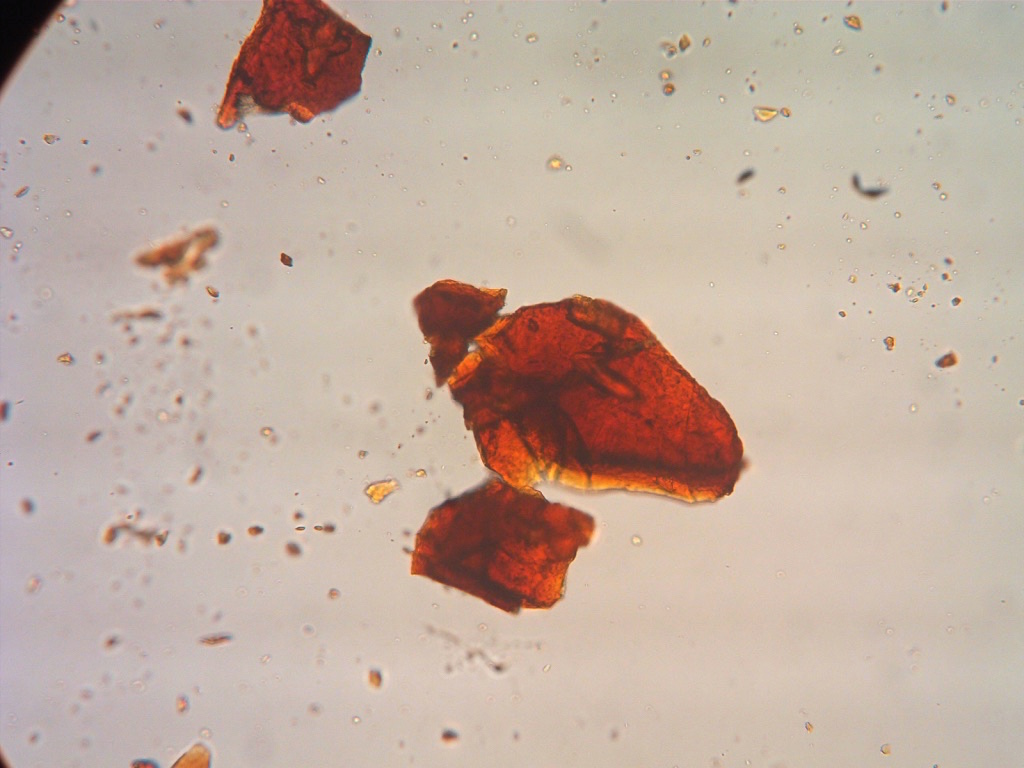 Saltburn, Ferrihydrite/Goetite Digital photograph Cross-Polarised Light (XPL) x1000, Field of view 0.1 mm
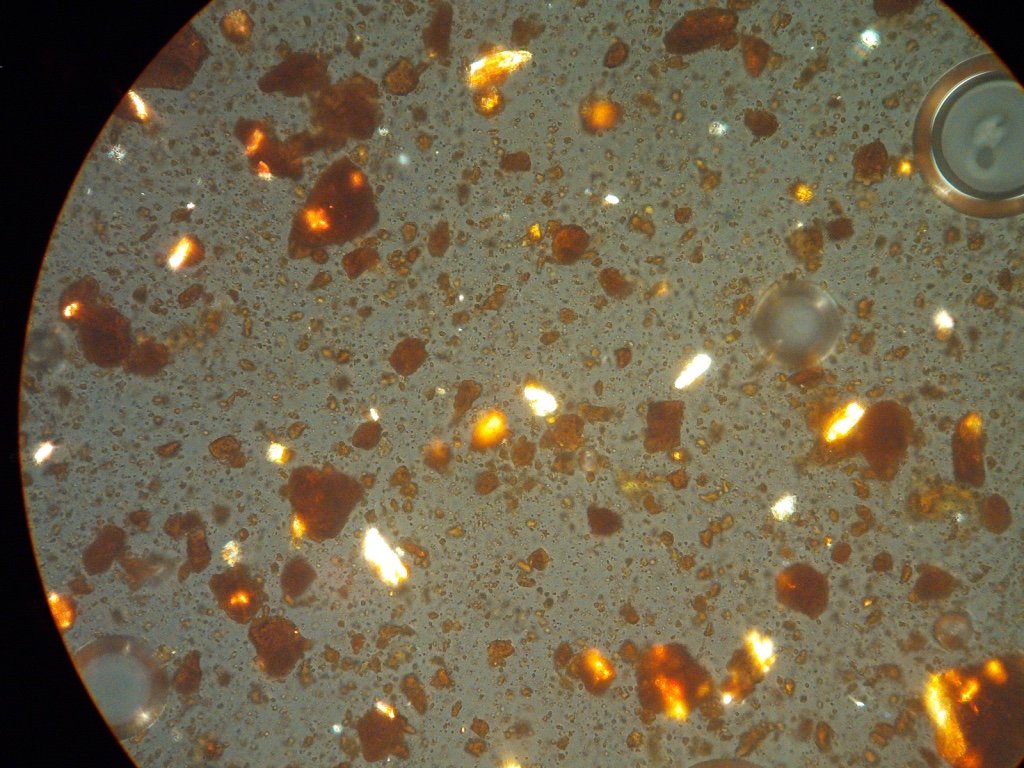 Six Bells, Ferrihydrite Digital photograph Cross-Polarised Light (XPL) x1000, Field of view 0.1 mm
Six Bells Goetite Digital photograph Cross-Polarised Light (XPL) x1000, Field of view 0.1 mm
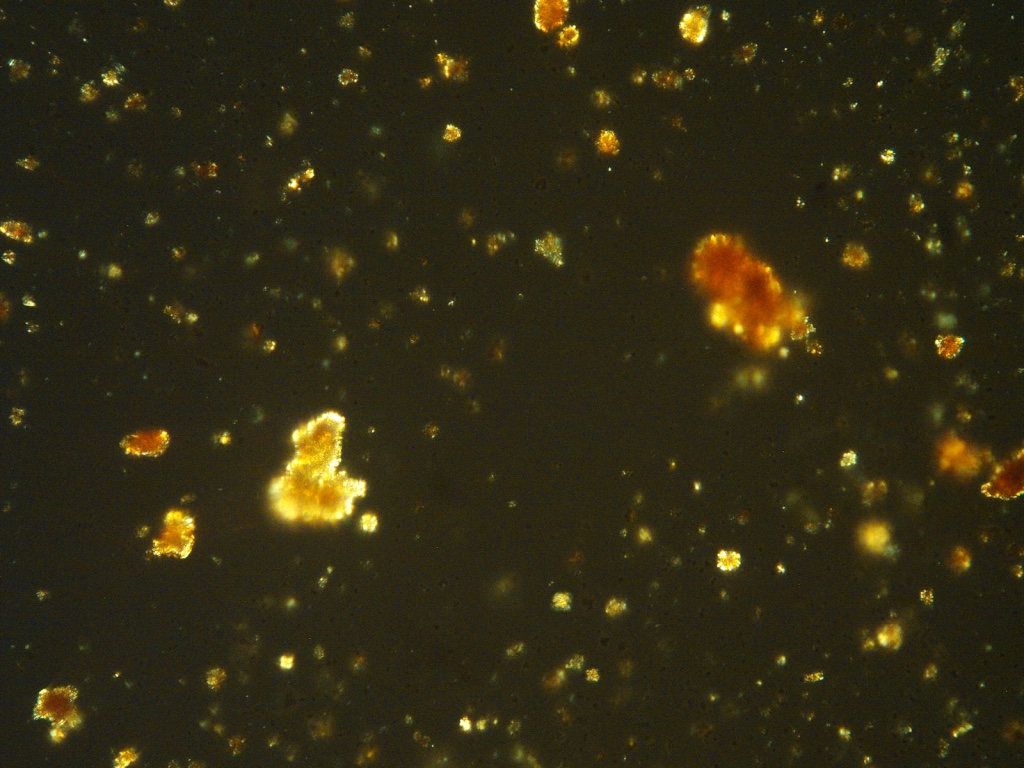 Tan-y-Garn Ferrihydrite Digital photograph Cross-Polarised Light (XPL) x1000, Field of view 0.1 mm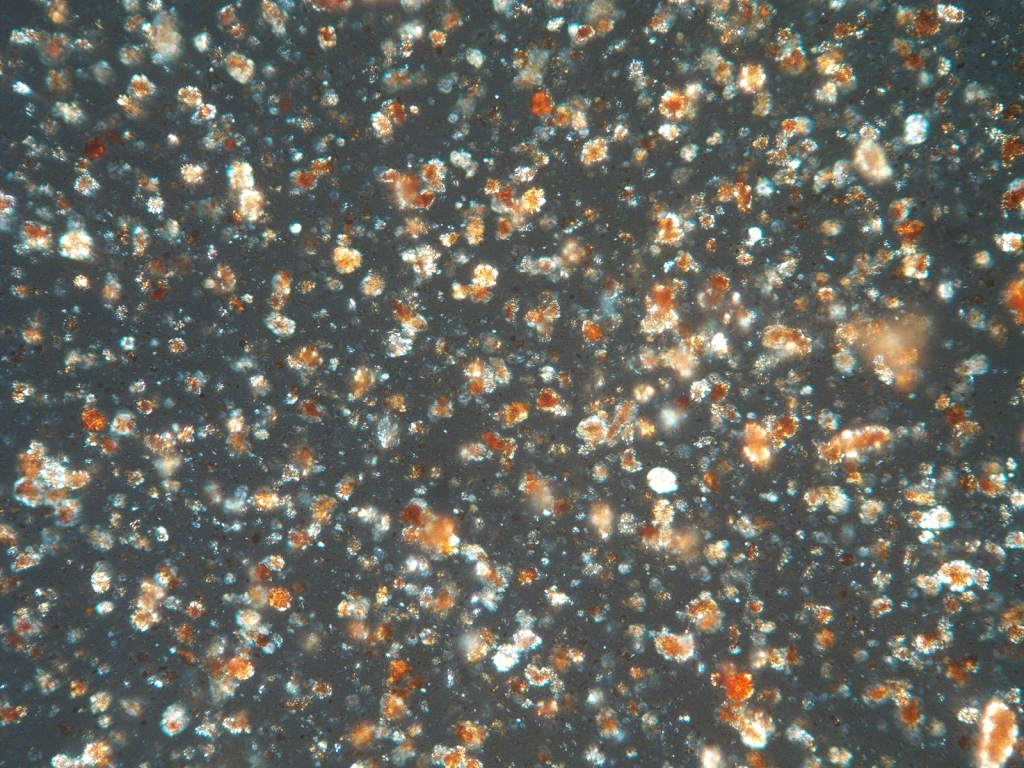
Tan-y-Garn, Ferrihydrite Digital photograph Cross-Polarised Light (XPL) x1000, Field of view 0.1 mm
The UCL Earth Science department were able to conduct X-ray diffraction tests on the pigments. A method that determines the atomic and molecular structure of a crystal by measuring the reflection patterns of a beam of X-rays off the crystal to determine its structure. The resulting graph reveals peaks according to where the beams have found a particular atomic spacing in a crystal structure. A small quantity of pigment, about a heaped teaspoon, was carefully placed in a crucible which was mounted and secured onto a rotating platform surrounded by a huge steel casing.
The results gave a clear indication of the presence of the crystalline structure of the mineral goethite. It was interesting to see this, and to know the exact mineral I was working with - to name it. Subsequently I have learned through handling the pigment - and comparing it to other similar goethite from established pigment sources - that its colour, texture and behaviour all consistently point to the mineral goethite.
Burning Ochre
Burning ochre at between 200 and 600 degrees will cause it to dehydrate, turning the yellow ochre material red. Red is the only colour that remains saturated (and therefore easily visible) in peripheral vision. The transformation from yellow to red, or from high salience to the highest perceptual salience, makes ochre especially suitable as a ritual symbolic material because of its transition from weakness to power. This transformation in the material world simulates the transitions in the immaterial immortal world - red ochre has the power to reverse transformations from life to death - its use in burials symbolises the opposite - from death back to life.
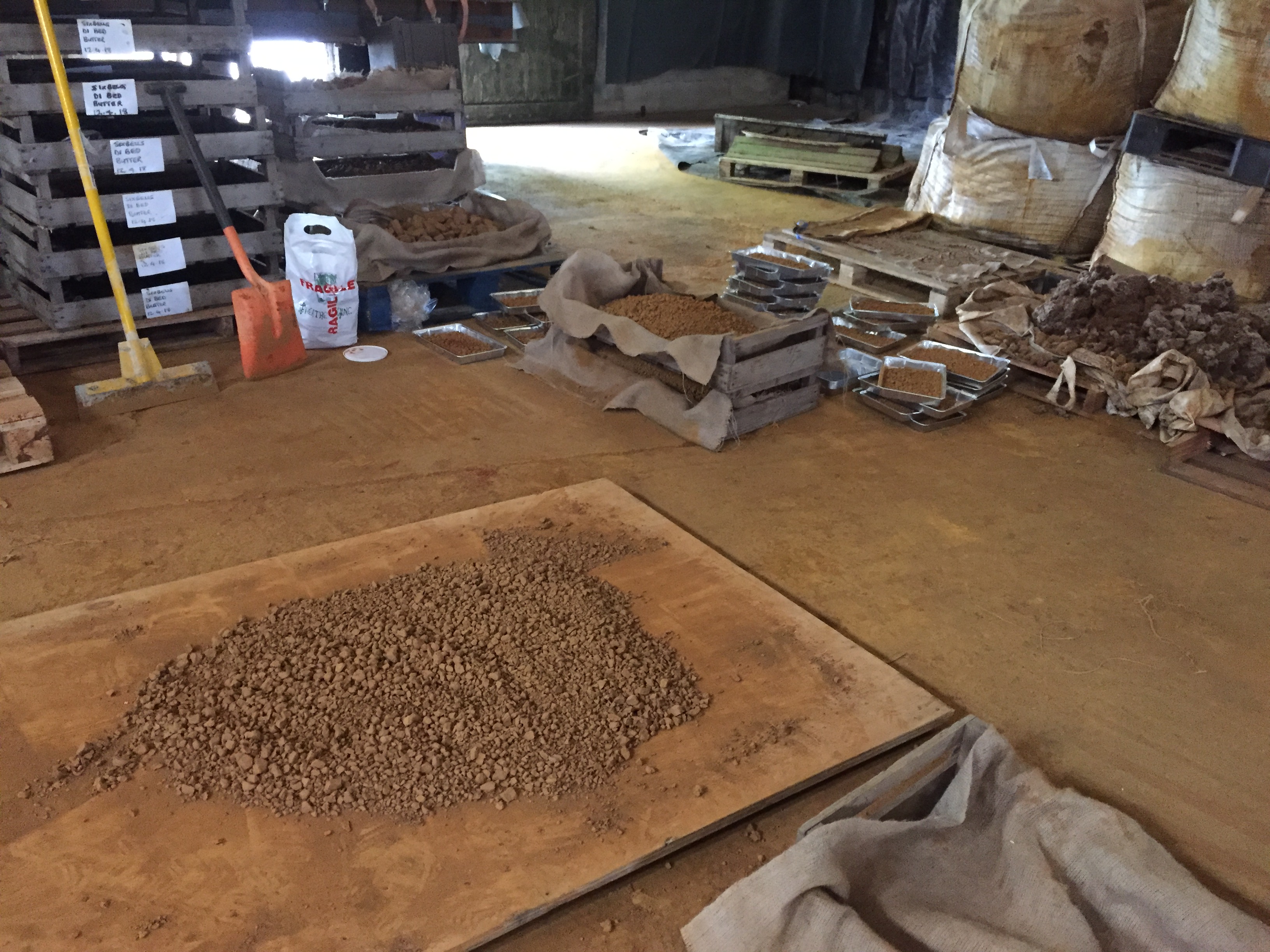
Dried ochre
 Batches of raw ochre going into the furnace, Yorkshire 2020
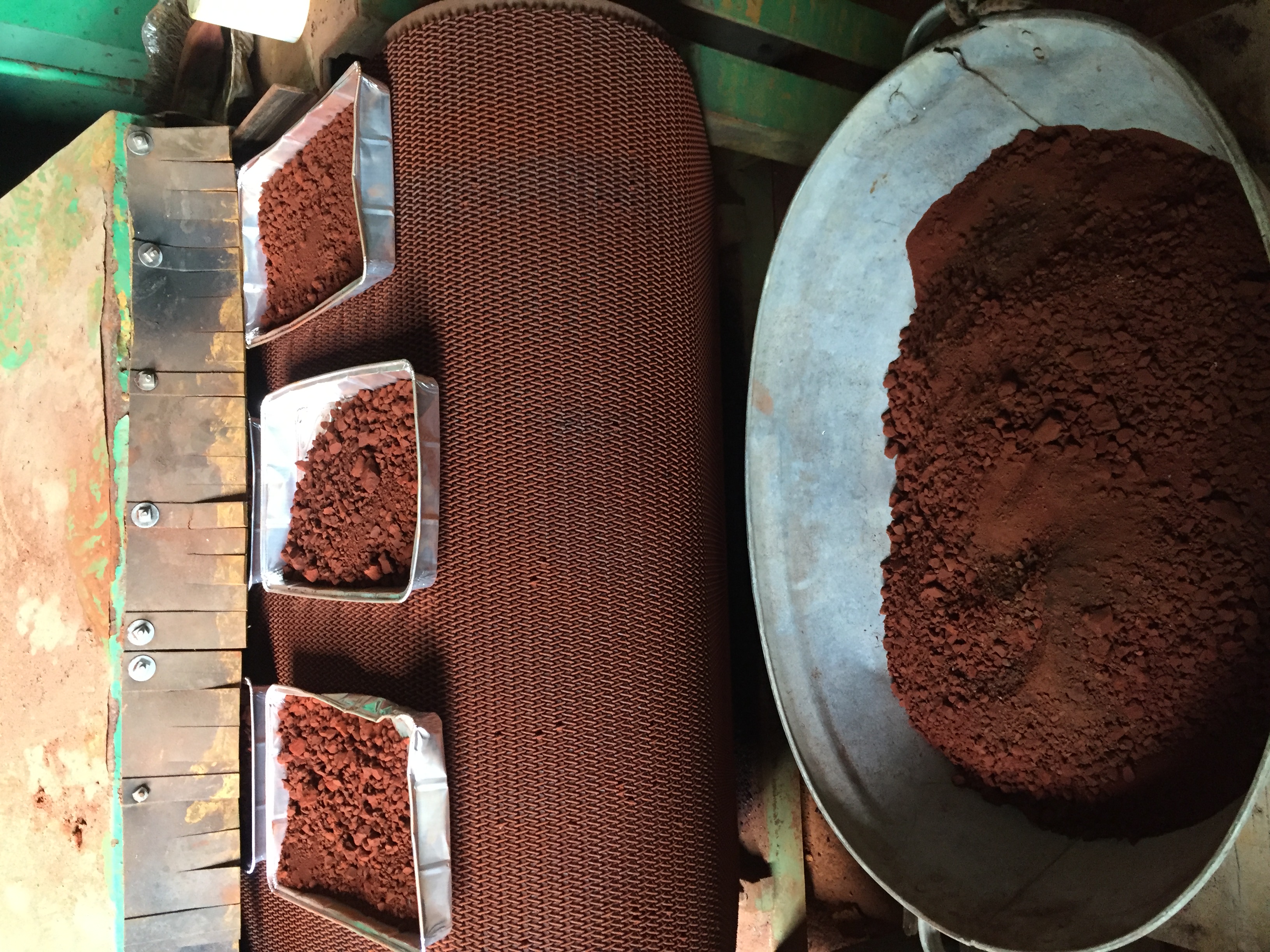 Burnt ochre coming out of the furnace. Yorkshire 2020
This supports the possibility that the circumstances of the materials manufacture - its transformative properties - imbue red ochre with meaning, establishing it as a source of magic and cementing powerful relationships between ochre and the human body. Such was the proximity of humans connection to the material world that complex rituals guided powerful transitions from one material state to another and one psychic state to another. It is said in Maori legend that the eating of ochre in the netherworld brings strength and restores life.
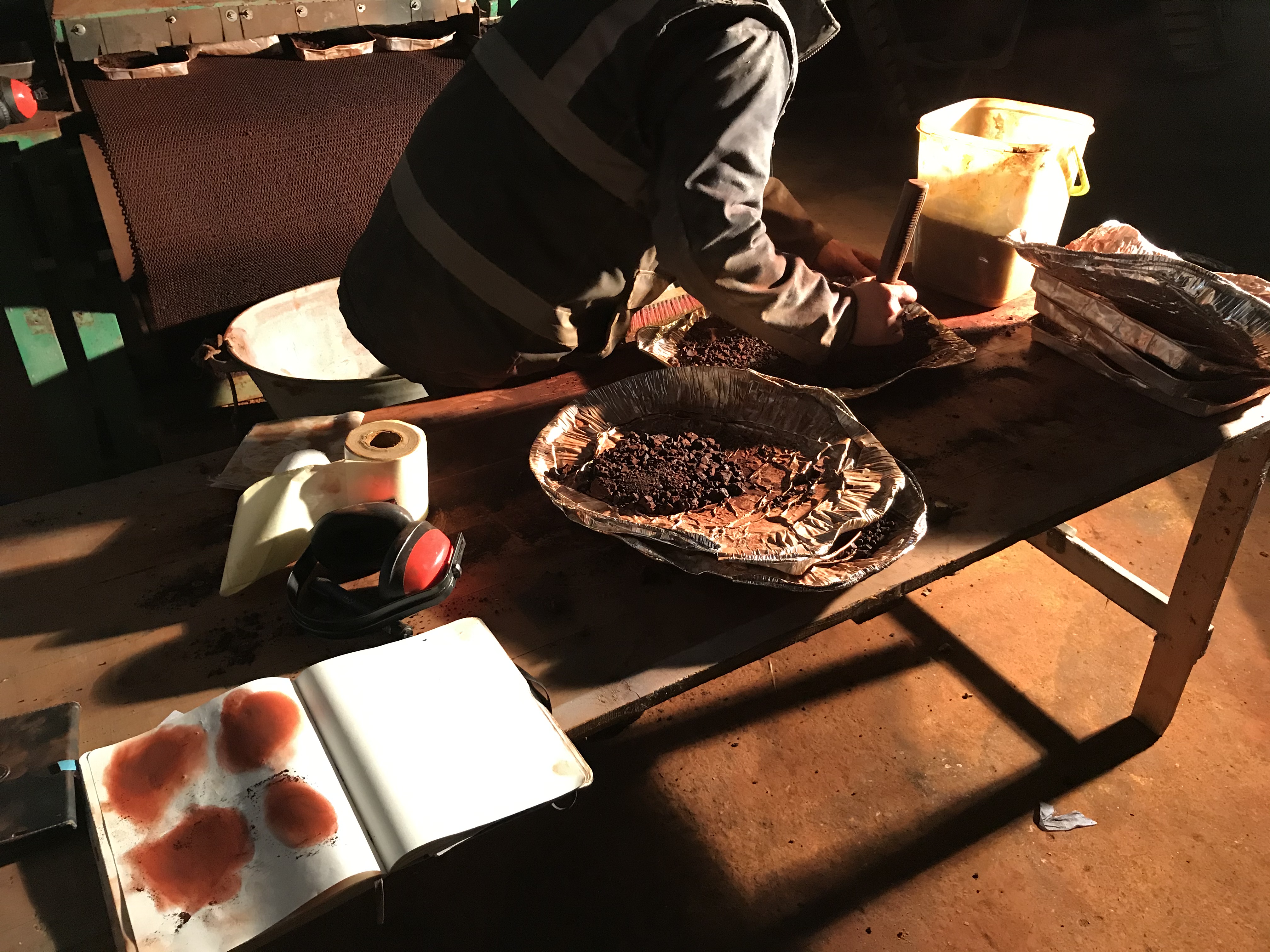
Ochre burning and preparation

First batch of burnt ochre, Six Bells, 2019
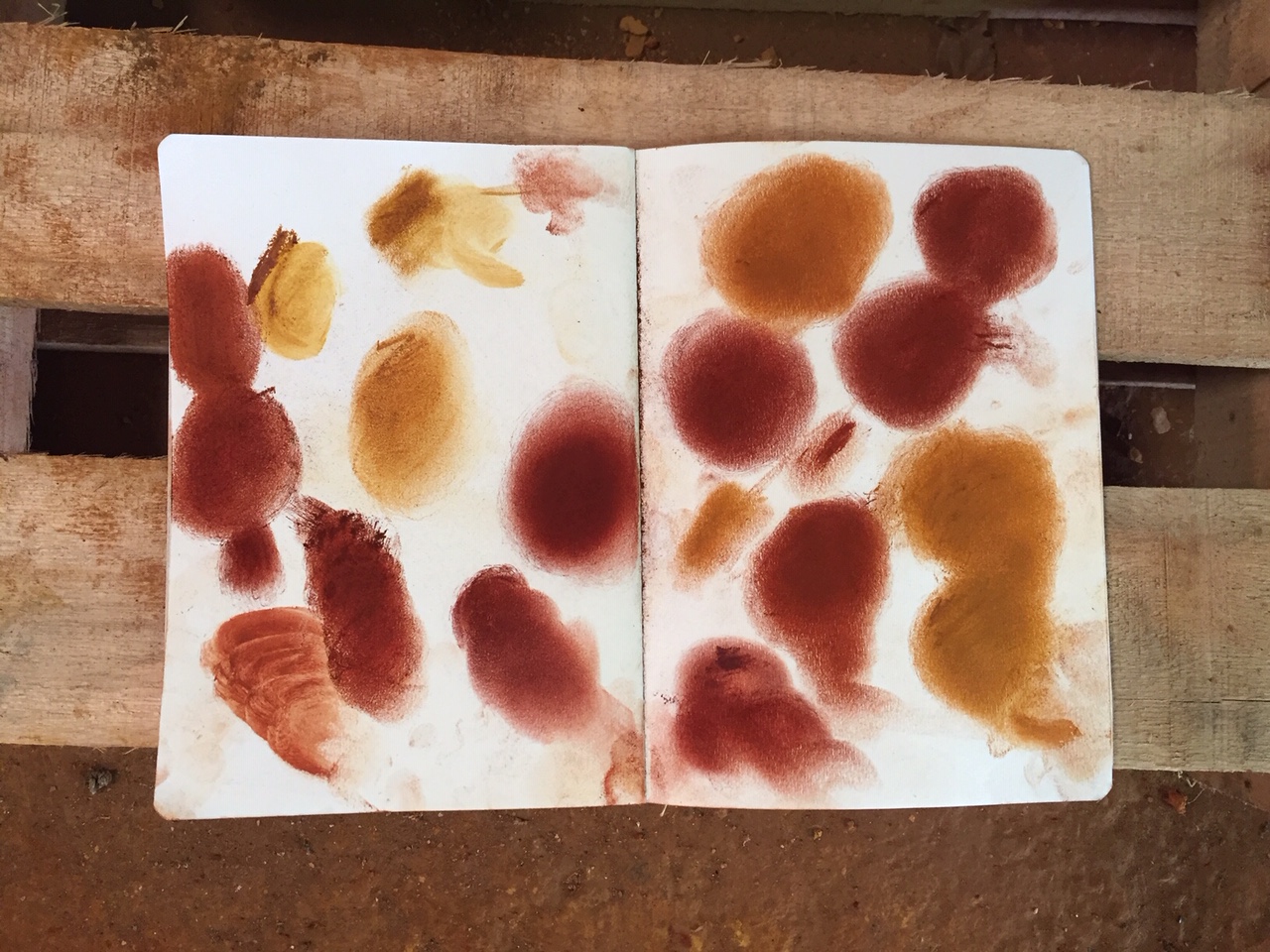 Sketchbook pages comparing burnt and raw ochre
Does the colour red heighten the symbolic significance of blood, rather than the other way round? Would blood hold the same power if it were grey the argument goes. This suggests the increasing frequency of burials using ochre over time corresponds with a growing capacity for perceptual colour categorisation and shared symbolic experience, and in the later Mousterian or middle Paleolithic period, with the acquisition of language.
Etymologically the relationship between red ochre and blood and between ochre and mothers comes signified in the Greek word haema or haima, as in haematite, which means blood. The relationship has been highlighted between the emphasis in the word haima and the most emphatic form in which basic root MA could be vocalized. The Greek Metra and the Latin Matrix refers to womb which has associations with the earth. It was believed for example that ores grew inside the earth like fruits, which is why many ancient cultures in diverse parts of the world associate the process of iron smelting with sex and reproduction, linking the furnace with the female body, and rituals conducted during the smelting process often involve the sacrifice of blood to the mine and to the earth.
The material’s transformability has played an important role in the evolution of human technologies over hundreds of thousands of years. The various theories relating to the consistent re-appearance of the use of ochre and specifically red ochre range from its visibility - its hue and saturation, to its associations with blood, life and rebirth. The red oxidised iron particles forming as bacteria first learned to harness the sun’s energy 2.8 billion years ago correspond with the earliest forms of life on this planet. Red, and specifically red iron, is a sign of life.
Watercolour Test Works
The Standard Test Method for Raw Materials is used to prepare pigments in watercolour and oil to show up comparative levels of transparency, opacity and hue. The recipe and method are very simple (see below) and I have used it on all 35 of the colours collected from sites across the UK.
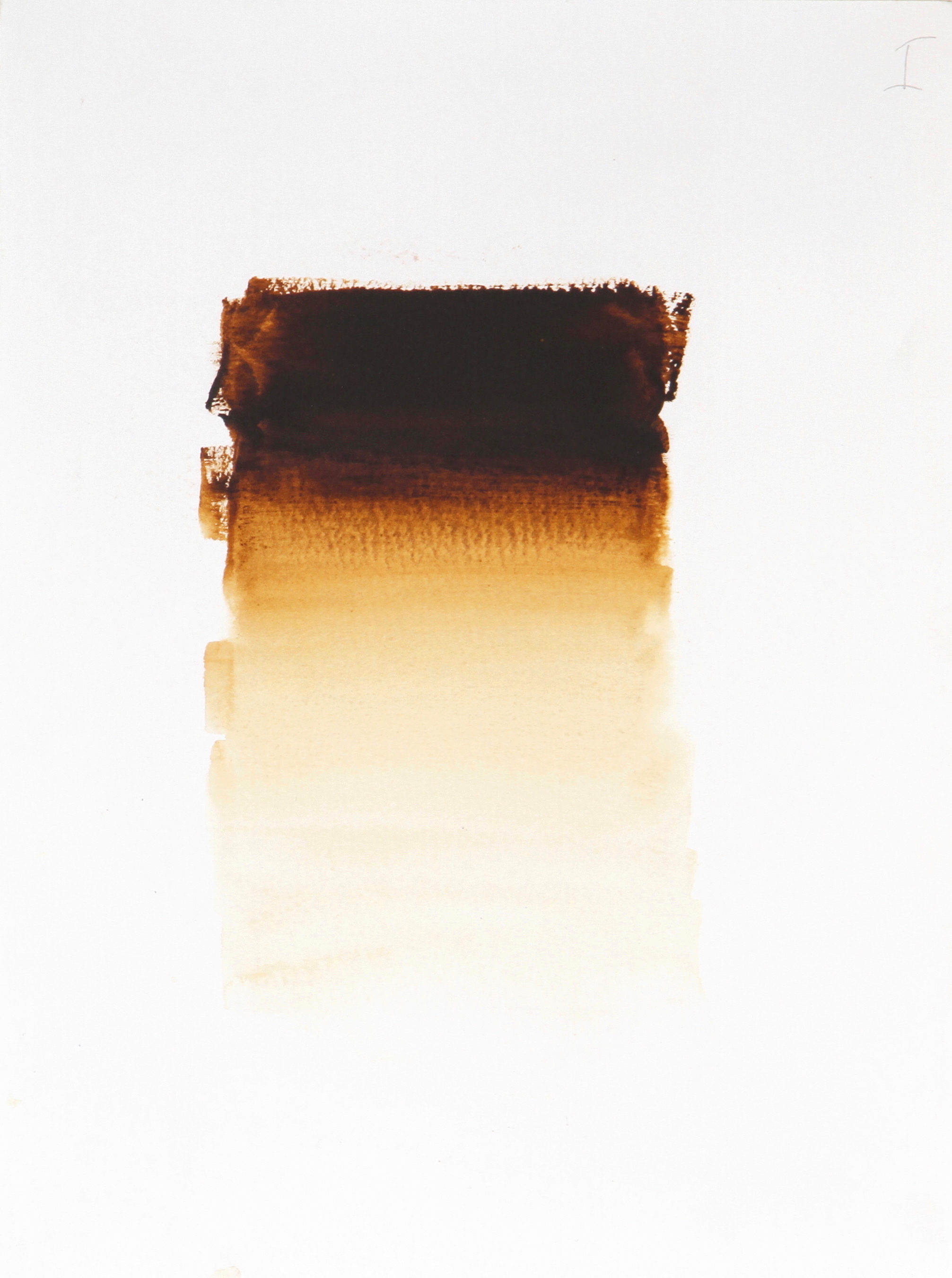
Six Bells raw ochre in gum arabic on paper
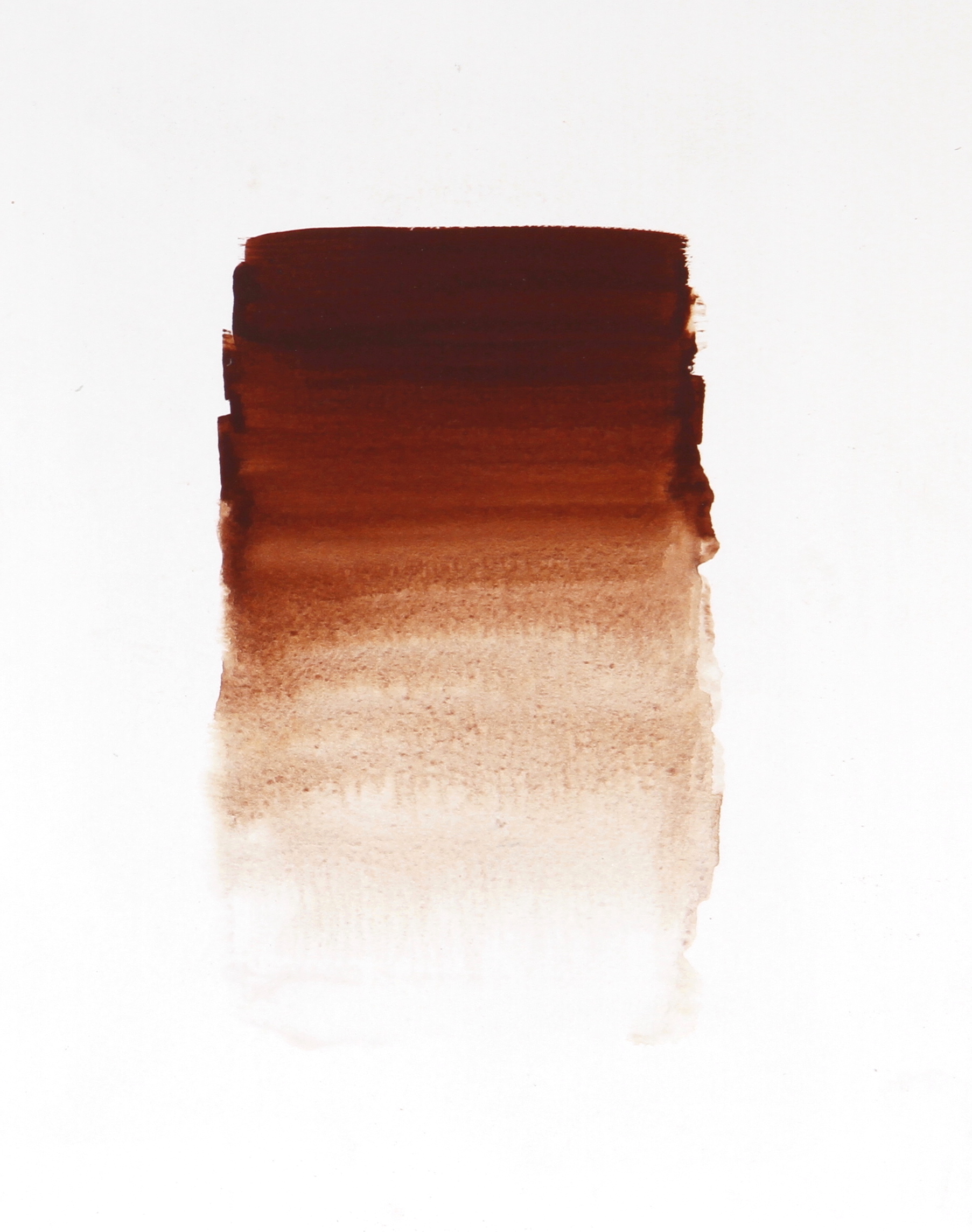
Tarn-y-garn raw ochre in gum arabic on paper
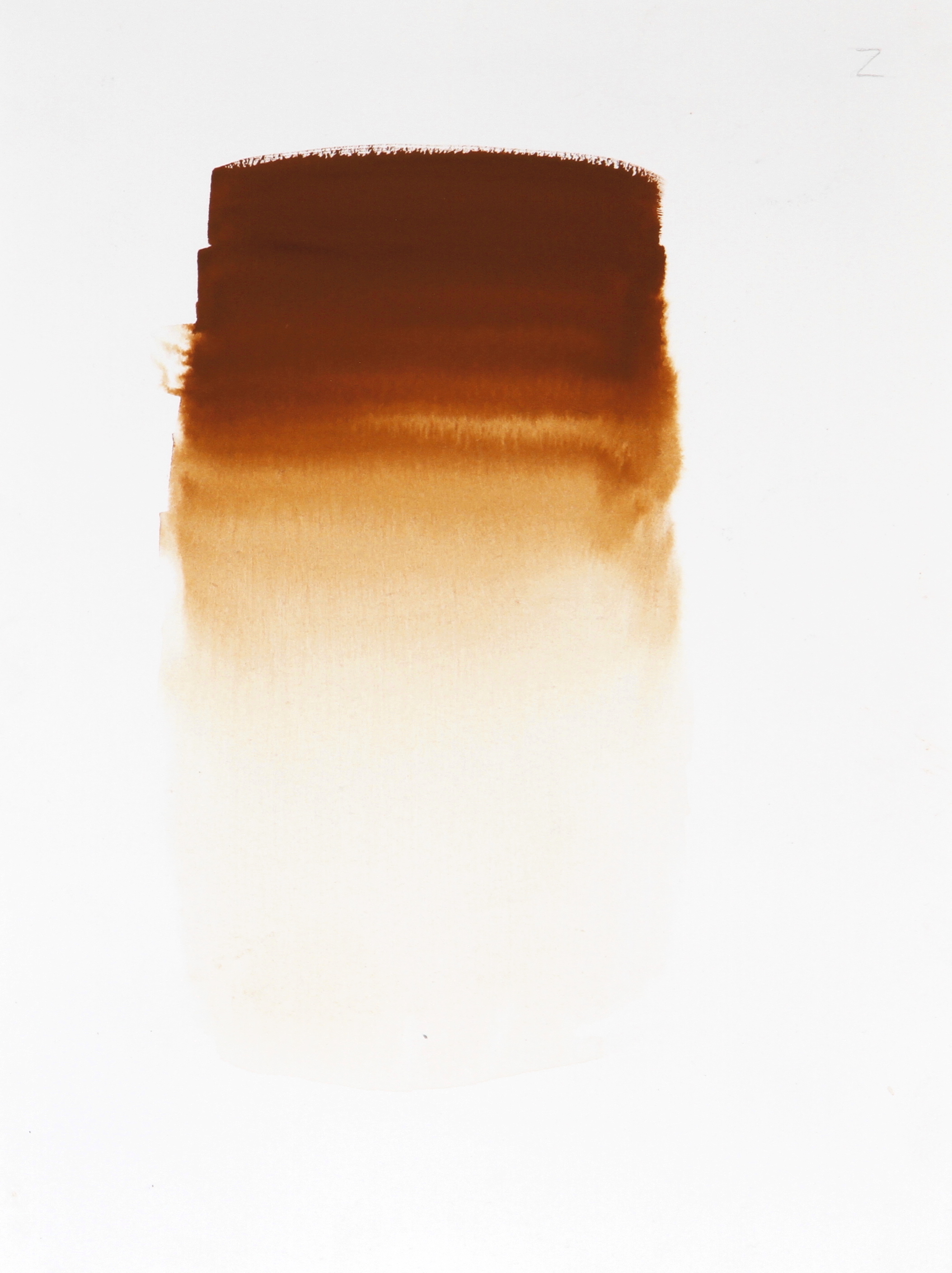
Cuthill raw ochre in gum arabic on paper
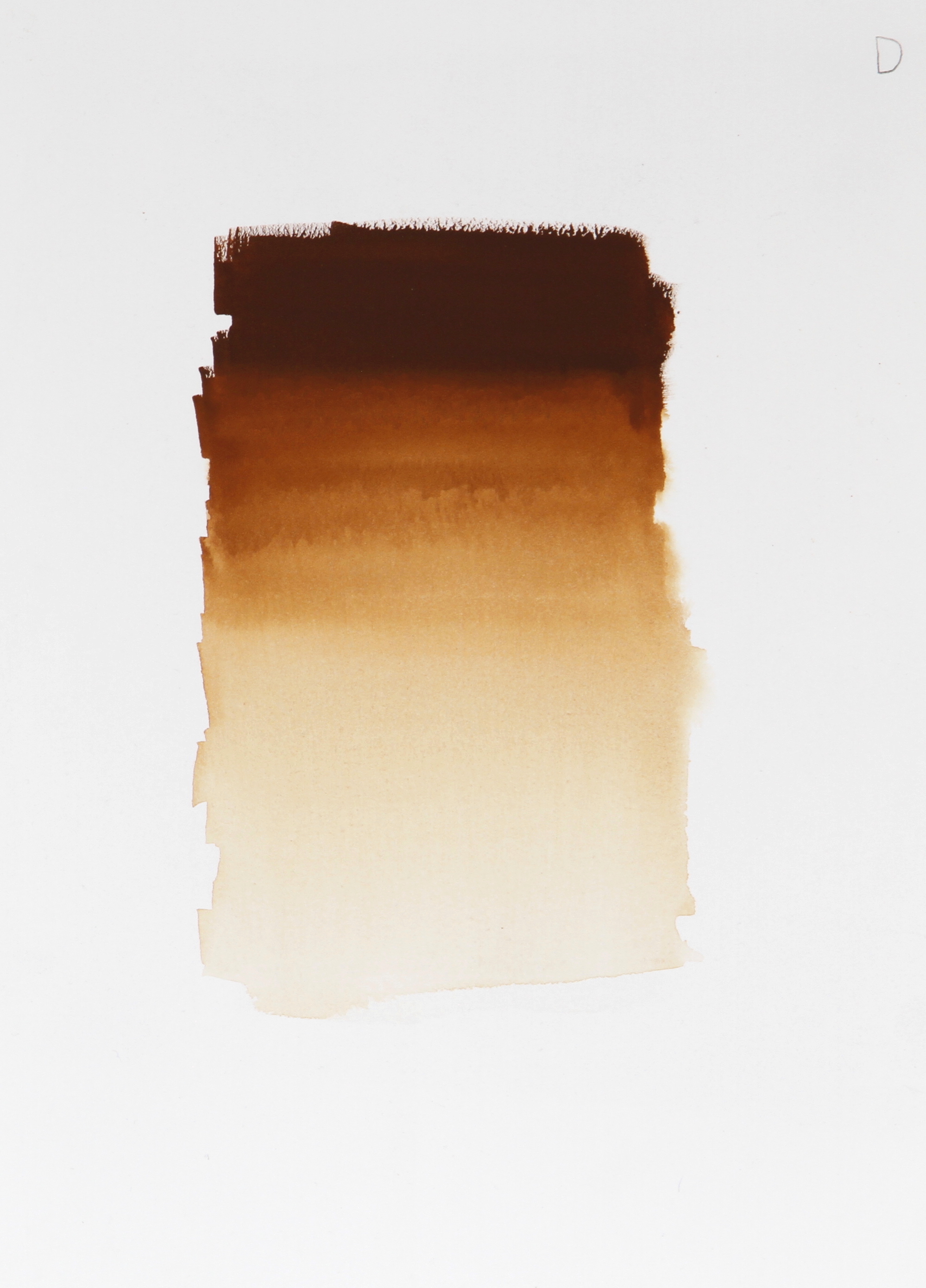
Caphouse raw ochre in gum arabic on paper

Saltburn raw ochre in gum arabic on paper
ColArt Standard Test Method For Raw Materials
Test Ref Number: Name of Test: Date and Status: Author:
Method 1
Pigments - Graded Wash Issue 2 October 2001 Jivan Patel
Purpose: To assess raw material quality for colour in water based systems.
Equipment required: Analytical Balance, Automatic Muller, Palette Knife
Method: Accurately weigh out the pigment to be tested. The quantity for individual pigments can be found under Raw Material Test Methods file in Datasys Formulations systems. (100ml)
Transfer pigment to the automatic muller.
Add 2 mls. of gum solution for RM Testing to the pigment.
Mix to an even paste with the palette knife.
Lower the muller plate and run for 25 revolutions without weights, scraping down between each series of cycles.
Make a graded wash as per test ref. Number 8 in the Quality Control Test Methods Procedure manual.
Findings:
Compare the graded wash with other washes from previous deliveries for colour variations
l
Preparing wall paintings
These works are part of an ongoing body of wall painting installations in different locations using different paint binders, processes and applications. The first of these works were installed in UCL cloisters in 2018 showing all five colours.

Cuthill Burnt ochre wall / Preparing wall painting at UCL, 2018
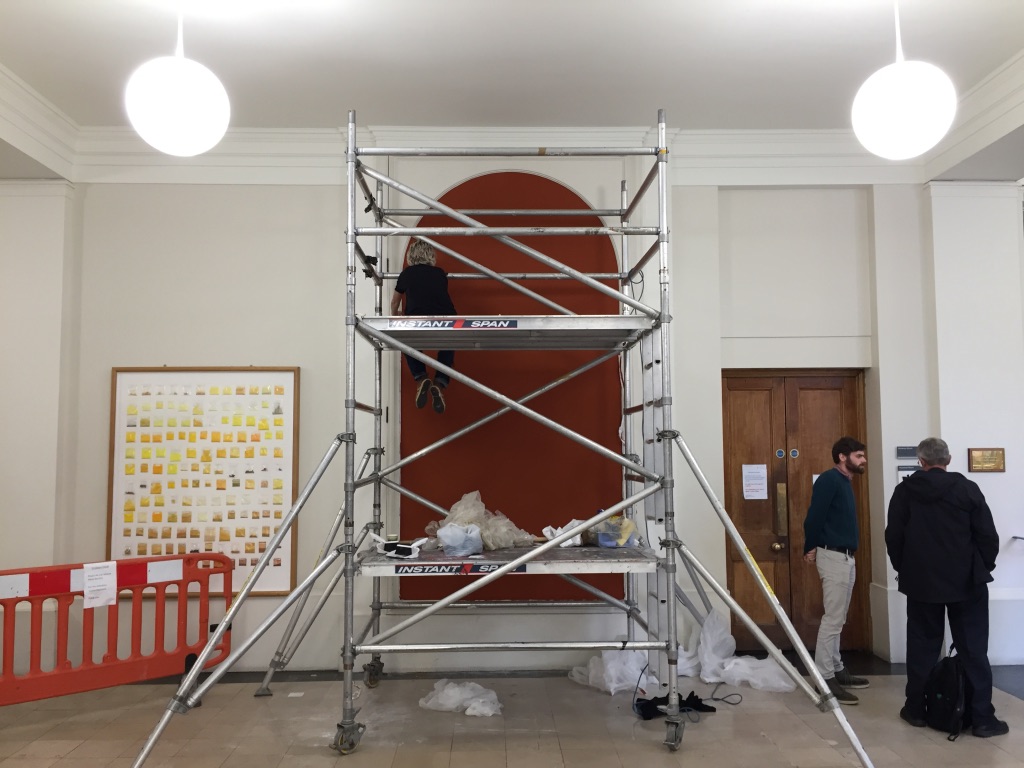
Cuthill Burnt Ochre wall / Preparing Wall painting UCL, 2018
 Cuthill. University College Locon North Cloister, 2018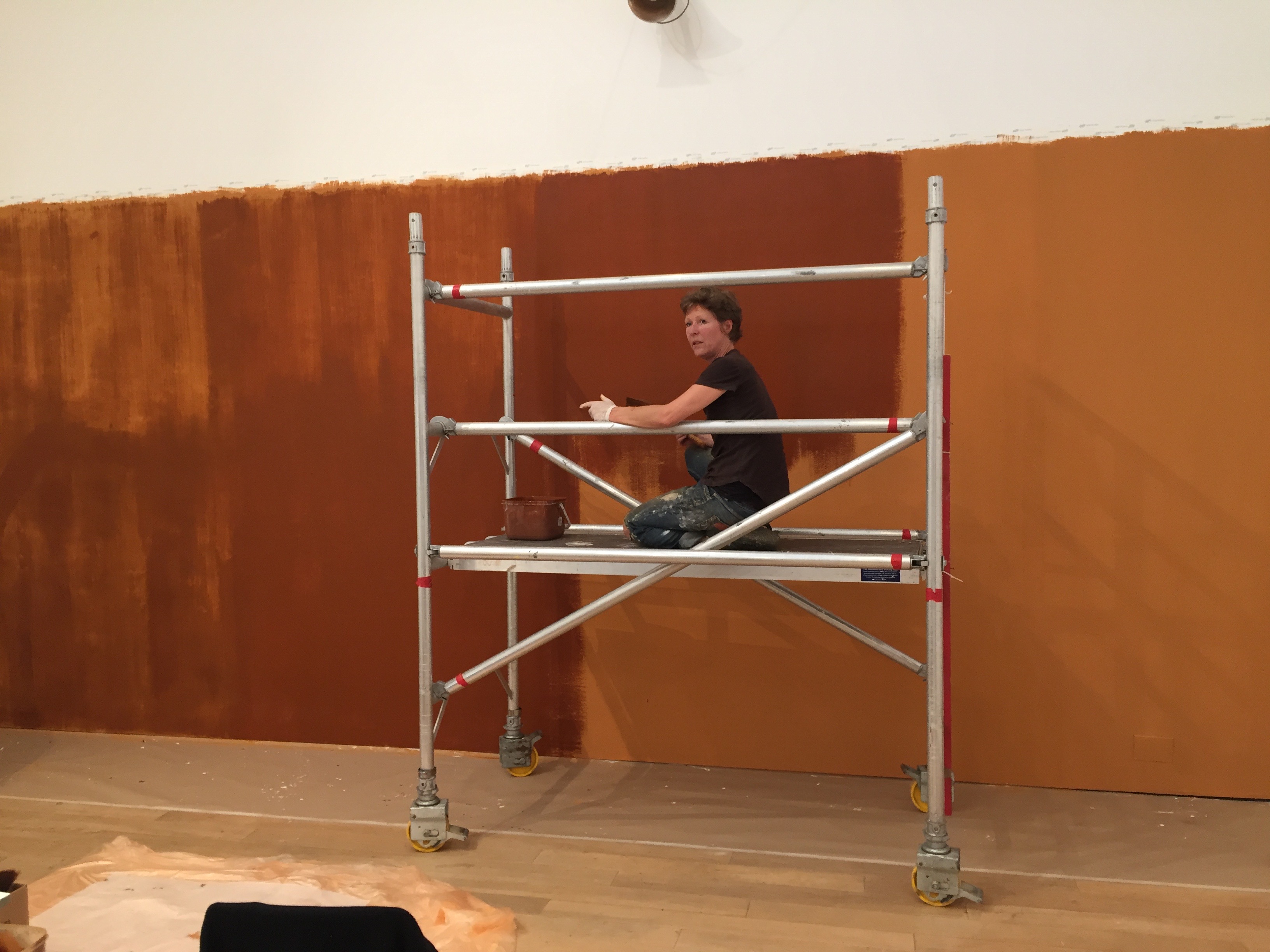
Wheal Jane Ochre Wall / Installation Europe After The Rain 2019
Wheal Jane
This installation was made at the Newlyn Gallery in 2019 for an exhibition curated by Simon Faithful Eurpoe After The Rain. The pigment for this work comes from Wheal Jane mine in Cornwall where in 1992 an internal collapse caused an outbreak and a major environmental disaster as mine water flooded Falmouth bay with toxic mine waste.
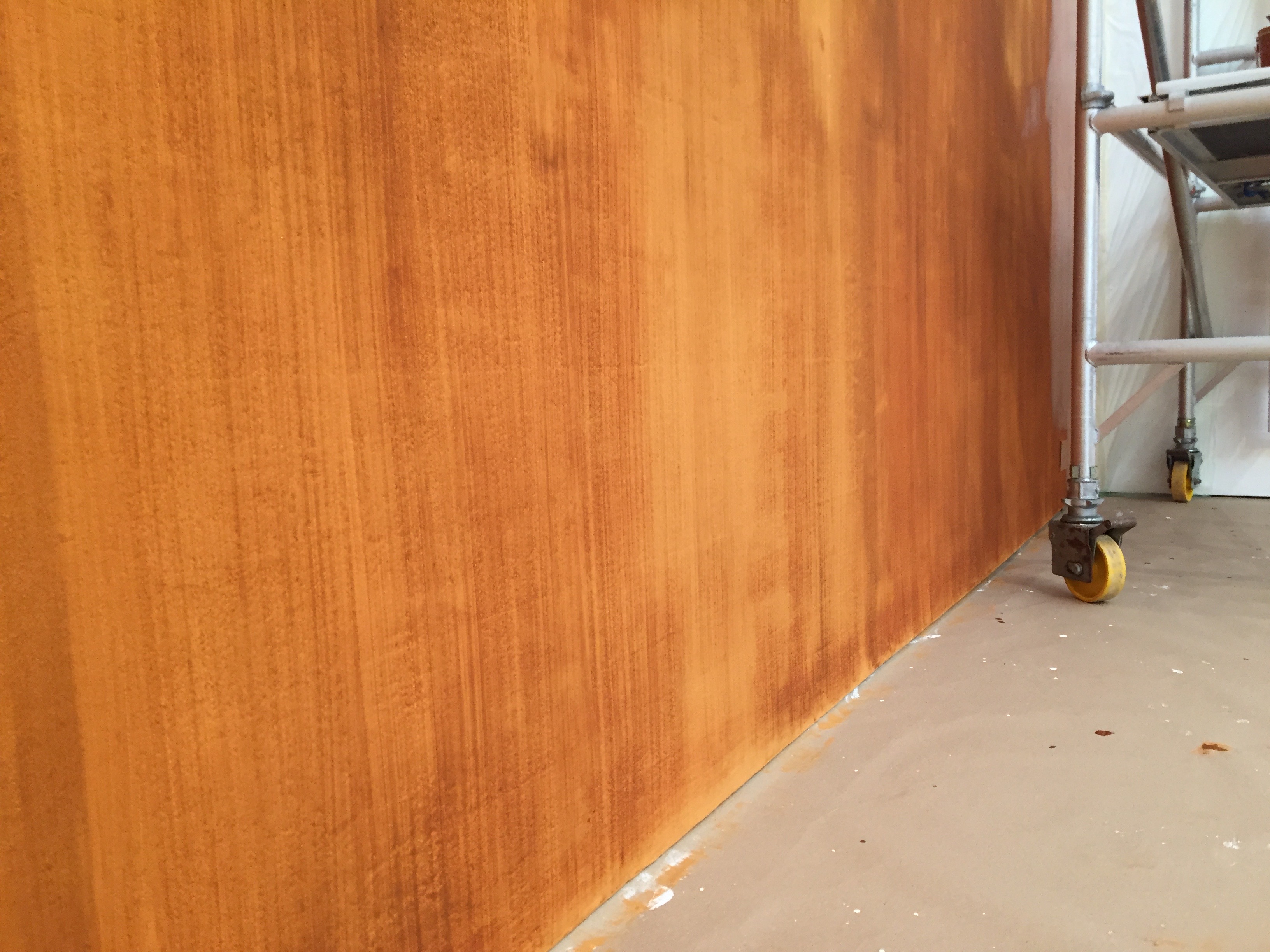
Preparation of ochre wall Newlyn Gallery Cornwall 2019
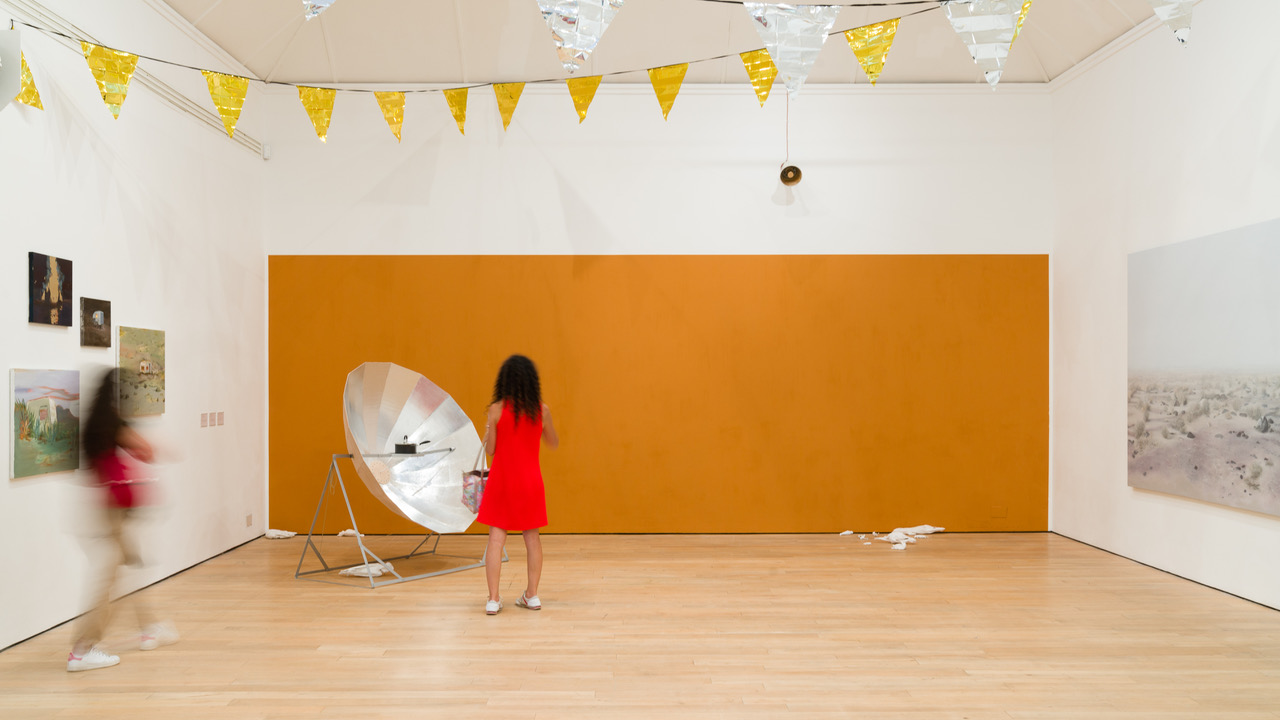 Wheal Jane/ Europe After The Rain, Newlyn Gallery 2019
Six Bells Red
A selected number of tins are available for larger scale community or public exterior wall spaces.
If you are interested in using the paint for this purpose please contact us for details.
A selected number of tins are available for larger scale community or public exterior wall spaces.
If you are interested in using the paint for this purpose please contact us for details.
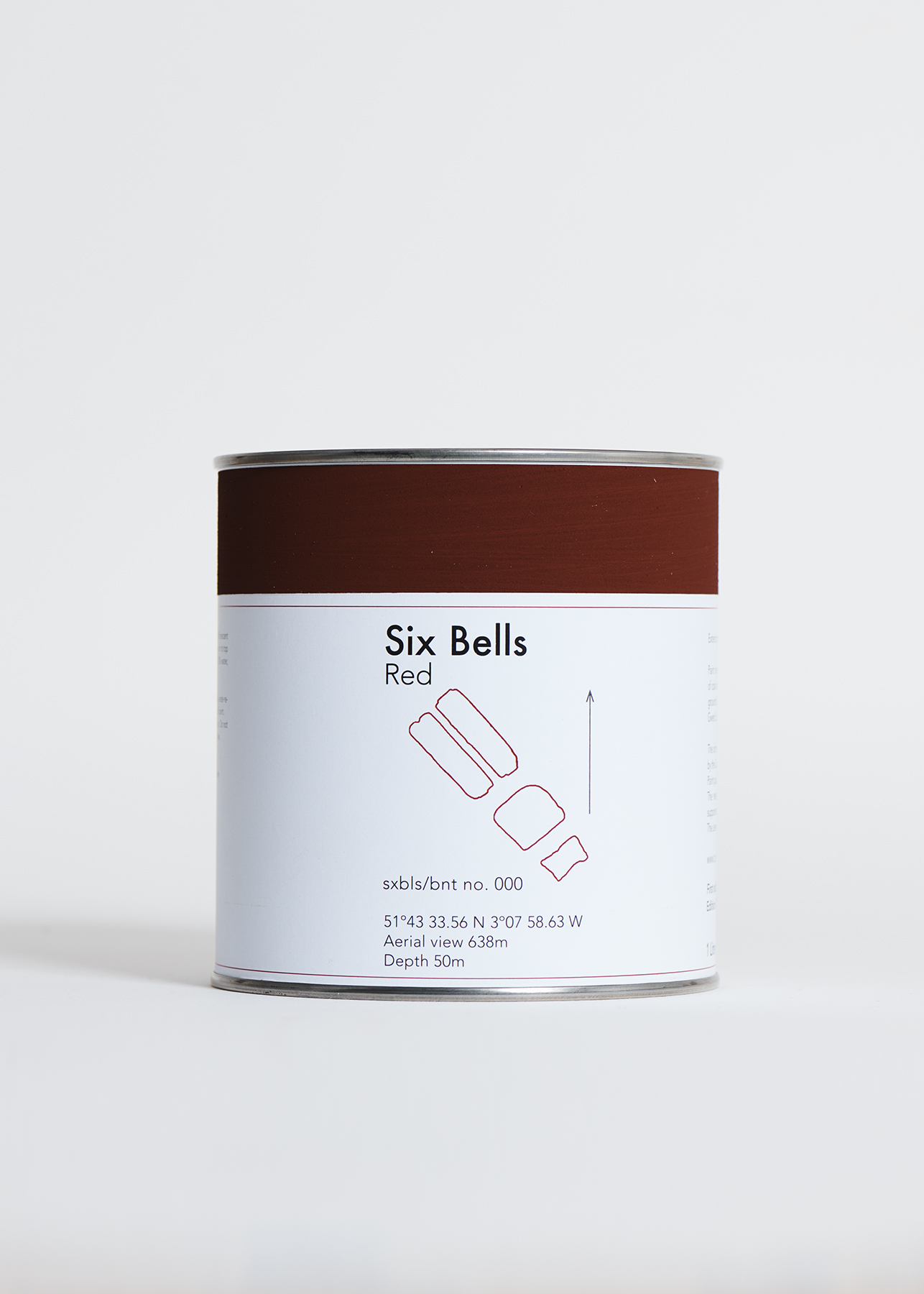
Six Bells Red (not currently available)
Mineral based exterior grade wall paint
1 Litre
Each tin comes individualy serial numbered 1-100
More information >>>
Mineral based exterior grade wall paint
1 Litre
Each tin comes individualy serial numbered 1-100
More information >>>
Six Bells Burnt Ochre (not currently available)
Artists’ oil paint
40ml
Each tube comes individualy serial numbered 1-1000
More information >>>
Artists’ oil paint
40ml
Each tube comes individualy serial numbered 1-1000
More information >>>
Six Bells Red
Mineral based exterior grade wall paint 1L
Six Bells Red is the first mineral based paint using 100% recycled residues forming as a result of the treatment of polluting mine water. The pigment has been burned to create a unique deep red colour and then combined with a mineral based paint binder to produce a new kind of paint which is environmentally responsible. The paint has a deep velvet matt finish and the light refraction gives the colour a richness because of the mineral chemical bonding process and the irregular pigment partical size.
Six Bells Red is combined with a mineral sol-silicate binding system and can be used on mineral surfaces such as concrete and render where it will chemically bond to the substrate, and it can be used on previously painted surfaces where it will mechanically bond to an existing paint coat. This paint is hard waring and can be use for exteriors and interiors.
The paint contains less than 5%VOC’s, and no solvents or petro-chemical derivatives so it does not give off any toxic gases and is non-combustible. Further info can be found on the Safety Data Sheet upon request.
The paint tin contains 1litre of paint which will cover 10 square metres with one coat or five square meters with two coats.
Some advice for applying the paint:
The tin will come with some advice about application, which slightly differs from regular emulsion paint. Such as always starting from a natural breakline and maintain a wet-edge at all times - don’t ‘cut in’ or work wet material into dry. Protect all surrounding surfaces and always remove splashes and spillages immediately as it has a slight etching effect if allowed to dry hard on glass or shiny surfaces The paint needs time to properly
chemically bond to the substrate and therefore it is important to let each coat dry for 12 hours, even if the paint appears ‘dry’ after only a few hours.
Six Bells Burnt Ochre
Artists’ oil paint
40ml tube
Each tube is individually numbered 1-1000
The pigment to make this paint has been recycled from waste ochre generated at Six Bells mine water treatment scheme. The pigment has been heated at a high temperature to change its colour from yellow to deep red. Then it has been mixed with linseed oil and put into tubes in Michael Harding’s paint factory in Cwmbran, South Wales. The name of the pigment was discussed with local residents who collectively agreed on the name with the addition of Burnt Ochre. It is completely unique to this place.


Past Events
Landscapes


Geevor, Cornwall
Text by Ruth Siddall, photograph Onya McCausland


Morvah North Pendeen, Cornwall (Salt Green)
Text by Ruth Siddall, photograph and painting by Onya McCausland

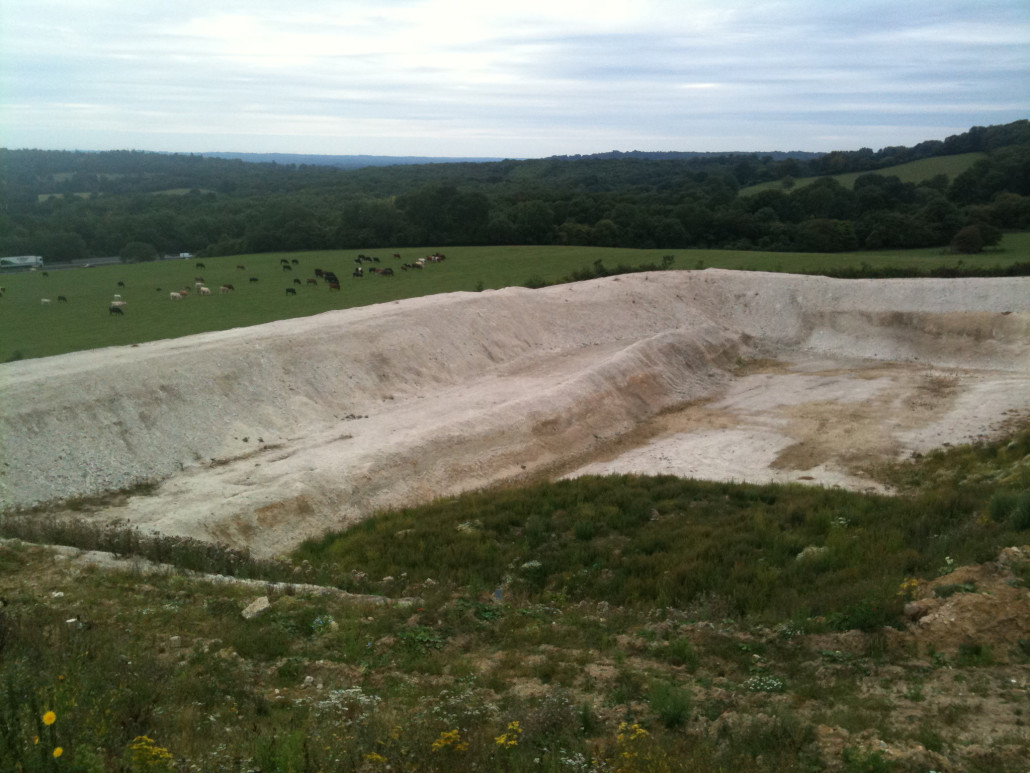
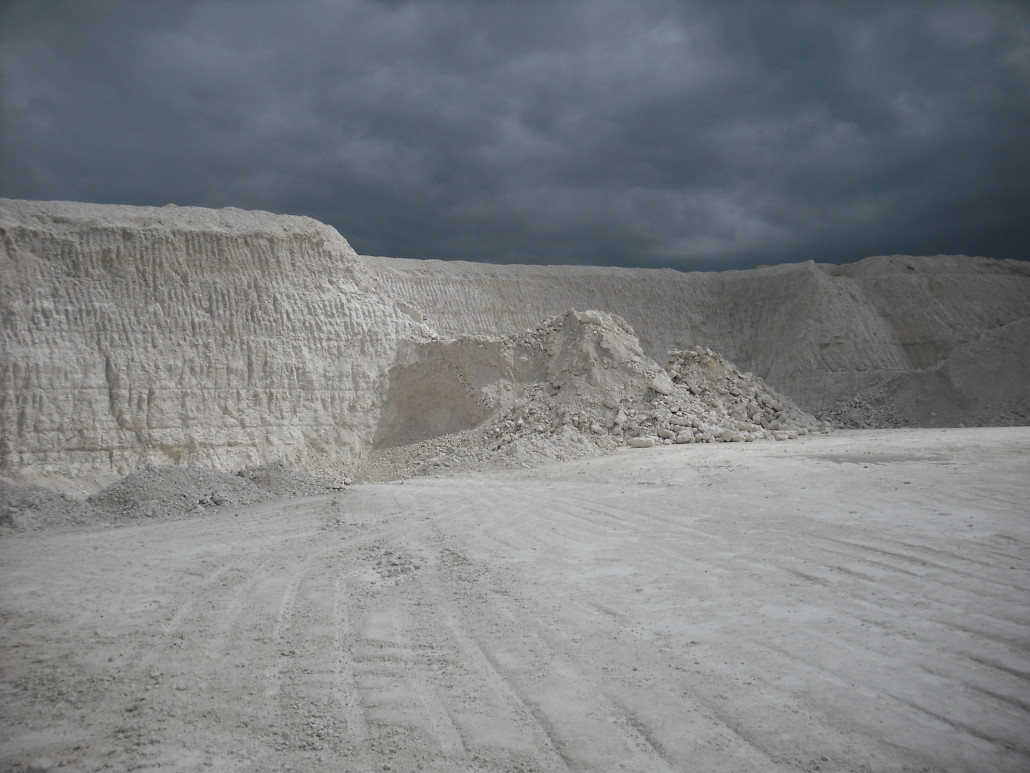

Oxted Quarry, Surrey
Text by Ruth Siddall, photograph Onya McCausland


Greencliff, Bideford, Devon (Bideford Black)
Text by Ruth Siddall, photograph Onya McCausland
Symposium in a Cave
Friday 15 April 2016


The Names of the Earths
Spike Bucklow ; Turning Landscape into Colour Limited edition artist book; Spike Bucklow, Ruth Siddall, Onya McCausland and Jo Volley. Slade Press. Provosts Small Grants Award. 2014
Earths
Attitudes towards earth have changed radically over time. The planet upon which we live was once the still centre about which the universe spun in harmony but ‘earth’ is now a tiny speck that hurtles around a star on the margins of one of countless galaxies. In the distant past, earth was venerated as the archetypal Mother, in more recent history she, or it, has been exploited as an apparently inexhaustible resource. More recently still, earth has become seen as an integral part of a potentially vulnerable ecological life-support system. Directly or indirectly, earth contributes to all aspects of life and, in many respects, earth’s contribution is now taken for granted.
So, it is not surprising that artists’ understandings of the painting material called ‘earth’ have also changed.
In art, parts of the earth have been acknowledged in the landscape tradition which harnesses vistas available on the surface. But the work presented here engages with what is beneath the surface and seeks to visualise a traditional use of earth in art, taking a contemporary approach to an established practice. The collaboration focuses on the extraction, preparation and incorporation of earth into the very substance of works of art and it connects with earth physically as well as visually.
Earths have been dug-out and used, either raw or burnt, to provided artists with colours, and paints incorporating earths have been in continuous use from at least 30,000BC.[i] Historically, the material was hewn from hillsides, usually in the autumn, the resulting boulders were crushed over the winter and washed through the spring, to be ground and allowed to dry through the summer. The timing of the processes took advantage of the seasons and was integrated with other agricultural tasks. The resulting powders could be re-washed, or ‘levigated’, to increase the intensity of their colour and burnt, or ‘calcined’, to change their colour. These processed earths were then used locally or transported, sometimes a considerable distance, as items of trade. In the European painting tradition, earth pigments have been mixed with lime for fresco, glue for distemper, egg for tempera, gum for watercolour, and with oils as well as more recently, acrylic.
Appropriately coloured earths are very widespread, ranging from yellows through reds to browns and including some intense purples and blacks. Burning earth turns the yellows into reds and can darken the browns. The dominant colouring matter in earths is iron, which comes in a variety of states and is generally accompanied by clays or quartz. The exact make-up varies due to the geographic origin and the pre-processing of the earth and accounts for their different colours and their opacity or transparency when used in paint.[ii] The yellow pigments contain iron oxide hydroxides, the reds are anhydrous iron oxides and the darker colours can contain significant amounts of manganese. Today, the more transparent pigments are called ‘siennas’, the opaque ones are called ‘ochres’ and the darker ones are ‘umbers’.
Names
This essay tries to uncover attitudes towards earth by examining the names by which artists knew these materials. But not all mineral colours that are dug from the earth are called earths. Where a mineral’s composition was exploited, as in a metal ore, it usually had a specific name, like cinnabar or vermilion. Where the mineral’s colour was particularly rare it also tended to have a specific name, as in lapis lazuli or ultramarine. These names provide insight into artists’ pigments so, for example, ‘ultra-marine’ literally means ‘over-seas’. Artists and patrons alike considered ‘ultramarine blue’ to be more exotic than other, local, blues and it cost ten times more than other, very similar looking, blue minerals.[iii]
Those mineral colours that actually are called earths – such as siennas, ochres and umbers – have always resisted classification. Twentieth-century reference works list more than twenty names for each of the red and yellow, natural and synthetic pigments,[iv] and more than fifty synonyms for the iron oxide-based pigments.[v] Historically, they have all been known generically as ‘earths’ as well as, specifically, by other names that usually allude to either the supposed geographic origin of the material or its colour.
Supposed geographic origins account for historic names such as ‘English red’,[vi] ‘Indian red’ and ‘Venetian red’, although not all materials described as such came from the claimed location. For example, a patent issued in 1626 mentions ‘Spanish brown’ which, despite its name, was ‘digged in the fforest of Deane’[vii] in Gloucestershire where natural earth pigments are still being produced today.[viii] Some pigments marketed under these names were even artificial colours with no identifiable geographic origin.[ix]
Most names do not fall neatly into geographic or colour categories. For example, ‘sinopia’ and its variants may refer to the Turkish city of Sinope, which according to different authorities was either the source of a red earth, the city through which the red earths of Cappadocia were transported,[x] or a generic term for red earths implying no specific origin. Alternatively, the name may be a variant on ‘cinabro’, or cinnabar, the natural ore for mercury which, because of its red colour, had obvious colour associations with the red earths.[xi] The Oxford English Dictionary suggests that, whilst sinoper could mean a red colour, a red earth or cinnabar, the latter use may have been the more usual sense.[xii] Still other names, like ‘rubrica’ and its variants,[xiii] as well as ‘haematite’,[xiv] further blur the boundaries between the geographic origins and the colours of earth pigments, as will be seen.
Medieval artists also knew that a pigment very similar to the red earths – rust – could be obtained directly from iron. A common waste-product from alchemical experiments was a purple-red iron compound known to alchemists and artists alike as caput mortem, Latin for ‘dead head’.[xv] From the seventeenth century onwards iron oxides were produced commercially by a variety of means.[xvi] These were marketed as ‘Mars’ colours and the prefix is still in use today for artificially-produced iron oxide-based paints. Naming an iron-based pigment after a planet provides a clue about the historic understanding of why different places had different coloured rocks and soils, Egypt’s earth being black, Libya’s red and Arabia’s pale, for example.[xvii]
The Mars colours acknowledge the traditional relationship between the planet Mars and the metal, iron. Different metals and stones on earth were said to be formed under the influence of different planets and stars in the heavens so, for example, the thirteenth-century Dominican, Albertus Magnus, said that the metal’s martial nature. Particularly pure deposits of iron oxide acknowledged this connection in the name haematite, literally, ‘blood stone’, which was used by both geologists and artists. It follows that particularly red earths were said to be found at the site of legendary battles.[xxii]
Ochres, Umbers and Sienna
The name of ochre is unambiguously related to a colour – it comes from the Greek for pale yellow.[xxiii] The name is therefore appropriate, if tautological, for ‘yellow ochres’, but a misnomer for ‘red ochres’ and ‘brown ochres’.[xxiv] It is a yellow (or red or brown) colour that comes from numerous different locations. For example, in the seventeenth century, John Smith wrote of ‘oakers’ extracted from the Shotover Hills near Oxford,[xxv] and Mary Beale, England’s first professional female painter, used ‘Bury Ochre’ from near Bury St Edmunds in Suffolk, close to her birthplace.[xxvi]
On the other hand, umbers are now commonly assumed to be earth pigments that come from a single locality – the Umbrian region of Italy. However, the existence of ‘Cyprian umber’, for example, suggests that the pigment’s name does not primarily refer to a place, since the same material cannot come simultaneously from both Cyprus and Umbria. Cyprus now accounts for about 80% of all artists’ umbers,[xxvii] but in 1821, Roberson, London’s premier fine art supplier, made paint from ‘English Umber’.[xxviii]
The most probable origin of umber’s name is not Umbria, but the Latin ombra, or shadow.[xxix] An Italian painter used the term terre d’ombre, or ‘earth of shadows, for a pigment that could be used in dark painting passages. This was translated by an English doctor as ‘umber’.[xxx] In two plays also written in or around 1599, Shakespeare used the word as both a material substance and as an optical phenomenon. Using the word to refer to a material in As You Like It, Celia said she would disguise herself ‘…in poor and mean attire / And with a kind of umber smirch my face’.[xxxi] But, in Henry V, troops had ‘umbered faces’ on the eve of battle not because they were smeared with the earth of Umbria, or of Agincourt, but because they were shadowed by flickering pre-dawn camp-fires.[xxxii] So at the beginning of the seventeenth century, umber meant both a shadow and a material with which shadow-like effects could be produced.
Sienna’s name relates to neither the colour of the material, like ochre, nor the colour of the paint passages to which it can contribute, like umber. According to the Oxford Dictionary of English Etymology, siennas are earth pigments from Siena.[xxxiii] This city may indeed have been the site of quarries and mines that produced earth pigments. Winsor and Newton obtained raw sienna from a mine south of the city until 1988, but more recently the company obtained the pigment from Sicily and Sardinia.[xxxiv] Today, the pigment is a synthetic transparent iron oxide known as Mars Yellow or, somewhat less poetically, PY42.
Evidence suggests that, through the nineteenth and twentieth centuries, most earths used in English artists’ paints were derived from Italy, Southern France and Cyprus. More far-flung sources, such as those in the Americas and Australia, etc, have not been widely used by European artists in spite of the voracious European exploitation of these sources for iron and steel and the local use of the same raw material as a pigment in indigenous art.[xxxv]
Sienna’s name may indeed reflect one of the pigment’s possible origins. Yet, from the nineteenth century, artists’ paints have been manufactured in batches of tens or hundreds of kilos. The composition of small-scale European geological deposits varies considerably even with very limited localities. It is therefore very unlikely that exactly the same sources of earth were used for each batch of paint – in order to maintain colour consistency, earths from a variety of sources have to be blended.[xxxvi] Sienna has no geographical qualifiers – there are no Cyprian, English or Bury siennas, as there are ochres and umbers – sienna’s only qualifiers relate to its colour, ‘raw’ for yellow and ‘burnt’ for red. The artists’ material is not related to a particular place, so, why call it sienna? And why, when other locality-based names like ‘Cologne earth’ have fallen from favour, has sienna’s name stuck?
The city of Siena was not famed for any particularly bloody battle, yet such a legendary explanation for the colour of its earth is unlikely since the first use of the name is in the mid-eighteenth century. This dates the invention of the name to after the demise of the quasi-mythical lapidaries (medieval encyclopaedia devoted to the origins and properties of stones) and puts the name firmly within the period in which geology was developing as a rational discipline.[xxxvii]
A mid-eighteenth-century English-speaking person with an interest in painting would have known the city of Siena – by reputation, if not first-hand experience – through the Grand Tour. The Tour was an institution in which the rich would visit the continent, and especially Italy, to gain exposure to culture for a matter of months or years, and by the time the pigment’s name was committed to print, the Tour had been established for over a century. It could be argued that naming the earth after the city enabled the pigment to bask in the city’s glory and one might speculate that the colour’s name will endure so long as the city remains a popular tourist destination amongst those interested in art. The suggestion that sienna’s name has broadly cultural – as opposed to strictly geographical – significance is reinforced by the observation that English names for earths that pre-date the Grand Tour tend to allude to English, Spanish or German rather than Italian origins.
It follows that a painter who has sienna on their palette has a nominal stake in an artistically-rich city or region in North Italy. Of course the amount of territory the painter acquires when purchasing the pigment is too small to build a villa on, but the physical acquisition of symbolic quantities of earth has a long history. For example, in the fifth century before Christ, Herodotus relates how Xerxes, King of Persia, demanded tributes of a handful of earth (and water) from the Greeks. Some Greeks gave earth as a token of submission but the Athenians, who did not, had their land and city devastated by the Persians.[xxxviii] Closer to home, Moot Hill in Scone, Perthshire, (previously known as the ‘Mount of Belief’[xxxix]) is a ceremonial mound that was said to have been made by handfuls of local earths brought by generations of chieftains to demonstrate the allegiance of their home territories to the Scottish king. A similar but more recent coronation ceremony is documented in Hungary. In the medieval period, artificial mounds of token earths grew in Székesfehérvár, during Ottoman occupation, in Bratislava, and then Budapest. In the twenty-first century, the Bratislava mound was moved and soil from every EU country was added to turn the old ‘Coronation Hill’ into the new ‘Integration Mound’.[xl]
Token tributes of transported earth acknowledge the profound connection between a people and the soil upon which they live. The concept is not restricted to conquering emperors or bureaucrats. It is also found in literature, so in the nineteenth-century, Bram Stoker had his fictional creation, Dracula, transport fifty boxes of his native soil in order to sustain himself whilst attempting to conquer England with the living-dead. The significance of Dracula’s transported earth was reinforced by the ship in which it was conveyed. The ship was named after the Greek earth goddess, Demeter.[xli]
Geo-political practices such as those of Persian and Scottish kings and Hungarian Eurocrats, as well as stories like Bram Stoker’s, are variants on the universal belief in the life-giving (or at least, un-dead-giving) connection with Mother Earth. They are institutional and fictional expressions of myths, such as the story about the apparently invincible Antaios, who could only be vanquished by Hercules when lifted into the air and thus physically separated from the earth.[xlii]
The English eighteenth-century painter’s name for the pigment sienna suggests an echo of the mythological significance of retaining contact with the soil of a particular locality. By using a pigment called sienna, a painter makes a nominal connection between his or her work and the earth upon which Duccio, Simone Martini or the Lorenzetti brothers walked.
Etymology
Ochre, umber and sienna are highly specialised technical words and they have limited circulation outside the artists’ workshop. They are all relatively new and their derivation is relatively simple.[xliii] On the other hand, older and more general words have much more complex derivations and, in the sense of a substance that is found underfoot, there are many different words for earth.[xliv]
According to Plato, ‘everything has a right name of its own’,[xlv] which may or may not correspond to the name in general usage, and the tradition that words have inherent – as opposed to merely conventional names – is also found in the Bible.[xlvi] Determining the ‘right’ name was the task of etymology, a word derived from etumos and logos, Greek for ‘true’ and ‘word’. Etymology is now practiced in two distinct modes, historical and semantic or poetic. The so-called historical mode traces the development of words noting, for example, the connection between the sounds ‘de’ and ‘ge’ that links the names of two Greek goddesses associated with earth – Demeter and Ge or Gaia.[xlvii] Such historical etymology is a relatively modern practice, and over the period in which the names of the earths were developing, the vast majority of etymology was of the semantic or poetic type.
Semantic or poetic etymology has been defined as a technique for ‘rescuing the text from prescriptive or reductive interpretations, without deforming it’ such that ‘what the name buries…the etymology animates or exhumes.’[xlviii] This has evident value in a biblical context,[xlix] and parallels have been drawn between semantic etymology and the practice of magic.[l] Plato’s Cratylus and Isidore of Seville’s seventh-century Etymologies, elaborate semantic etymologies and both texts had wide and enduring influence,[li] with exactly the same general pattern of word-interpretation being followed, for example, in Chaucer’s Canterbury Tales.[lii]
Earth
The word ‘earth’ comes from the Greek for ‘on the ground’. However, most interpretive etymology involves the names of to ‘the upper surface which is worn away (terere)’, whilst the lower material was ‘soil (humus)…or moist (humidus) earth’. The ground was called ‘ground (tellus) because we carry away (tollere) what it produces.’[lvi] The upper surface of the earth can be worn away with wind as dry dust but it is the lower, humid, earth that is dug-up and carried-off to make pigments for painters.
Plato acknowledged that the semantic connections in Greek may owe something to older languages and could be obscured by changes in language over time.[lvii] He related the word earth to ‘mother’ through the already ancient earth goddess.[lviii] In Ge or Gaia, the prefix ‘ge’ relates to modes of creation, and the idea that the earth ‘gives’. The prefix ‘ge’ survives in English words such as ‘geology’, the science of the earth, ‘geography’, the practice of drawing the earth and ‘geometry’, the origins of which were measuring the earth.[lix] Exactly the same prefix is also found in words that relate to maternal expressions of giving, such as giving birth. Obvious examples include ‘genitals’, ‘genetics’ and ‘genealogy’ with less obvious examples including ‘gentlemen’ and ‘gentry’ as classes of people who enjoy particular birth-rights. The earth has always been seen as ‘generous’, which means ‘of noble birth’.[lx]
Birth from the soil and birth from sexual activity are connected in the story of man’s creation from the earth and the connection between the first man’s name and earth, ‘Āḏām and ‘aḏāmah respectively, in Hebrew.[lxi] Greek mythology had the same with Hephaestus’ creation of man’s companion, Pandora, from earth mixed with water.[lxii] So, with reference to Latin, Isidore was following a long tradition when he declared that ‘humans’ are so-called ‘because they were made from the soil (humus)’.[lxiii] The profound connection between sex and agriculture is evident in the word ‘husband’. This title derives from being ‘house-bound’ in a legalistic, rather than a disabled, sense and what binds the husband to the house is the bed and the land. As a noun, it means a man joined to a woman, and as a verb, it means to till the soil.[lxiv] The link continues with twentieth-century slang such as to ‘have your oats’ or ‘sow wild oats’.[lxv]
Humans may be made of humus, but to be more precise, humans are traditionally made of a body and a soul, the soul being the immortal ‘sign’ of the person and the mortal body, a temporary ‘tomb’ for the soul.[lxvi] Earth is connected to the body, the exterior part that entombs the soul,[lxvii] and so relates not only to birth, but also to death. The earth’s double role – as something which both gives and receives – was noted by Shakespeare’s Friar Lawrence who played upon the earth as the ‘womb’ and ‘tomb’ of all material things.[lxviii] As Isidore said, ‘Each element [of our body] has its own physical part, something of which must be repaid [to the earth] when the composite dissolves.’[lxix] The connection is reinforced in the Book of Common Prayer with the phrase ‘earth to earth’, which is invoked upon the body’s internment and which echoes the Neolithic burial ritual of scattering red ochre over the deceased.[lxx]
Mother Earth’s ability to absorb her pro-gen-y was necessary in order to re-gen-erate and maintain her productive capacities. This aspect of burial is also reflected in the names of earth goddesses since the linguistic root of both Gaia and Demeter ‘frequently occurs in the context of hiding or covering things (or people)’.[lxxi] And earth itself was used to cover or hide things, for example, contemplating death, Hector wished to ‘hide’ and Achilles wished to ‘cover’ their bodies with earth.[lxxii] As well as covering or hiding the bodies of the deceased, earth envelops the roots of the plants, the subterranean regions, like Hades, and secreted riches, like gold.
Earth’s roles as both the support for visible life and the hidden abode of death are reflected in other artists’ names. So, for example, Cennini’s haematite and the colour ‘red’ are both related to blood, since red is rudhirás and blood is rudhirám in Sanskrit.[lxxiii] The red earths, and gemstones such as ruby,[lxxiv] were therefore associated with Mother Earth’s life-giving menstrual blood, as well as the individual’s life-blood that martial forces send back to earth.
Finally, one other meaning of the word ‘earth’ should be acknowledged. In the biblical and classical phrase ‘heaven and earth’, earth is half of all reality. This meaning relates especially to ‘umber’ through the Neoplatonic significance of shadows. At the time when Shakespeare used the word umber to mean both a shadow and a material that could emulate shadow, heaven was seen as an eternal reality and earth was its passing shadow. Heaven was the model and earth was its approximate copy.[lxxv] So, in addition to the literal darkness cast by light, shadow could also mean; a reflection, a representation, an image or a painting.[lxxvi] Painting with ‘umber’ is using a copy to create a copy of a copy.[lxxvii]
Matter and colour
Painting with ‘sienna’ merely uses the matter that Duccio’s feet may once have touched. Painting with ‘earth’, on the other hand, is painting with the matter of which, according to myth, all humans are made and the matter with which a significant proportion of all reality is hidden. And, as a thing that hides, earth etymologically reinforces the activity of painting since painting involves the application of colour. In turn, the word ‘colour’ is related to the Latin celare, to cover or conceal, making the colour of something merely its ‘outward show’. [lxxviii]
The stated purpose of semantic or poetic etymology (also achieved indirectly by some historic etymology) is to penetrate the ‘outward show’ of words and to reveal their essence. The etymology of ‘colour’, for example, helps account for the long-held view that some aspects of painting were considered superficial or deceptive. This is one of the reasons why colour has been relatively neglected in the history of art and why, whilst designo and colore are both necessary in painting, they have not always enjoyed equal status. When both were personified as feminine, colore was ‘bawd’,[lxxix] and when one was male and the other female, colour was said to be of secondary importance simply because it was feminine.[lxxx]
The matter that provides colours has been even more neglected. And in the case of the earth pigments, this is in complete accordance with the etymologies outlined above. The word humus shares the same root as ‘humble’, meaning to make lowly, as in humiliate, or to be lowly, as in human.[lxxxi] (Man is lowly with respect to the divine, since, according to Plato, the name of ‘man’ derives from to the Greek for ‘to look up’.[lxxxii]) The lowly earth pigments reflect the lowly status of matter – derived from mater, the trunk of a tree, or the mother of its limbs, branches and leaves – which, in European cultures, is deeply engendered, being related to ‘matriarch’ and ‘matron’.
If the design is the masculine side of a painting, then the materials are its feminine side. The earth pigments are parts of an earth goddess – Ceres, Proserpina, Demeter, Ge or Gaia – hewn, crushed, washed, ground and transported to become the humblest parts of the humblest aspect of a painting. And in this respect, it could be argued that the city of Siena has qualities that are appropriate for the name for a humble earth. After all, thanks to the Grand Tour, Siena became famous as a city of Renaissance art. ‘Renaissance’ literally means ‘re-birth’ but the original out-poring of art in Siena was due to its cult of the Virgin, the mother who in the European tradition most profoundly personifies humility.[lxxxiii] Of course, few earth pigments actually come from Siena and local earth – which lacks the prestige of exotic origins and is usually anonymous or misleadingly purveyed under more a more exalted name – is automatically humble.
Conclusion
This essay’s focus on an apparently insignificant detail – artists’ names for earth pigments – is an exercise in ‘microhistory’. The historian Luis Gonzalez called this style of cultural analysis ‘matria history’. He described it as a practice ‘suitable to evoking that small, weak, feminine, sentimental world of the mother which revolves around the family and the village’. He also called microhistory ‘yin history’, saying that is recalled all that is ‘feminine, conservative, terrestrial, sweet, obscure and painful’.[lxxxiv] A microhistory of earth’s names therefore reveals glimpses of deep-set cultural attitudes towards one of artists’ oldest materials. The pigment’s names are linguistic fossil-records of the ‘feminine, conservative, terrestrial, sweet, obscure and painful’ place these materials held when part of ‘the family and the village’. That significance was largely lost when the production of artists’ materials became a mainly urban industrial process, although faint echoes live-on in local place names and practices.
The whole earth’s trajectory, from venerated goddess to exploited resource, is reflected in earth pigments’ use in art. Earth pigments were once acknowledged as empowered – and empowering – parts of a goddess but their ritual significance has been forgotten.[lxxxv] And, further distancing us from earth, some of the pigments have now been replaced by man-made substitutes.[lxxxvi]
So it is not surprising that the natural pigments explored in this collaboration do not have particularly revealing names – they are just local ‘earths’. The work presented here aims to reclaim some of their values. The raw materials are unrecognised parts of the English countryside and they are not even necessarily from picturesque parts of that countryside. The earths that are physically present in these screen-prints are just ‘Other’, in keeping with the origin of the word ‘country’, which comes from contra, literally ‘against’ or ‘opposite’.[lxxxvii] These contra-pigmented prints are reminders that their matter and colour belonged first to nature before becoming part of culture. Earths grow-up in the wild before taking-up residence in art.
References
[i] M.-P. Pomiers, M. Menu and C. Vignaud, ‘Red Palaeolithic pigments; natural haematite or heated goethite?’, Archaeometry, 41, 1999, pp. 275-85.
[ii] K. Helwig, ‘Iron Oxide Pigments: Natural and Synthetic’, in Artists’ Pigments, vol. 4, ed. B. Berrie, National Gallery of Art, Washington, and Archetype, London, 2007, pp. 39-110.
[iii] S. Bucklow, The Alchemy of Paint, London, 2009, pp. 43-74.
[iv] Colour Index, 3rd ed., Society of Dyers and Colourists, Bradford, 1982.
[v] W. Gardiner, Chemical Synonyms and Trade Names, 7th ed. London, 1971.
[vi] Plusiers Secrets de Peinture, (VII, 23) in M. P. Merrifield, Original Treatises on the Arts of Painting, New York, 1967, vol. 2, p. 810.
[vii] R. D. Harley, Artists’ Pigments, c.1600-1835, London, 1982, pp. 119-120.
[viii] Clearwell Colour, Clearwell Caves, nr. Coleford, Royal Forest of Dean, GL16 8JR.
[ix] L. Carlyle, The Artists’ Assistant, London, 2001, p. 506.
[x] Theophrastus, On Stones, tr. E. R. Caley and J. C. Richards, Columbus OH, 1956, pp. 175-8.
[xi] Cennino Cennini, (XL), The Craftsman’s Handbook, tr. D. V. Thompson, New York, 1960, p. 24.
[xii] Oxford English Dictionary Online version, accessed June 2012.
[xiii] Theophilus, On Divers Arts, (xxx), tr. J. G. Hawthorne and C. S. Smith, New York , 1979, p. 14.
[xiv] Cennino Cennini, Op cit., (XLII), pp. 25-6.
[xv] See for example, de Mayerne, BM MS Sloane 1990, cited in Harley, Op cit., p. 121.
[xvi] Helwig, Op cit., p. 46.
[xvii] Herodotus, The Histories, (II, 12), tr. R. Waterfield, Oxford, 1998, p. 99.
[xviii] Albertus Magnus, Book of Minerals, (II, iii, 4), tr. D. Wyckoff, Oxford, 1967, pp. 138-9.
[xix] Pliny, Natural History, (xxxiv, 138), tr. H. Rackam, London, 1968, vol. 9, pp. 228-9.
[xx] Ibid., (xxxiv, 141), vol. 9, pp. 230-1.
[xxi] Albertus Magnus, Op cit., (II, ii, 5), p. 90.
[xxii] Plutarch, Greek Questions, (56), tr. W. R. Halliday, Oxford, 1928, pp. 207- 8.
[xxiii] OED, Online version, accessed June 2012.
[xxiv] The Oxford Dictionary of English Etymology, ed. C. T. Onions, Oxford, 1966, p. 622.
[xxv] John Smith, The Art of Painting in Oyl, London, 1685, p. 22.
[xxvi] Dictionary of National Biography, online version, accessed June 2012.
[xxvii] P. Robinson, ‘Endangered Species’, Turps Banana, 10, 2011, p. 42.
[xxviii] Roberson Archive, HKI MS 239-1993 folio 38a. My thanks to Sally Woodcock for bringing this reference to my attention.
[xxix] The Oxford Dictionary of English Etymology, p. 955.
[xxx] G. P. Lomazzo, A Treacte containing the Artes of Curious Paintinge Carvinge and Buildinge, trans. Richard Haydocke (Oxford ,1598) (Farnborough, 1970), p. 99.
[xxxi] As You Like It, (I, iii, 107-8).
[xxxii] Henry V, (IV, prologue, 9).
[xxxiii] The Oxford Dictionary of English Etymology, p. 826.
[xxxiv] P. Robinson, ‘Endangered Species’, Turps Banana, 10, 2011, p. 42.
[xxxv] T. Heyd, ‘Rock art aesthetics; trace on rock, mark of spirit, window on land’, Journal of Aesthetics and Art Criticism, 57, 4, 1999, p. 455.
[xxxvi] Ian Garrett, Technical Director of Winsor and Newton (retired). Personal communication.
[xxxvii] W. R. Albury and D. R. Oldroyd, ‘ From Renaissance Mineral Studies to Historical Geology, in the light of Foucault’s The Order of Things’, British Journal for the History of Science, 10, 3, 1977, pp. 187-215.
[xxxviii] Herodotus, Op cit., (VII, 131-8), pp. 448-50.
[xxxix] P. J. O’Reilly, ‘Notes on the Coronation Stone at Westminster and the Lia Fail at Tara’, Journal of the Royal Society of Antiquaries of Ireland, (5th Series), 37, 1, 1902, p. 79.
[xl] R. B. Salisbury, ‘Engaging with soil, past and present’, Journal of Material Culture, 17, 2012, p. 31.
[xli] Bram Stoker, Dracula, London,1897.
[xlii] Apollodorus, The Library of Greek Mythology, (II, v, 11), tr. R. Hand, Oxford, 1998, p. 82.
[xliii] The OED notes the first use of ‘ochre’ as 1364, ‘umber’ as 1568 and ‘sienna’, 1774. Online version, accessed June 2012.
[xliv] The OED notes over 7000 instances of the use of ‘earth’ predating 1050. Online version, accessed June 2012.
[xlv] Plato, Cratylus, (1a), tr. H. N. Fowler, London, 1970, vol. 4, p. 7.
[xlvi] Genesis 2:20.
[xlvii] A. Willi, ‘Demeter, Ge, and the Indo-European words for ‘earth’’, Historische Sprachforschung / Historical Linguistics, Bd. 120, 2007, pp. 169-194.
[xlviii] H. Marks, ‘Biblical naming and poetic etymology’, Journal of Biblical Literature, 114, 1, 1995, pp. 28 and 34.
[xlix] II Corinthians 3:6. ‘… the letter killeth but the spirit giveth.’ (King James Version)
[l] J. Bronkhorst, ‘Etymology and magic; Yasha’s Nirukta, Plato’s Cratylus, and the riddle of semantic etymologies’, Numen, 48, 2, 2001, pp. 147-203.
[li] The Etymologies of Isidore of Seville, tr. and ed. S. A. Barney, W. J. Lewis, J. A. Beach and O. Berghof, Cambridge, 2006, pp. 24-6.
[lii] Iterpretatio Nominis Ceciliae, ‘The Second Nun’s Tale’, The Canterbury Tales, tr. N. Coghill, Harmondsworth, 1975, pp. 454-5.
[liii] J. Lovelock, Gaia, A new look at life on earth, Oxford, 2000.
[liv] OED Online version accessed June 2012.
[lv] The Etymologies of Isidore of Seville, (VIII, xi, 59), p. 187.
[lvi] The Etymologies of Isidore of Seville, (XIV, i, 1), p. 320.
[lvii] J. Bronkhorst, Op cit., pp. 165-8.
[lviii] Plato, Cratylus, (410b-c,), vol. 4, pp. 93-5.
[lix] Herodotus, The Histories, (II, 109), p. 136.
[lx] OED Online version accessed June 2012.
[lxi] Genesis 2:7. ‘… God formed man from the dust of the ground …’ (King James Version)
[lxii] Hesiod, Theogony, (571), tr. M. L. West, Oxford, 1966, p. 133.
[lxiii] The Etymologies of Isidore of Seville, (XI, i, 4), p. 231.
[lxiv] The Oxford Dictionary of English Etymology, p. 454.
[lxv] OED, (‘Oat’, phrases, colloquial), online version, accessed June 2012. See also Genesis 49:25-26 and Deuteronomy 33:13-15, variants on Genesis 27:28 as supplications for fertility.
[lxvi] Plato, Cratylus, (400c), vol. 4, p. 63.
[lxvii] The Etymologies of Isidore of Seville, (XI, i, 6), p. 231.
[lxviii] Romeo and Juliet, (II, iii, 5-6).
[lxix] The Etymologies of Isidore of Seville, (XI, i, 14), p. 232.
[lxx] P. van de Velde, et al, ‘The Social anthropology of a Neolithic Cemetery in the Netherlands’, Current Anthropology, 20, 1, 1979, p. 39.
[lxxi] A. Willi, Op cit., p. 190.
[lxxii] Homer, Illiad, (6, 464 and 18, 332), tr. E.V. Rieu, Harmondsworth, 2003, pp. 112 and 328.
[lxxiii] The Oxford Dictionary of English Etymology, p. 748.
[lxxiv] De Rosnel, Le Mercue Indien, (1672), p. 12, in M. Eliade, The Forge and the Crucible, Chicago, 1978, p.44.
[lxxv] I Corinthians 13:12. ‘…now we see through a glass darkly … now I know in part …’ (KJV)
[lxxvi] A. Gash, ‘Shakespeare’s comedies of shadow and substance; word and image in Henry IV and Twelfth Night’, Word and Image, 4, 3-4, 1988, p. 629.
[lxxvii] Plato described figurative art (made with unspecified materials) as ‘a third remove from reality’ or as a copy of a copy. Plato, The Republic, (597e), tr. D. Lee, Harmondsworth, 1974, p. 425.
[lxxviii] The Oxford Dictionary of English Etymology, p. 192.
[lxxix] C. A. du Fresnoy, The Art of Painting (1667), in J. Gage, ‘Color in Western Art: An Issue?’, Art Bulletin, 72, 4, 1990, p. 519.
[lxxx] C. Blanc, Grammaire des arts du dessin, Paris, 1867, p. 22, cited in Gage, Op cit., p. 519.
[lxxxi] The Oxford Dictionary of English Etymology, p. 452.
[lxxxii] Plato, Cratylus, (399c ), vol. 4, p. 59.
[lxxxiii] T. Burckhardt, Siena, City of the Virgin, Bloomington, 2008.
[lxxxiv] L. Gonzalez, Invenciaon a la microhistoria, Mexico City, 1972, p. 14, in C. Ginzburg, ‘Microhistory: two or three things I know about it’, Critical Inquiry, 20, 1, 1993, p. 12.
[lxxxv] Since this essay has focussed on words, it is worth recalling that ‘forgetting’ is the opposite of ‘re-membering’ so the loss of earth pigments’ cultural significance is part of the ‘dis-membering’ of the world-view that once embraced Earth and all her parts.
[lxxxvi] P. Robinson, “Endangered Species”, Turps Banana, 10, 2011, p. 43.
[lxxxvii] OED online version, accessed June 2012.
Publications
From Coal Mine Waste to Landscape Painting: New British Earth Symposium 2018 held at UCL; Speakers include; Isla Smail; Spike Bucklow; Ruth Siddall; Peter Thorn and Onya McCausland.
Five Colour / Five Landscapes 2018
Exhibition of wall installation paintings throughout UCL’s cloisters by Onya McCausland
Turning Landscape Into Colour, Onya Wilder McCausland 2017
https://discovery.ucl.ac.uk/id/eprint/10039744/
Turning Landscape into Colour Limited edition artist book; Spike Bucklow, Ruth Siddall, Onya McCausland and Jo Volley. Slade Press. Provosts Small Grants Award. 2014