Turning Landscape into Colour
Turning Landscape into Colour is a research site and community exploring the material and social condition of landscapes impacted by the effects of industrial scale coal and metal mining. Much of the research focus is on the legacy of mining in South Wales, Scotland, the South West and North East of England.
As mineral extraction is expanding in many parts of the world - serving the industries we call ‘sustainable’ - landscapes and communities are threatened by the depletion and pollution of natural resources they rely on to survive.
The research in these pages shows some of the early stages of a long term ongoing investigation into the formation and life cycle of a material that signals the environmental catastrphy we are living in.
__________________________________________________________________________________________________
Where ever mines have been dug, water will find its way back into the chambers left by extrated ground. Over time, rain water seeps back down into the exposed hollowed out subterrainian landscape of former mines.
This process has the combined significance of a geological, environmental and social event in time. One that defines and describes the industrial scale extraction and exploitation of mineral materials and people. Landscapes deformed and damaged by inducstrial scale extraction are exposed to an environmental catastrophy caused by the damage that that same extraction is doing to the climate.
The water that enters these tunnels and chambers travels, collecting the dislodged and exposed mineral residues, the leftovers of the mining process as it washes through the ground. Eventually water reaches back to the surface, pouring into rivers, bringing those displaced minerals with it. Sometimes these can be very toxic: arsicnic, mercury, lead, iron, manganses, copper. Sometimes they are just the oxidised irons, but these suck the oxygen from the water as they arrive - leaving everything else without life.
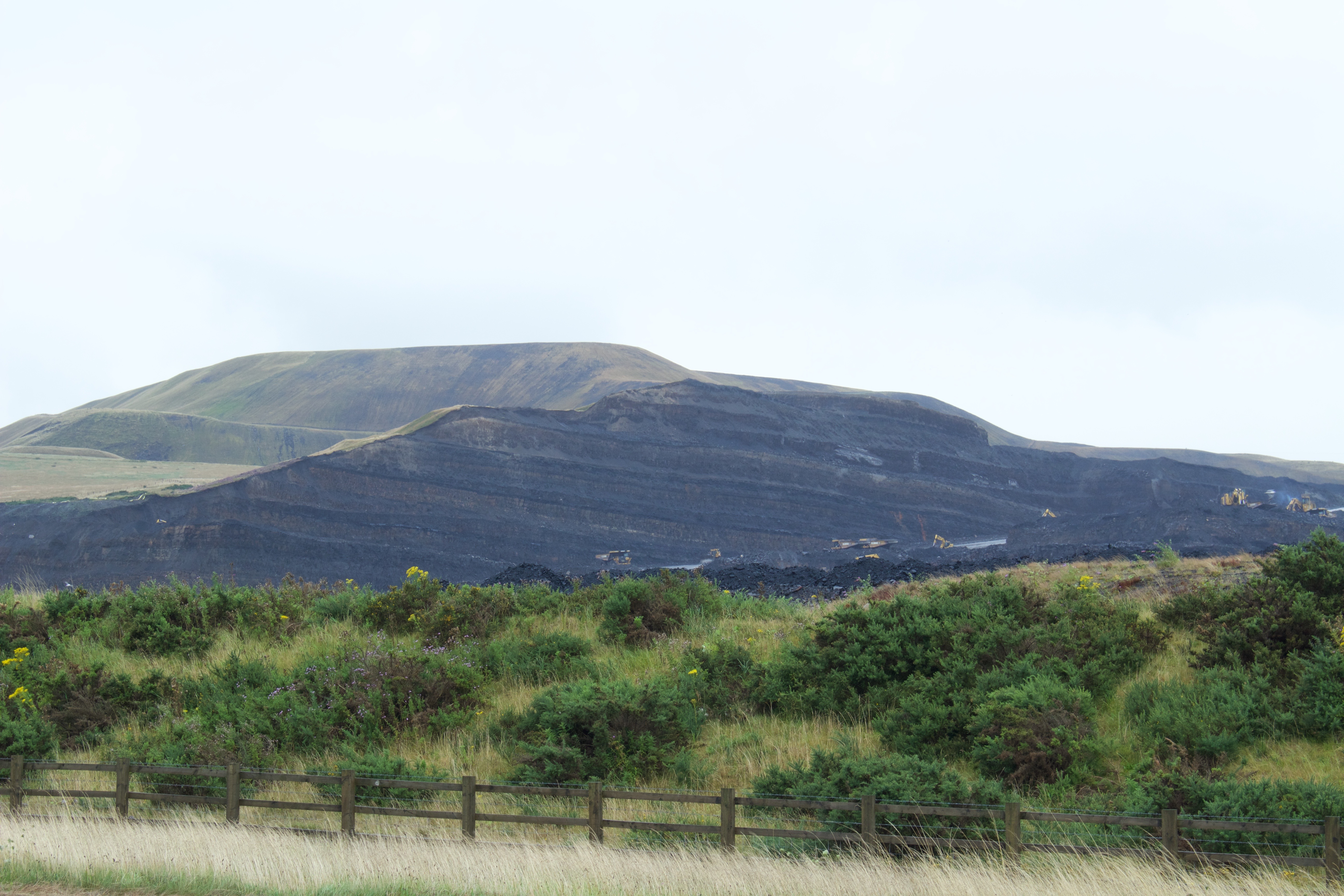
Photograph of Tower open cast coal mine 2015. Coal extraction at the Tower opencast site came to an end in 2017 after changes in environmental regulations.

Six Bells and Abertillery showing underground mine workings overlaid with surface topography and infrastructure
Historic mine map of Vivian pit Abertillery, the source of the pollution forming now at Six Bells.
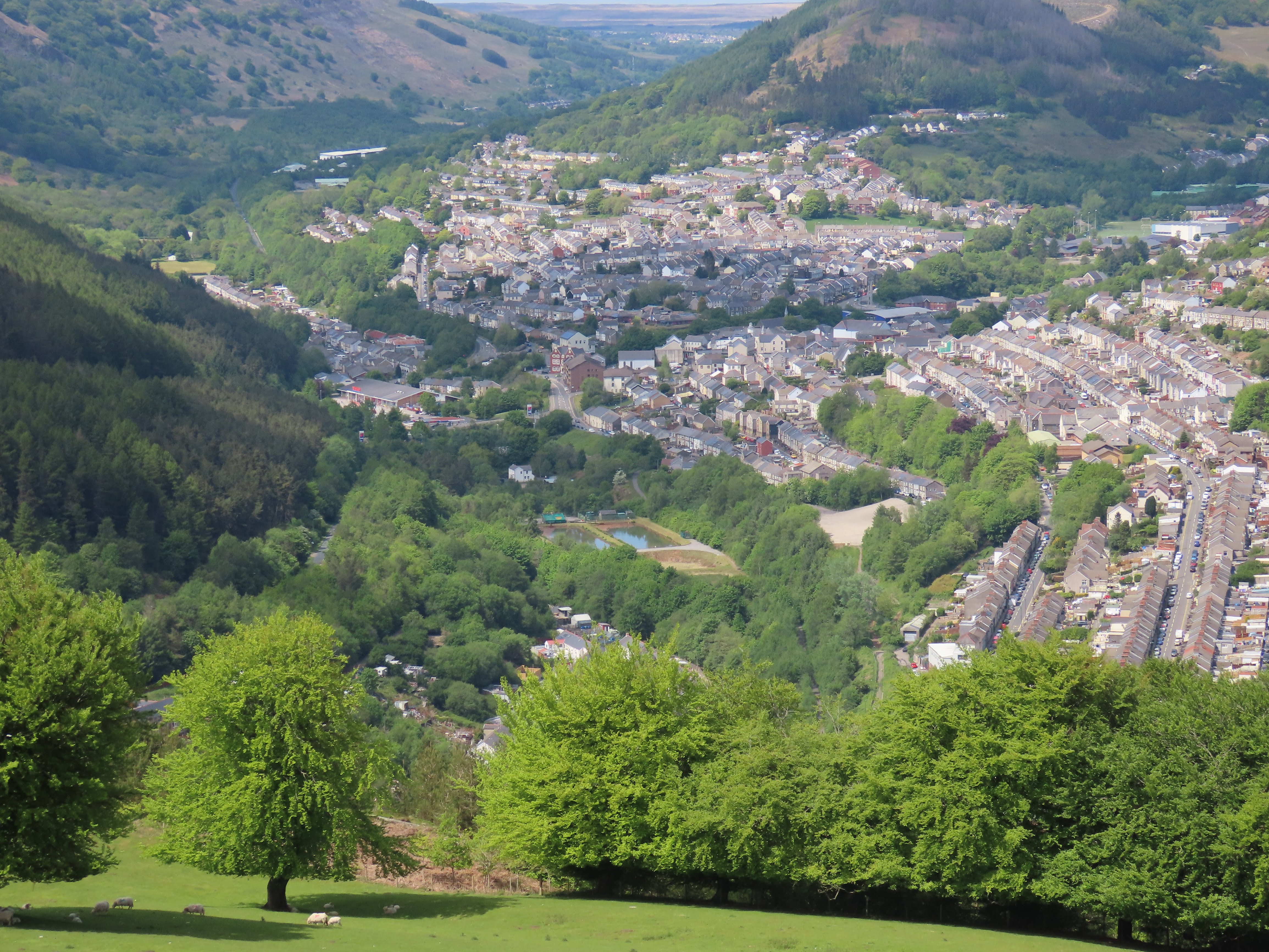
Six Bells and Abertillery with the mine water treatment scheme just visible in the lower middle of the picture 2020.
Overlaying the material effects of landscape are the cultural complexities that are woven so deeply into each landscape structure that they become inseparable; the geological, the social; the ecological and the economic. These pages consider how the complicated interdependencies between humans and the earth can be described through a single material.

The coal mine ochre colours have a different life from ‘traditional’ or historic ochres. These new or geologically young minerals are brought into being through the treatment of polluting water in former coal mining landscapes across the UK. The conditions of each individual landscape influences the minerals forming there.
The discovery of these qualities has happened through making artworks that follow five individual ochres from their geological landscape contexts through physical transition into usable pigments for paint. A process that simultaneously exposes layers of sociopolitical history, along with the contemporary cultural and economic connections to place.
Ochre is the oldest of cultural materials with roots stretching back to the beginning of human history. The mine water ochres can be aligned with traditional historic ochre - a mineral that has been found sprinkled on cave floors, caked onto the buried bones of ancient humans;1 mixed with binder and turned into paint on cave walls, some 30,000 years ago and forming patterns on the built walls of early human settlements at Djade al- Mughara, Aleppo, Syria 11,000 years ago.2
The research has developed and been informed through a focused practice of painting and its traditions, referring to the earliest marks on cave walls, neolithic marks and the minimalist marks of the modernist / post modern traditions: Painting has been a line to follow and also to drift off from. Collaboration with chemists, earth scientists and paint manufacturers have helped to shape and understand the analytics of the material as pigment, from particle size, transparency and lightfastness, using x-ray diffraction, scanning electron microscopy (SEM) and cross polarised light microscopy, to drying, burning, grinding and sieving, scaling up, ratios of one medium to another to find a route to get a paint that carries the weight of the conditions of its formation, that can be applied to a wall.
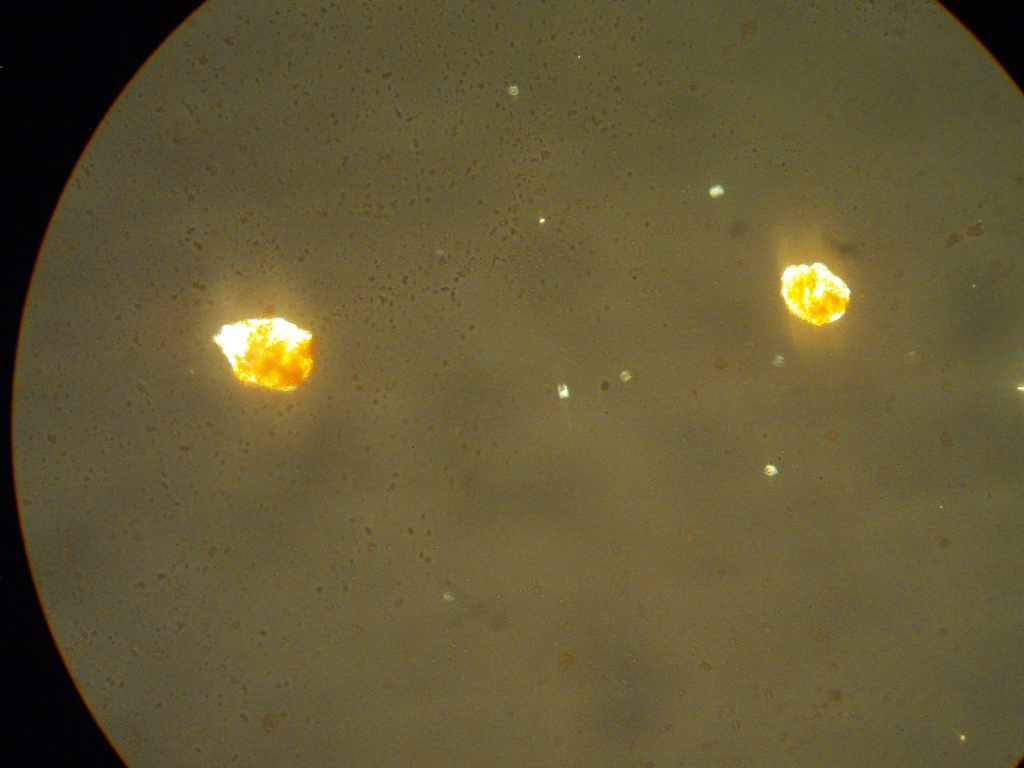
Cuthill ferrihydrite digital photograph using cross-polarised Light (XPL) x1000, field of view 0.1 mm.
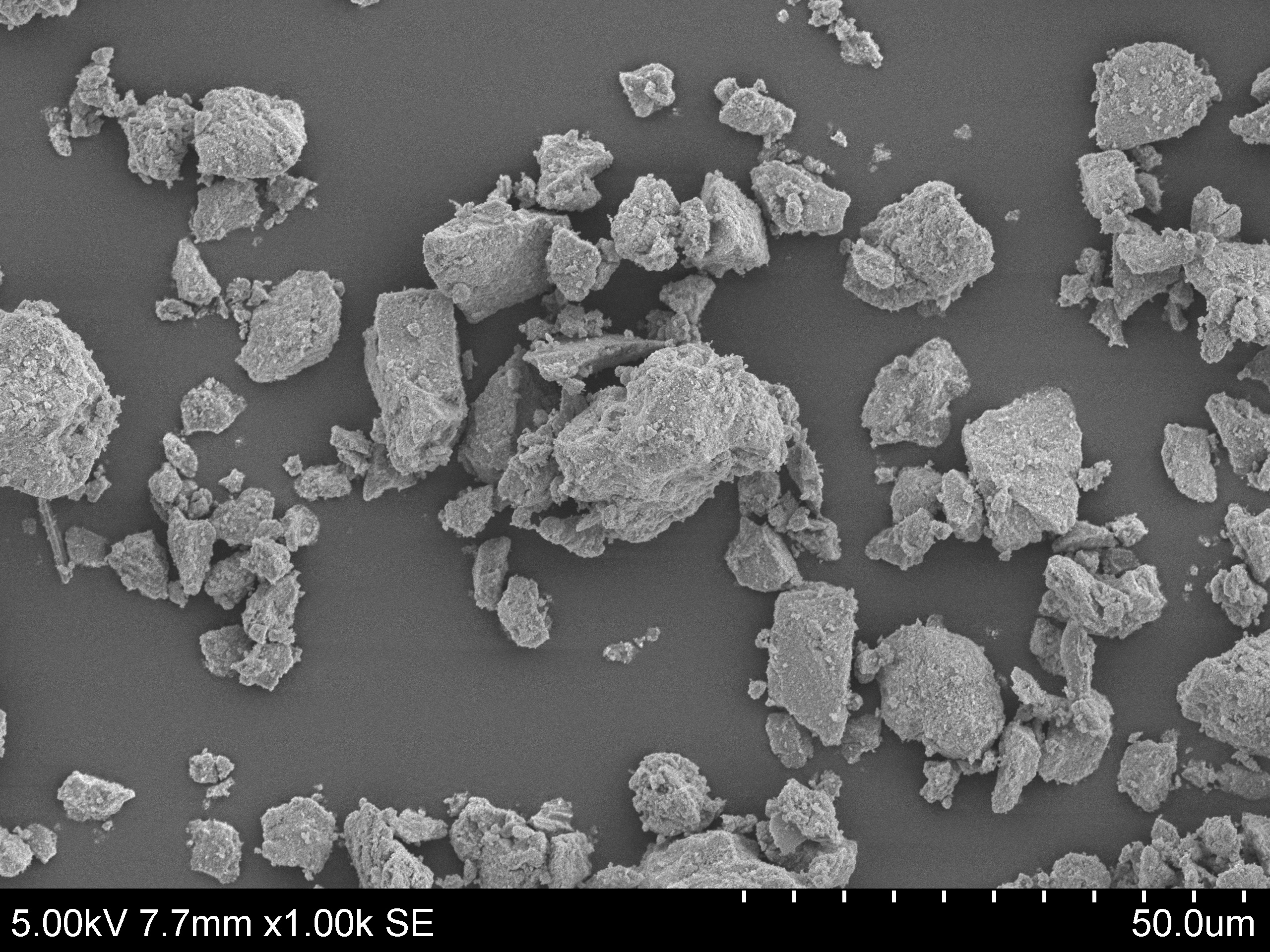
Scanning electron microscopy (SEM) Six Bells ochre
Coal Authority Video
In 2018 the Coal Authoity produced a short film oulining the processes involved in their mine remediation programme and ochre formation. The film shows the collaborative between Onya and the Coal Authority.
Turning Landscape CIC Community Interest Comany was based Ty Ebbw Fach in the former mining village of Six Bells, Blaenau Gwent, South Wales between 2020 - 2023.
The organisation continues now in a new form supporting workshops and talks about the formation of colour from the mines into usable pigment material, bringing together people with interest in the social, economic and environmental legacies of coal mining and extractive practices.
The research was developed by Onya McCausland through Leverhulme research funding between 2018 - 2021.
1 The Red Lady of Paviland: OUMNH Q.1. Visit to see the remains at Oxford Museum of Natural History 2016. One of the richest 1Palaeolithic sites in Europe is in South West Wales on the Gower Peninsula between Port Eynon and Rhossili. Sollas, W.J. The Journal of the Royal Anthropological Institute of Great Britain and Ireland, Vol.43 (Jul. - Dec., 1913)
2 National Geographic online: http://news.nationalgeographic.com/news/2007/10/photogalleries/wip-week50/photo7.html, accessed: 217th December 2014. And: Caroline Cartwright (2008) The World’s Oldest Wall Painting In Syria?, Palestine Exploration Quarterly, 140:1, 3-3, DOI: 10.1179/003103208x288645 http://dx.doi.org/10.1179/003103208x288645 Published online: 02 Dec 2013
Turning Landscape into Colour Abstract, link to PhD: https://discovery.ucl.ac.uk/id/eprint/10039744/
Further info on individual artworks www.onyamccausland.com